
Managed security services (MSS) get discussed often, but rarely with precision. Most conversations stay abstract — "better protection," "peace of mind" — without connecting to the outcomes that actually matter for operations, budgets, and compliance.
This article covers five specific, measurable benefits of managed security services: what they deliver, who benefits most, and how they translate into reduced breach risk, lower costs, and stronger compliance posture.
TL;DR
- MSS involves outsourcing continuous security monitoring, threat detection, and incident response to a specialized external provider
- The five core benefits: access to expert talent, 24/7 monitoring, reduced costs, built-in compliance support, and proactive threat intelligence
- Startups, mid-market SaaS companies, and organizations entering regulated markets gain the most from MSS
- Ongoing MSS delivers the highest value when paired with periodic penetration testing — treat it as a continuous practice, not a one-time fix
What Are Managed Security Services?
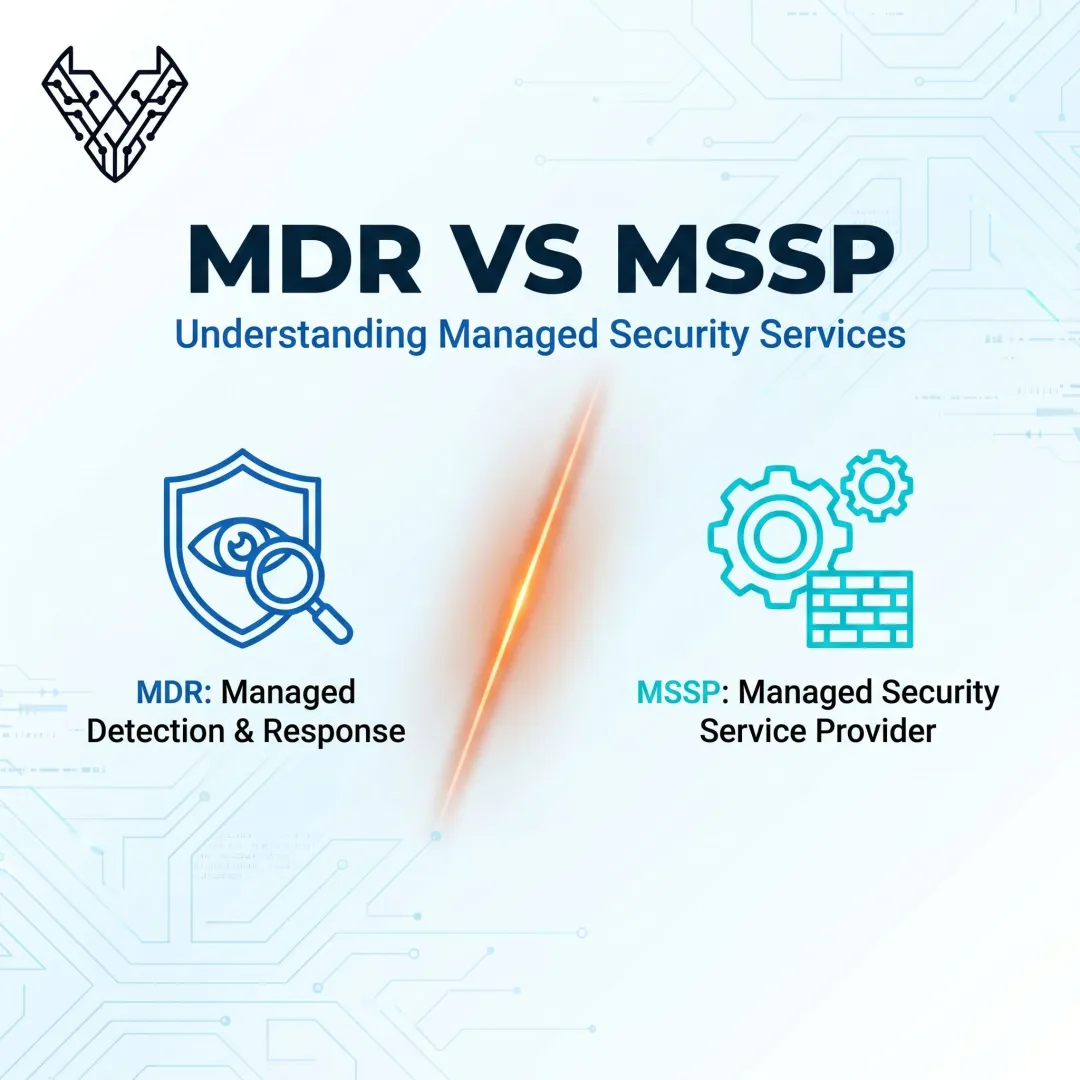
Managed security services (MSS) are a model where a third-party provider continuously monitors, detects, and responds to threats on behalf of a business — replacing or supplementing the in-house security function.
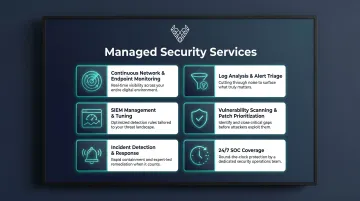
What MSSPs typically handle:
- Continuous network and endpoint monitoring
- Log analysis and alert triage
- SIEM platform management and tuning
- Vulnerability scanning and patch prioritization
- Incident detection and response
- 24/7 Security Operations Center (SOC) coverage
Done right, managed security reduces breach risk, maintains uptime, and keeps compliance requirements on track — while freeing internal teams to focus on core business priorities.
5 Key Benefits of Managed Security Services
Each benefit below connects to a measurable business outcome — whether that's reduced breach cost, faster incident response, regulatory compliance, or lower total cost of ownership.
Benefit 1: Access to Specialized Security Expertise on Demand
One of the clearest drivers behind MSS adoption is the talent shortage. Organizations can't hire fast enough, and the competition for qualified analysts is brutal.
ISACA's 2025 State of Cybersecurity report found 55% of cybersecurity teams are currently understaffed and 65% have unfilled positions. Only 29% of enterprises are actively training non-security staff for security roles — down from 41% the prior year.
When a business engages an MSSP, it immediately gains access to a cross-functional team with experience across dozens of client environments and threat scenarios. Security expertise isn't just headcount — it's pattern recognition. An MSSP analyst who has seen the same phishing infrastructure appear across three industries in six months will catch it faster than an isolated in-house hire seeing it for the first time. That exposure to varied attack chains, misconfigurations, and breach patterns is difficult to replicate internally.
The financial stakes are direct: IBM's 2024 Cost of a Data Breach Report found that organizations with high-level security staffing shortages averaged $5.74M per breach, compared to $3.98M for those with adequate staffing — a $1.76M penalty for under-resourcing the security function.
KPIs impacted: Mean time to detect (MTTD), mean time to respond (MTTR), analyst coverage hours, incident escalation accuracy
When this matters most: Startups scaling without a dedicated security hire; organizations with a single-person IT team; businesses entering regulated markets for the first time
Benefit 2: 24/7 Monitoring and Incident Response Without the Overhead
Attackers don't work 9-to-5. Ransomware groups specifically target nights, weekends, and holidays — periods when in-house teams are understaffed or offline. A Semperis study found that 78% of companies cut SOC staffing by 50% or more during holidays and weekends.
MSSPs maintain round-the-clock coverage using automated alert triage, SIEM platforms, and human analyst oversight. Threats get caught and contained before they escalate — regardless of when they occur.
Internal SOC teams face a volume problem that coverage alone can't solve. Industry data consistently shows the majority of security alerts go uninvestigated due to overload and noise — legitimate threats buried under false positives. MSSPs distribute alert triage across larger, specialized teams with tuned detection pipelines, improving investigation rates without burning out analysts.
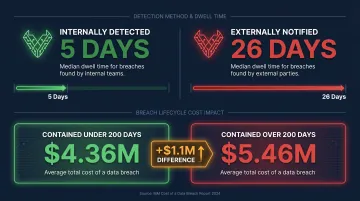
When threats go undetected, costs compound fast. According to IBM 2024 data:
| Detection Method | Median Dwell Time |
|---|---|
| Internally detected | 5 days |
| Externally notified | 26 days |
| Breach Lifecycle | Average Breach Cost |
|---|---|
| Under 200 days | $4.36M |
| Over 200 days | $5.46M |
That's a $1.1M cost difference based on how quickly a breach is contained. Continuous MSSP monitoring directly compresses that window.
KPIs impacted: Mean dwell time, containment time, alert investigation rate, false positive rate, uptime during attack events
When this matters most: Cloud-native SaaS providers with always-on customer-facing infrastructure; e-commerce businesses during peak seasons; healthcare and financial organizations with high breach consequences
Benefit 3: Lower Security Costs Without Lowering Your Guard
Building an in-house security program is expensive — and the costs scale faster than most organizations expect.
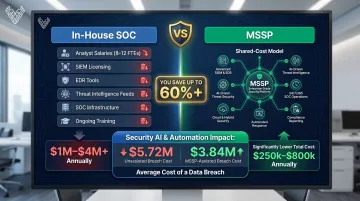
A realistic internal security stack includes: analyst salaries (minimum 8-12 FTEs for true 24/7 coverage), SIEM licensing, EDR tools, threat intelligence feeds, SOC infrastructure, and ongoing training. Industry estimates place annual 24/7 in-house SOC costs at $1M to $4M+ depending on organization size and coverage model.
MSSPs distribute these costs across multiple clients, making enterprise-grade tooling and expertise accessible at a fraction of what internal replication would cost.
IBM 2024 data adds another dimension: organizations extensively using security AI and automation averaged $3.84M in breach costs versus $5.72M for those without — a $1.88M difference. That automation capability is typically bundled into MSSP engagements rather than purchased and maintained separately.
Cost reduction through an MSSP isn't just a line-item saving. Those freed resources can be directed toward:
- Periodic penetration testing to validate MSSP controls
- Security awareness training for employees
- Access control reviews and architecture improvements
- Compliance readiness work for frameworks like SOC 2 or ISO 27001
KPIs impacted: Total cost of ownership (TCO) for security, cost per protected endpoint, security budget as a percentage of IT spend, reduction in unplanned security expenditures
When this matters most: Pre-Series B startups that can't justify a dedicated security team; mid-market companies at growth inflection points; organizations that have experienced a breach and need rapid capability improvement without a capital-heavy rebuild
Benefit 4: Built-in Compliance Support for SOC 2, ISO 27001, and GDPR
Many businesses — especially SaaS companies pursuing enterprise contracts — face compliance requirements that demand documented security controls, audit trails, and continuous monitoring. Building this from scratch is time-consuming and difficult to audit accurately.
The stakes are concrete:
- Average GDPR fine: €2.36M, with over 2,200 fines issued between 2018 and 2025
- PCI DSS non-compliance penalties escalate to $25,000–$50,000/month after 90 days
- SOC 2 certification reduces enterprise sales cycle length by 30–50% for SaaS companies
MSSPs support compliance by implementing required security controls, generating audit-ready logs and reports, maintaining documentation, and alerting teams to regulatory changes.
Continuous monitoring covers one layer — but it doesn't validate whether controls actually hold up under attack conditions. Frameworks like SOC 2 Type II and ISO 27001 require demonstrable evidence that controls are effective, not just present.
That's where manual-first penetration testing, like what Vynox Security provides, fills the gap. Vynox's compliance-aligned VAPT services deliver audit-ready reports mapped to specific framework requirements — SOC 2, ISO 27001, GDPR, and PCI DSS — along with remediation guidance and retesting to close identified gaps. For startups pursuing SOC 2 Type II to unlock enterprise deals, pairing MSSP monitoring with structured pen testing gives auditors both the continuous monitoring evidence and the active testing validation they need.
KPIs impacted: Audit pass rate, number of compliance findings, time-to-certification, reduction in compliance-related security incidents
Benefit 5: Proactive Threat Intelligence and Risk Visibility
MSSPs serve dozens or hundreds of clients across industries simultaneously. That breadth gives them a threat intelligence picture that no single organization can develop independently — and they apply learnings across their client base proactively.
The timeline between vulnerability disclosure and active exploitation has collapsed. In H1 2025, 28% of observed exploits were launched within 24 hours of CVE disclosure, while the average remediation time for critical vulnerabilities remains 74 days. Attackers have roughly a 30-day head start over defenders who rely on reactive patching.
MSSPs with strong threat intelligence capabilities close this gap by:
- Applying intelligence from attacks on other clients to your environment proactively
- Prioritizing emerging CVEs based on active exploitation data, not just severity scores
- Delivering regular risk assessments and threat briefings that give leadership actual visibility into their risk posture
- Identifying patterns in your environment that match known attack chains before they progress
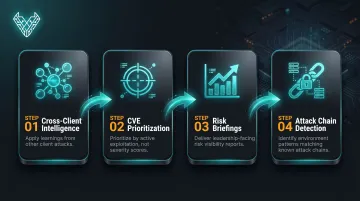
The result is forward-looking intelligence that informs security investment decisions — not just reactive alerts after something has gone wrong.
What Happens When Managed Security Is Missing
Running security reactively — without structured monitoring, triage, or response capability — creates predictable consequences.
Threats go undetected for weeks. Alerts pile up, get ignored, and incidents escalate into full breaches before anyone responds. Internal IT teams, already overloaded, end up managing crises rather than preventing them.
The numbers reflect the exposure:
IBM's 2024 Cost of a Data Breach Report puts the global average breach cost at $4.88M — a 10% increase from the prior year and the largest spike since the pandemic. Healthcare organizations averaged $9.77M per breach; financial services, $6.23M.
Beyond the immediate cost, only 12% of breached organizations reported having fully recovered from a breach. The operational and reputational damage persists long after remediation.
Recovery doesn't fix the root cause:
When organizations lack managed security, the underlying gaps — talent, tooling, process — stay unaddressed even after a breach is contained. That persistence creates a cycle of:
- Reactive firefighting and emergency spending
- Rising cyber insurance premiums (premiums grew 30%+ from 2017 to 2022)
- Compliance failures that jeopardize enterprise contracts
- Eroded customer trust that's difficult to rebuild
How to Get the Most Value from Managed Security Services
MSS delivers the highest return when it's treated as an ongoing operational practice — one that's actively managed, reviewed, and improved over time. Three principles make the difference between MSS that protects and MSS that just runs:
Establish regular review cadences. Schedule monthly security reviews, act on vulnerability findings within defined SLAs, and recalibrate coverage as infrastructure evolves. MSSP threat reports only create value when acted on.
Pair monitoring with active testing. Continuous monitoring tells you what's happening. Penetration testing tells you whether your defenses would hold if something actually happened — two very different questions.
Manual-first penetration testing (such as Vynox Security's approach) goes 3× deeper than automated scans, catching business logic flaws, authorization gaps, and attack chains that monitoring tools miss. Testing at least annually — and after major infrastructure changes — validates that the controls your MSSP manages are effective under realistic attack conditions.
Measure outcomes, not just activity. Track KPIs that reflect security improvement over time:
- Mean time to detect (MTTD) and mean time to respond (MTTR)
- Percentage of critical vulnerabilities remediated within SLA
- Compliance audit pass rates
- Reduction in unplanned security incidents quarter over quarter
Organizations that track these metrics consistently are far better positioned to identify coverage gaps before they become incidents — and to justify security spend to leadership with concrete data.
Conclusion
The five benefits of managed security services — expert talent access, 24/7 monitoring, cost efficiency, compliance support, and proactive threat intelligence — each address a real operational gap that most businesses cannot close on their own.
The value compounds over time. Consistent coverage builds threat context, tightens response times, and strengthens compliance posture — often in ways that only become visible when an incident doesn't happen.
Treat security as a continuous practice, not a checkbox. Periodically validate that your managed defenses are actually working — through active penetration testing, not just passive monitoring. That's where real gaps tend to surface.
Frequently Asked Questions
What are the benefits of managed security services?
The five core benefits are access to expert security talent, 24/7 monitoring and incident response, lower total security costs, built-in compliance support, and proactive threat intelligence. These address the operational gaps that most businesses — especially those without a dedicated security team — cannot close internally.
What do managed security service providers do?
MSSPs monitor networks and endpoints around the clock, triage alerts, manage security tooling, and support compliance documentation. Their SOC operates continuously, ensuring threats are caught and contained no matter when they occur.
What is a managed security service?
MSS is the outsourcing of cybersecurity monitoring, detection, and incident response to a specialized third-party provider. Unlike one-time assessments or general IT outsourcing, it delivers continuous coverage rather than a point-in-time evaluation.
How much do managed security services typically cost?
Pricing varies based on scope, organization size, and service level. MSS is generally more cost-effective than building an equivalent in-house SOC, which can cost $1M to $4M+ annually when factoring in analyst salaries, tooling licenses, infrastructure, and ongoing training.
How is an MSSP different from an in-house security team?
MSSPs offer immediate expertise, 24/7 coverage, and shared tooling across multiple clients — without the recruiting, training, and retention costs of building internally. In-house teams offer deeper organizational context but require significant ongoing investment to maintain comparable capability.
When should a startup consider managed security services?
Key triggers include pursuing SOC 2 or ISO 27001 certification, scaling infrastructure without a dedicated security hire, or recovering from a security incident. Early adoption builds a stronger compliance foundation and makes enterprise sales conversations easier to win.