Automated scans and annual compliance audits don't close that gap. They tell you what vulnerabilities exist on paper. They don't tell you whether a determined attacker could chain those vulnerabilities together, bypass your detection tools, and walk out with your most sensitive data.
That's what red teaming addresses. This article covers what red teaming is, how a real engagement works, how it differs from penetration testing, and when your organization actually needs it.
TL;DR
- Red teaming is a controlled cyberattack simulation run by security professionals to expose real vulnerabilities before actual attackers find them
- It goes further than a penetration test — stealthier, longer, and testing people, processes, and technology together
- Exercises follow defined phases: scoping, reconnaissance, attack simulation, post-exploitation, and reporting
- Red, blue, and purple teams each play a distinct role in a mature security program
- Organizations with existing security controls, particularly those in regulated industries, benefit most from red teaming
What Is Red Teaming?
Red teaming is the practice of authorized security professionals simulating real-world adversarial attacks against an organization's systems, people, and processes. The CNSSI 4009-2015 standard, referenced in the NIST Security Glossary, defines a red team as "a group authorized and organized to emulate a potential adversary's attack or exploitation capabilities against an enterprise's security posture."
The Adversarial Mindset
What separates red teaming from other security assessments is how the testers think. Rather than working through a checklist, red teamers think, plan, and act like real threat actors — using the same tactics, techniques, and procedures (TTPs) that actual attackers use today. They ask: given everything we know about this organization, how would we get in, move around, and cause damage?
This means testing the full attack surface:
- Network infrastructure and perimeter controls
- Endpoints and internal systems
- Human behavior through social engineering and phishing
- Physical access where in scope
- Business logic and application workflows beyond the reach of automated tools
Origins: From Cold War Wargames to Enterprise Security
The methodology traces back to the 1960s, when the RAND Corporation ran military simulations for the U.S. government. "Red" represented the USSR; "blue" represented U.S. forces. The goal was to stress-test strategies from the adversary's perspective.
That logic carried directly into enterprise cybersecurity once organizations found that compliance-driven testing repeatedly missed what skilled attackers actually exploit.
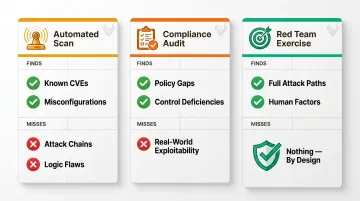
Red teaming is distinct from automated vulnerability scans and compliance audits. Those tools efficiently surface known CVEs and configuration errors — but they can't detect multi-stage attack chains, business logic flaws, or the human and procedural gaps that skilled attackers routinely exploit. Red teaming does.
| Assessment Type | What It Finds | What It Misses |
|---|---|---|
| Automated scan | Known CVEs, misconfigurations | Attack chains, logic flaws |
| Compliance audit | Policy gaps, control deficiencies | Real-world exploitability |
| Red team exercise | Full attack paths, human factors | Nothing by design |
How a Red Team Exercise Works
Scoping and Rules of Engagement
Every engagement starts with a defined scope and agreed rules of engagement. This covers which systems are in scope, what's off-limits, how the simulated threat is characterized (external attacker, insider threat, nation-state actor), and what success looks like. A clear scope document protects both parties and ensures findings translate into meaningful action.
With boundaries established, the red team moves into intelligence gathering.
Reconnaissance
Before touching any systems, the red team gathers intelligence using open-source methods: LinkedIn profiles, job postings, DNS records, public code repositories, and company documentation. This is how real attackers profile targets before striking.
MITRE ATT&CK catalogs this as the Reconnaissance tactic (TA0043), covering techniques from domain enumeration to identity gathering.
Attack Simulation and Exploitation
The active phase begins. Common initial access techniques include:
- Phishing targeted at specific employees identified during recon
- Credential stuffing using leaked credentials from prior breaches
- Exploiting unpatched vulnerabilities in exposed services
- Abusing misconfigurations in cloud environments or network devices
All techniques are derived from documented real-world threat actor behavior and mapped to the MITRE ATT&CK framework, ensuring the simulation reflects how real threat actors actually operate — not sanitized hypotheticals.
Once initial access is confirmed, the exercise shifts to what happens next.
Post-Exploitation and Lateral Movement
Initial access is rarely the end goal. After gaining a foothold, the red team attempts to:
- Move laterally through internal networks
- Escalate privileges toward domain admin or cloud root access
- Locate and access sensitive data (customer records, financial data, IP)
- Simulate the actual business impact an attacker would achieve
This phase is where the real risk becomes visible. A misconfigured service account that looks low-severity in isolation becomes critical when it's the pivot point to your production database.
Reporting and Remediation
A red team report tells the full story of what happened: every attack path taken, evidence collected, detection failures observed, and the business impact that would have occurred in a real incident. Findings are prioritized by actual exploitability and business risk — with clear, actionable remediation steps rather than generic advice.
Red Teaming vs. Penetration Testing
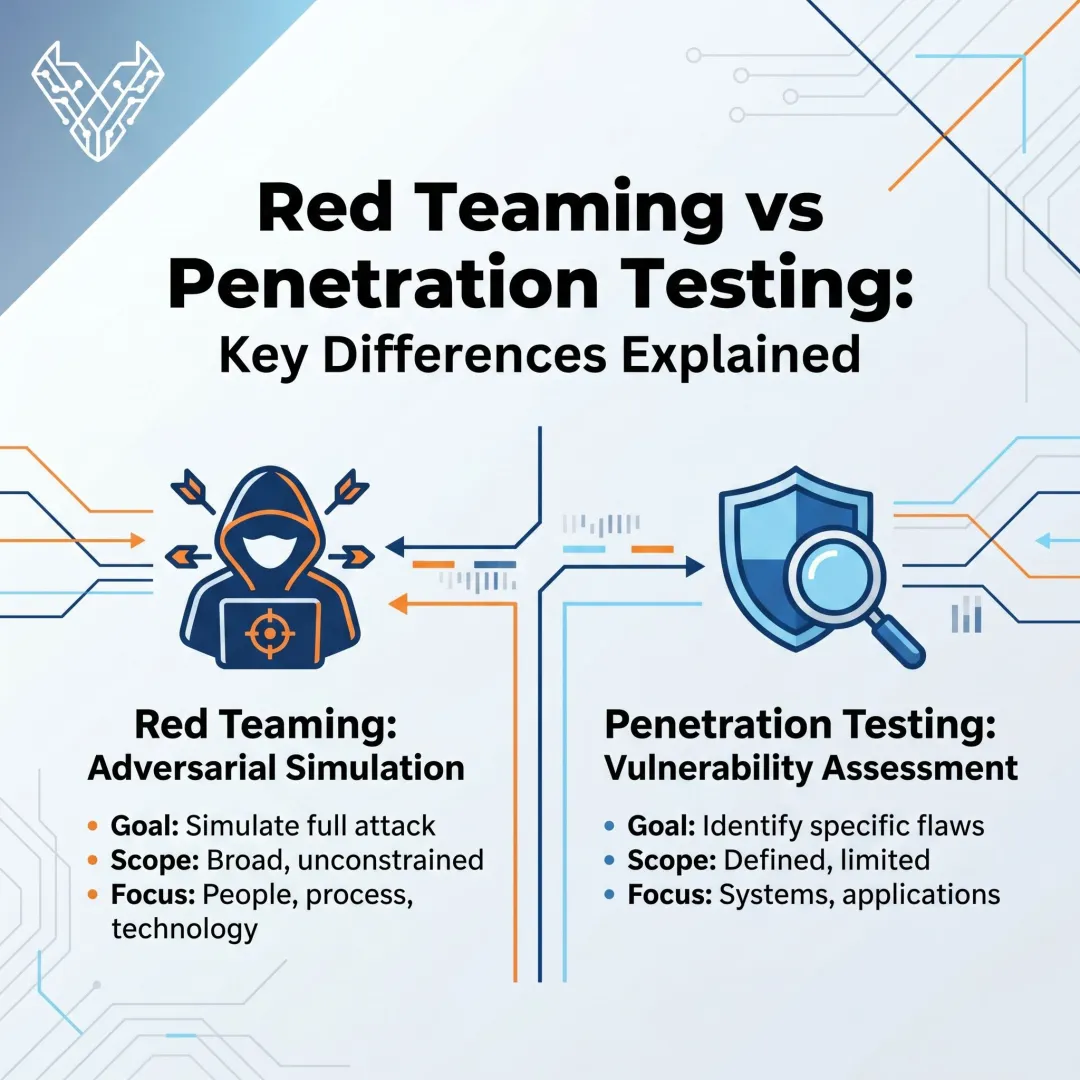
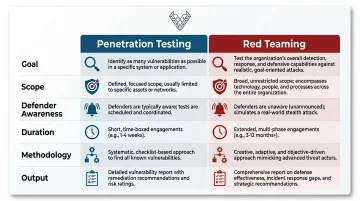
Both disciplines use ethical hacking techniques, but they answer different questions. Penetration testing asks: what vulnerabilities exist in this specific system? Red teaming asks: can our defenses detect and stop a real attack?
| Dimension | Penetration Testing | Red Teaming |
|---|---|---|
| Goal | Find and validate technical vulnerabilities | Test detection, response, and resilience |
| Scope | Specific systems, applications, or networks | Full organization — people, process, technology |
| Defender Awareness | Typically aware testing is occurring | Often conducted without defender foreknowledge |
| Duration | 1–3 weeks | 3–6 weeks or longer |
| Methodology | PTES, OWASP Testing Guide | MITRE ATT&CK, CREST red team standards |
| Output | Vulnerability list with severity ratings | Attack path narrative and detection gap analysis |
When to Choose Each
Penetration testing suits organizations validating specific systems, meeting compliance requirements, or addressing known technical gaps. It's faster, more structured, and delivers a clear vulnerability inventory.
Red teaming is appropriate when an organization wants to know whether its defenses hold up against a realistic, sustained attack. It requires existing security controls to test — if there's no SOC or incident response function, there's nothing to evaluate. That prerequisite matters: red teaming stress-tests controls that already exist, not ones you're still building.
In practice, organizations use both. Penetration testing identifies and closes specific gaps; red teaming confirms whether those fixes actually hold when an attacker is actively working against them.
Red Team, Blue Team, and Purple Team Explained
The Core Dynamic
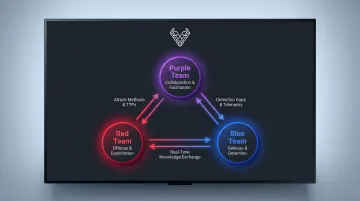
- Red team = offense. Authorized security professionals simulating attackers.
- Blue team = defense. Your internal security team or SOC, responsible for detecting, responding, and protecting. The blue team is typically unaware a red team exercise is underway — that's what makes the test realistic.
The Purple Team Model
Purple teaming isn't a permanent third team — it's a collaborative operating model. The SANS Institute describes it as a "symbiotic relationship" where red and blue teams share findings in near-real-time, rather than waiting for a final report weeks later.
In practice, this means:
- Red teams share attack methods so blue teams can tune detection rules
- Blue teams share what they did and didn't detect, so red teams can refine their techniques
- Detection gaps get closed faster, and both sides improve continuously
Red teams don't want to reveal attack methods prematurely, and blue teams don't want to expose detection blind spots. Structured purple team sessions — often starting with lower-stakes reconnaissance exercises to build trust — resolve this tension over time.
Worth noting: The TIBER-EU framework explicitly frames the exercise outcome not as pass/fail but as a learning effect that raises security maturity — a useful lens for any organization running its first red team engagement.
Key Benefits of Red Teaming
Finding What Automated Tools Miss
Automated scanners are effective for breadth — identifying known CVEs and configuration errors across large environments quickly. What they can't do is reason about context. They miss:
- Multi-stage attack chains where no single step looks dangerous in isolation
- Business logic flaws that require understanding how the application is supposed to work
- Social engineering susceptibility and human process gaps
- Attack paths that combine technical and non-technical vectors
Expert-led red teaming closes these gaps by combining human reasoning with targeted automation — surfacing the attack paths that tools are structurally incapable of finding on their own.
Testing the Human Layer
Red teaming is one of the few methods that genuinely tests whether your security team can detect a real intrusion. It surfaces:
- Gaps in detection rules and SIEM configurations
- Response playbooks that haven't been tested under realistic conditions
- Security awareness weaknesses among employees who handle credentials or sensitive systems
- Incident response procedures that look solid on paper but break under pressure
Organizations that detect breaches internally save approximately $900,000 compared to those notified by external parties, according to IBM's data. Red teaming directly builds that internal detection capability by exposing exactly where detection fails before an attacker finds the same path.
Compliance Alignment
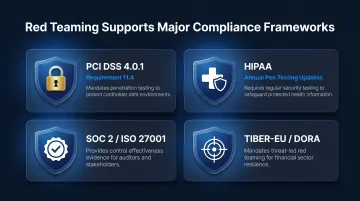
Red teaming supports requirements across major frameworks:
- PCI DSS 4.0.1 (Requirement 11.4): mandates annual penetration testing; red teaming satisfies and exceeds this for mature programs
- HIPAA: proposed updates would require annual penetration testing
- SOC 2 / ISO 27001: red teaming provides strong evidence for security control effectiveness
- TIBER-EU / DORA: explicitly mandates threat-led red teaming for qualifying financial institutions in the EU
Together, these three benefit areas — coverage depth, detection capability, and compliance alignment — make red teaming one of the highest-signal investments an organization can make in its security program.
When Does Your Organization Need Red Teaming?
Red teaming delivers the most value when there are existing defenses to test. Strong candidates typically share these characteristics:
- Completed at least one penetration test and addressed major findings
- Have a functioning security team, SOC, or incident response capability
- Operate in regulated industries (financial services, healthcare, SaaS handling sensitive data)
- Want to validate their security program against realistic, sustained attack scenarios — not just known vulnerabilities
If your organization is still working through basic vulnerability management or building its first security program, a targeted penetration test is the right starting point. Red teaming assumes those foundations are already in place — it validates how well they hold under real attack conditions.
If you're unsure where your program stands, a scoping conversation is a practical first step. Vynox Security works with both early-stage companies and mature security teams to match the right engagement type — penetration test or full red team — to your actual risk exposure.
Frequently Asked Questions
What is a red team assessment?
A red team assessment is a controlled, simulated cyberattack where authorized professionals emulate real threat actors to test your defenses, detection, and incident response. Unlike a vulnerability scan, it covers the full attack surface — people and processes included — under realistic adversarial conditions.
What is the red team assessment process?
The process follows five phases: scoping and rules of engagement, reconnaissance (OSINT and intelligence gathering), active attack simulation, post-exploitation and lateral movement, and final reporting with prioritized remediation guidance. Each phase mirrors how a real attacker would operate.
How long does a red team exercise last?
Most red team engagements run two to four weeks, though complex environments or broader scopes commonly extend to six weeks or more. This contrasts with penetration tests, which typically complete in one to three weeks. Nation-state simulation exercises can run significantly longer.
How much does a red team assessment cost?
Costs vary based on scope, attack surface complexity, and engagement duration. Vendor references suggest ranges from roughly $40,000 to $150,000 or more for comprehensive exercises. A scoping consultation clarifies what's right for your environment — and the cost is generally far less than responding to an actual breach.
What is an example of a red team exercise?
A red team might phish employees for initial access, move laterally using stolen credentials, escalate privileges, and simulate exfiltrating customer records. Throughout, the blue team tries to detect the intrusion — without knowing the exercise is happening.
What is the red team blue team concept?
Red team equals offense (simulating attackers); blue team equals defense (your internal security team or SOC). The adversarial dynamic tests whether your real defenses hold up — and surfaces exactly where they don't.