Traditional security testing wasn't built for this reality. Vulnerability scans find known CVEs. Compliance audits confirm controls exist on paper. Neither answers the question that actually matters: if a determined attacker targeted your organization today, would you stop them — and would you even know?
Adversary simulation is the methodology designed to answer exactly that question. This guide covers:
- What adversary simulation is and how it works
- How it differs from adversary emulation, red teaming, and pen testing
- The role of MITRE ATT&CK
- Key benefits and best practices for running effective simulations
TL;DR
- Adversary simulation replicates real attacker behaviors (TTPs) in a controlled environment to test whether defenses actually work
- It differs from pen testing by measuring behavioral detection, not just exploitability
- MITRE ATT&CK provides the common language for planning, executing, and measuring simulations
- 82% of modern attacks use no malware — TTP-level behavioral testing is how you catch what signature tools miss
- One-time annual simulations aren't enough — effective programs run continuously
What Is Adversary Simulation?
Adversary simulation is a cybersecurity approach that replicates the full tactics, techniques, and procedures (TTPs) of real-world attackers — not to cause harm — but to evaluate whether an organization's people, processes, and technology can detect, respond to, and withstand a realistic attack.
The key word is realistic. Unlike passive vulnerability scanning or theoretical risk assessments, adversary simulation executes actual attack sequences in a controlled environment, covering the full attack lifecycle from initial reconnaissance through lateral movement to data exfiltration.
What "TTPs" Actually Means
Each layer of the TTP hierarchy describes a different level of attacker behavior:
- Tactics: The goal — initial access, persistence, privilege escalation
- Techniques: The method — spearphishing, credential dumping, scheduled task abuse
- Procedures: The specific implementation — exact commands, tooling, sequencing
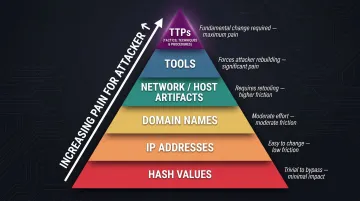
This distinction matters because attackers change their tools constantly. They rotate IP addresses, swap malware variants, and generate new file hashes between campaigns. What they don't change as easily is how they operate.
The Pyramid of Pain model illustrates why this matters: file hashes and IP addresses sit at the base (trivially swapped), while TTPs sit at the apex. Detecting and disrupting at the TTP level forces an attacker to rebuild their entire operational playbook.
The Detection Gap Traditional Testing Misses
Mandiant's M-Trends 2025 report found the global median dwell time was 11 days — meaning attackers operated undetected for over a week on average. When organizations relied on external parties to notify them of a breach, that number jumped to 26 days.
Compliance-driven assessments don't surface this gap — and the data makes that hard to argue with. Financial services, one of the most heavily regulated sectors on the planet, accounted for 17.4% of all Mandiant investigations. Regulatory checkboxes don't stop determined attackers.
The core question adversary simulation is designed to answer isn't "do we have vulnerabilities?" It's: could a determined adversary get in, stay in, and achieve their objective — and would we know?
Adversary Simulation vs. Adversary Emulation vs. Red Teaming
Most security teams use these terms interchangeably — and that's where scoping mistakes happen. Each approach has a distinct objective, and choosing the wrong one means testing for the wrong thing.
How Each Approach Is Defined
Adversary simulation takes a broad-scope approach: replicating realistic attacker behaviors across the full detection stack and response capabilities without constraining the test to a single named threat actor. The goal is stress-testing defenses against plausible multi-stage attack scenarios.
Adversary emulation is precision-focused. It replicates the exact documented TTPs of a specific, named threat group — APT29, FIN7, Lazarus Group — based on detailed cyber threat intelligence. MITRE publishes Adversary Emulation Plans that map directly to named actors, and tools like CALDERA automate post-compromise behavior using pre-configured adversary models.
Red teaming is goal-oriented. A team of offensive security professionals is given an objective ("access payroll data," "compromise the domain controller") and operates with minimal constraints. It tests the organization's overall defensive posture and incident response under realistic, open-ended conditions.
Penetration testing is different from all three — it's primarily vulnerability-driven and asset-scoped. The goal is identifying exploitable weaknesses in specific systems, not measuring behavioral detection coverage or response capability.
Comparison Table
| Adversary Simulation | Adversary Emulation | Red Teaming | Penetration Testing | |
|---|---|---|---|---|
| Focus | Realistic attack behaviors | Specific threat actor TTPs | Goal achievement | Vulnerability discovery |
| Threat-actor specificity | None — broad scenarios | High — named actor | None — open-ended | None |
| Primary goal | Validate detection coverage | Validate against known adversary | Test overall security posture | Identify exploitable vulnerabilities |
| Scope | Full attack lifecycle | Constrained to actor's playbook | Open-ended | System/asset-scoped |
| Best used when | Maturing security programs | Facing known, targeted threats | Testing detection & response | Scoping specific asset risk |
When to Use Each Approach
The table above shows what each approach tests — but choosing between them depends on your threat context and maturity level:
- Adversary simulation: Best when you want broad validation across your detection and response stack without anchoring to a single threat actor. Suits organizations running periodic resilience testing or maturing their security programs.
- Adversary emulation: Best when your industry faces specific, known threat groups. A financial institution concerned about LockBit, or critical infrastructure facing nation-state APTs, benefits from testing against that actor's exact documented playbook.
- Red teaming: Best when you want to test how your people, processes, and controls hold up under a realistic, unconstrained attack with a defined objective — not just whether alerts fire.
- Penetration testing: Best when you need to scope risk for a specific system, asset, or environment before release or audit — focused on finding exploitable flaws, not behavioral coverage.
How Adversary Simulation Works: The 4-Phase Process
Phase 1 — Define Scope and Gather Threat Intelligence
The process starts by defining what gets tested — which systems, environments, and user populations — and identifying which threat scenarios are relevant to the organization's specific industry, geography, and risk profile.
This phase draws on threat intelligence reports, industry-specific attack data, and MITRE ATT&CK mappings to answer a practical question: which adversary behaviors are most likely to target this organization, not just organizations in general?
Phase 2 — Design Realistic Attack Scenarios
Security teams translate that threat intelligence into specific attack sequences — chaining TTPs together the way a real adversary would. A typical chain might look like:
- Initial access via spearphishing with a credential harvesting lure
- Credential dumping (e.g., LSASS memory access) for lateral movement
- Scheduled task creation for persistence across reboots
- Living-off-the-land techniques using native tools like PowerShell or WMI to avoid detection
- Data staging and exfiltration to simulate objective completion
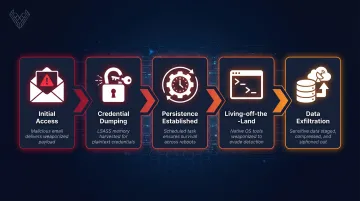
The goal is building multi-stage scenarios that reflect plausible attack paths against the specific target environment, not textbook attack chains. Once scenarios are finalized, the simulation moves into controlled execution.
Phase 3 — Execute in a Controlled Environment
The security team executes attack sequences under close monitoring, observing how detection tools (SIEM, EDR), analysts, and response processes actually perform. No real damage is caused, but every action mirrors what a genuine attacker would do.
This is where the gap between "we have security controls" and "our security controls work" becomes visible. A detection rule that was never properly tuned, a SIEM alert no analyst reviews after hours, an EDR policy that flags but doesn't block — these failures surface during execution, not in a configuration audit.
Phase 4 — Analyze, Report, and Remediate
The team then analyzes the full simulation and documents:
- Which attacker actions were detected vs. which went unnoticed
- Where defenders responded quickly vs. where response was slow or absent
- Which vulnerabilities enabled attacker progression at each stage
- What detection rule changes and process improvements would close the gaps
The output is an actionable report prioritizing remediation steps, detection engineering improvements, and response process gaps — not just a list of CVEs. This is the same approach Vynox Security takes: their adversary simulations are built to expose the business logic flaws and multi-stage attack chains that CVE-focused automated scans routinely miss.
The Role of MITRE ATT&CK in Adversary Simulation
MITRE ATT&CK is a globally accessible, continuously updated knowledge base of real-world adversary behaviors. It organizes attacker actions by tactics (the adversary's goals) and techniques (how they achieve those goals). As of ATT&CK v19 (April 2026), the Enterprise domain covers 15 tactics, 222 techniques, and 475 sub-techniques — enough granularity to plan and measure simulations at a precise level.
Offensive and defensive teams alike use it as a shared language — aligning on the same technique IDs when planning exercises, communicating findings, and measuring coverage gaps.
ATT&CK vs. NIST: A Common Point of Confusion
Both frameworks serve distinct purposes and work well together.
- MITRE ATT&CK is a behavioral knowledge base focused on how attackers operate. It's used by offensive and defensive security teams to map TTPs, identify detection gaps, and plan simulations. It requires hands-on, technical implementation.
- NIST CSF is a risk management framework covering the full security lifecycle (Identify, Protect, Detect, Respond, Recover). It's more accessible to executive stakeholders and focuses on program structure rather than adversary behavior.
NIST CSF defines what your security program should accomplish. MITRE ATT&CK documents what attackers actually do — so you can test whether your program holds up against real techniques, not just on paper.
How ATT&CK Is Used in Practice
- Map each simulated action to a specific ATT&CK technique ID (e.g., T1078 for Valid Accounts, T1059 for Command and Scripting Interpreter)
- Use the ATT&CK Navigator to visualize which techniques your current detection coverage addresses and where gaps exist
- Track improvement over time by re-running simulations and measuring which previously undetected techniques now generate alerts
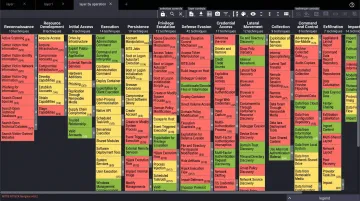
Run the same simulation three months later, and the delta in alert coverage tells you exactly how much your detection posture improved — no guesswork required.
Key Benefits of Adversary Simulation
Validates Real-World Resilience, Not Just Compliance
Adversary simulation tests whether security controls actually stop or detect attacks — not just whether they're configured and documented. This distinction matters because compliance posture and security posture diverge significantly in practice.
Mandiant's data shows financial services — one of the most compliance-burdened sectors globally — still accounts for nearly one in five of all their major breach investigations. Passing an audit doesn't mean surviving an attack.
Surfaces Detection Blind Spots Automated Tools Miss
With 82% of 2025 detections involving no malware whatsoever, signature-based scanners are structurally blind to the majority of modern attacks. Adversaries abuse valid credentials, exploit trusted SaaS integrations, and use native system tools — none of which trigger traditional detection signatures.
Where automated tools evaluate vulnerabilities in isolation, manual adversary simulation chains them together. A realistic attack path might combine:
- A low-severity authorization gap
- A credential access opportunity
- A misconfigured scheduled task
Each finding looks minor on its own. Chained together, they represent full compromise. Automated scanners flag each item separately and miss the connection entirely — which is exactly what a skilled attacker exploits.
Supports Compliance and Audit Readiness
Adversary simulation doesn't just improve security posture — it produces documented evidence of security control effectiveness. That evidence maps directly to compliance requirements:
- SOC 2 Type II: Demonstrates controls are operating effectively over time, not just in point-in-time configuration reviews
- ISO 27001: Provides audit-ready documentation tied to specific Annex A controls
- GDPR: Validates that technical measures are genuinely protective, supporting Article 32 requirements for appropriate security of processing
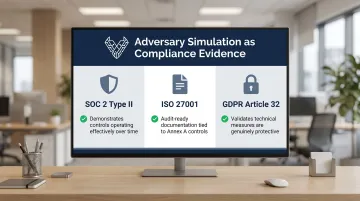
Vynox Security structures its deliverables to serve both operational and compliance purposes — audit-ready reports that double as evidence of control effectiveness for external reviewers.
Best Practices for Running Effective Adversary Simulations
Define Clear, Measurable Objectives First
Vague goals produce vague results. Before each simulation, specify exactly what the exercise is designed to answer — for example: "Can our SOC detect lateral movement within 24 hours?" or "Does our EDR catch credential dumping from LSASS?" These objectives drive TTP selection, scope, and how results get measured.
Ground Every Scenario in Current Threat Intelligence
Generic attack scenarios won't tell you much about your real exposure. Scenarios built from CTI feeds, industry threat reports, and MITRE ATT&CK data test whether you can withstand the adversaries actually targeting your sector. CrowdStrike's 2026 data shows average eCrime breakout time has dropped to 29 minutes, down from 48 minutes the year before. That compression matters: your simulation scenarios need to reflect that attackers are moving faster, not slower.
Commit to a Remediation Cycle, Not Just a Report
The simulation itself isn't the value — what happens after is. Best practice involves:
- Collaborative review between offensive and defensive teams (purple teaming)
- Detection rule improvements based on what went undetected
- Response playbook updates based on where defenders were slow
- Re-testing to confirm gaps are actually closed
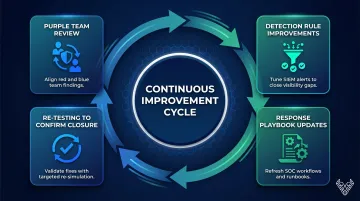
As SANS Institute puts it, adversary simulation should be "conducted in a continuous manner rather than as isolated events." Running it once and filing the report misses the point entirely.
Frequently Asked Questions
What is adversary simulation?
Adversary simulation replicates real-world attacker TTPs in a controlled environment to test whether an organization's defenses can detect, respond to, and contain realistic attacks. Unlike passive vulnerability scanning or compliance audits, it executes actual attack sequences to expose gaps in detection and response, not just configuration weaknesses.
What is adversary emulation in cybersecurity?
Adversary emulation is a high-fidelity variant of security testing that replicates the documented TTPs of a specific, named threat actor (such as APT29 or FIN7) using cyber threat intelligence. The goal is to validate defenses against that actor's known playbook rather than generic attack scenarios.
What is the difference between adversary emulation and simulation?
Simulation is broad-scope and not tied to any specific threat actor — it tests defenses against plausible attack scenarios drawn from the broader threat landscape. Emulation is precision-focused, constrained to replicating the exact behaviors of a named adversary based on documented intelligence.
How does adversary emulation differ from a red team?
Red teaming is goal-oriented with open-ended scope — the team is given an objective and operates with minimal constraints. Adversary emulation is constrained by threat intelligence defining what a specific actor would plausibly do.
What are the 4 phases of an attack?
The typical attack lifecycle covers four phases: (1) initial access and reconnaissance, (2) execution and persistence, (3) lateral movement and privilege escalation, and (4) objective completion, such as data exfiltration or operational disruption. Adversary simulation tests defensive coverage across all four phases, not just the initial entry point.
What is the difference between NIST and MITRE?
MITRE ATT&CK is a behavioral framework cataloging real-world adversary TTPs, used for offensive and defensive security testing at a technical level. NIST publishes risk management standards and control frameworks like NIST CSF, focused on program structure and governance. The two are complementary: NIST CSF establishes the program structure; ATT&CK provides the technical detail needed to validate whether that program holds up against real adversary behavior.