Introduction
Organizations routinely invest in firewalls, EDR platforms, SIEM tools, and vulnerability scanners — then discover, mid-breach, that nobody knows who authorizes ransom payment decisions, legal hasn't seen the breach notification template, and IT is waiting on an executive approval that never comes.
Security tools protect your perimeter. Tabletop exercises protect your response.
The financial case for that preparation is concrete. According to IBM's 2024 Cost of a Data Breach Report, organizations with high levels of incident response (IR) planning and testing saved an average of $2.22 million per breach compared to those with little or no preparation. The average breach now costs $4.88 million (a 10% year-over-year increase).
This guide breaks down what a tabletop exercise actually is, how to structure one that surfaces real gaps, which scenarios matter most, and how it compares to penetration testing.
TL;DR
- A tabletop exercise is a structured, discussion-based simulation where teams walk through a hypothetical cyber incident — no live systems touched.
- The goal: find gaps in your response plans and clarify who does what before a real attack hits.
- Common scenarios include ransomware, phishing/BEC, insider threats, supply chain compromise, and cloud account takeover.
- NIST, HIPAA, PCI DSS, DORA, NIS2, ISO 27001, and SOC 2 all require or strongly recommend documented IR testing.
- Tabletop exercises test how your team decides and communicates under pressure; penetration testing tests whether your systems can be broken. You need both.
What Is a Tabletop Exercise in Cybersecurity?
A tabletop exercise (TTX) is a discussion-based activity where key stakeholders simulate a real-world cyber incident in a controlled, low-pressure setting. No systems are touched. No alerts fire. The focus is entirely on decision-making, communication, and cross-team coordination.
NIST SP 800-84 defines it as an exercise where "personnel with roles and responsibilities in a particular IT plan meet in a classroom setting to validate the content of the plan by discussing their roles during an emergency and their responses to a particular emergency situation."
Four characteristics set tabletop exercises apart from other security drills:
- Scenario-driven — built around a realistic, threat-intelligence-informed incident
- Collaborative — involves IT, legal, HR, communications, finance, and executive leadership simultaneously
- Adaptable — works for any organization size or industry, from a 50-person SaaS company to a hospital network
- Low barrier — can run in as little as one hour; CISA even offers free Tabletop Exercise Packages to reduce preparation costs
How Does a Tabletop Exercise Work?
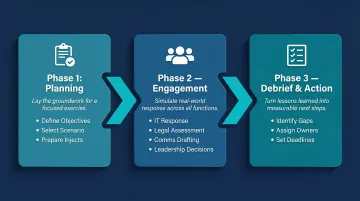
A well-run tabletop exercise follows three distinct phases.
Phase 1: Planning. The facilitator sets a specific objective before anyone enters the room. Common goals include testing ransomware escalation authority or validating regulatory notification timelines. Key preparation steps:
- Define the scenario based on the organization's actual threat landscape
- Identify participants and confirm their roles
- Prepare scenario injects — new developments introduced mid-exercise to simulate an evolving incident
Phase 2: Engagement. Participants walk through the scenario in real time, each team playing their actual role. Key actions during this phase:
- IT addresses the technical response and containment options
- Legal assesses regulatory obligations and disclosure timelines
- Communications drafts stakeholder messaging
- Leadership makes go/no-go decisions with incomplete information
The facilitator introduces injects to escalate pressure: a second threat actor is discovered, backup systems are also encrypted, a journalist calls. These moments reveal how teams perform under realistic stress.
Phase 3: Debrief and Action. The team reviews what worked and what failed, documents gaps with root causes, and converts findings into a prioritized remediation plan with assigned owners and deadlines. Without this step, the exercise produces discussion — not improvement.
Why Tabletop Exercises Matter: Key Objectives and Benefits
Stress-Testing Your Incident Response Plan
The primary objective is straightforward: find out what breaks before an attacker does. Incident response plans look solid on paper. Under simulated pressure, organizations routinely discover that escalation paths are unclear, decision authority is undefined, and cross-team handoffs rely on undocumented assumptions.
Only 26% of organizations have a formal IR plan applied consistently across the enterprise, according to Ponemon Institute research. The gap between having a plan and having a tested plan is where real incidents become expensive disasters.
Building Muscle Memory Across Non-Technical Teams
Legal, HR, PR, and finance teams rarely engage with cybersecurity until a crisis hits. That's exactly the wrong moment for them to encounter the process for the first time. Regular tabletop exercises give these stakeholders concrete roles before pressure arrives:
- Legal: Understands breach notification timelines and regulatory obligations
- HR: Knows how to handle insider threat scenarios and employee communication
- PR/Comms: Has pre-approved messaging frameworks ready before media inquiries arrive
- Finance: Can authorize emergency spend without waiting for procurement cycles
That preparation turns reactive scrambling into coordinated response.
Satisfying Compliance and Regulatory Requirements
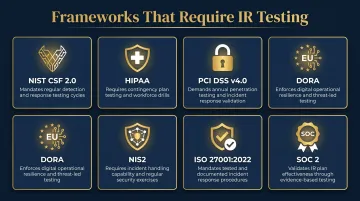
Seven major frameworks now require or strongly recommend documented IR testing:
| Framework | Specific Requirement |
|---|---|
| NIST CSF 2.0 | IR testing recommended; references NIST SP 800-84 |
| HIPAA (45 CFR 164.308) | Periodic testing and revision of contingency plans |
| PCI DSS v4.0 (Req. 12.10.2) | IR plan tested at least once every 12 months |
| DORA (Article 11) | ICT response/recovery plans tested at least yearly |
| NIS2 (Article 21) | Incident handling and crisis management measures required |
| ISO 27001:2022 (Annex A 5.24) | IR procedures must be documented and tested |
| SOC 2 | Response capabilities evaluated during Type II audits |
One well-documented tabletop exercise can generate compliance evidence applicable to multiple audits simultaneously — making it the most compliance-efficient form of IR validation available.
The Financial Case
The numbers make the case plainly. With the average US data breach costing $9.36 million and organizations that test their IR plans saving $2.22 million per breach on average, a properly run tabletop exercise pays for itself many times over on the first incident it improves. That's not a soft benefit — it's measurable risk reduction with a clear return before the exercise even ends.
Common Cybersecurity Tabletop Exercise Scenarios
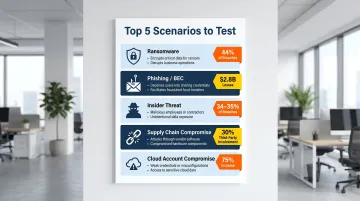
The best scenarios are tailored to the organization's specific industry, threat landscape, and regulatory obligations. A SaaS startup faces very different risks than a healthcare provider or financial institution. Five scenarios reflect current threat intelligence and apply across most organizations.
Ransomware Attack with Data Exfiltration
An attacker uses a compromised credential to move laterally across the network, deploys ransomware, and simultaneously exfiltrates customer data — presenting a double-extortion demand. Ransomware appeared in 44% of breaches in the Verizon DBIR 2025 dataset, a 37% year-over-year increase.
Key decision points to stress-test:
- Who has authority to authorize or decline ransom payment?
- Are backups verified intact and isolated from the compromised network?
- What are the regulatory notification windows (72 hours under GDPR, for example)?
- When and how does the organization communicate with affected customers?
Phishing and Business Email Compromise (BEC)
A finance employee receives a spoofed executive email requesting an urgent wire transfer. It clears spam filters because it originates from a legitimately compromised inbox. The FBI IC3 recorded $2.8 billion in BEC losses in 2024 alone across 21,442 complaints.
Key decision points to stress-test:
- What verification procedures exist before any wire transfer is approved?
- At what dollar threshold does a second-channel confirmation become mandatory?
- How quickly can the organization coordinate with banks to attempt fund recovery?
- What training gaps does this scenario reveal for finance and procurement teams?
Insider Threat
A departing employee downloads large volumes of sensitive IP to a personal device during their final week. A DLP alert fires after they've already offboarded. Internal actors drove 34–35% of breaches per the Verizon DBIR 2024–2025.
Questions to pressure-test:
- When are access privileges revoked during offboarding — final day or final notice?
- How does HR coordinate with legal and IT on evidence preservation?
- What monitoring policies exist for privileged users during notice periods?
Supply Chain Compromise
A critical third-party vendor used for identity management pushes a malicious update installing a backdoor. The organization learns from a news report before the vendor notifies them. Third-party involvement in breaches doubled from 15% to 30% year-over-year per Verizon DBIR 2025.
Critical decisions:
- How quickly can the organization scope which systems received the malicious update?
- What compensating controls can be activated while the vendor update is blocked?
- What contractual obligations does the vendor have for notification timelines?
- Which downstream customers may need to be notified?
Cloud Account Compromise
An attacker obtains valid credentials to a Microsoft 365 or AWS environment through phishing, exfiltrates documents from cloud storage, and sets up persistence via mail-forwarding rules. Cloud-based intrusions increased 75% in 2024 per CrowdStrike's 2025 Global Threat Report, with 84% of cloud-targeting adversaries using valid credentials.
Key decision points to stress-test:
- How quickly can credential revocation and session termination be executed?
- What cloud audit log visibility exists, and how far back do logs go?
- Has the organization coordinated with its cloud provider's security team before?
- What GDPR or breach notification obligations apply to exfiltrated data?
From Vynox Security's cloud assessment work across AWS, Azure, and GCP, the misconfigurations most commonly exploited in real environments include over-permissioned IAM roles, publicly accessible storage buckets, absent MFA on admin accounts, and disabled audit logging — all of which map directly to the attack path in this scenario.
How to Run a Cybersecurity Tabletop Exercise
Before the Exercise: Plan and Prepare
What you find in a tabletop exercise depends almost entirely on how well you prepared for it.
- Define a specific objective — not "test our IR plan" but "validate who has authority to take systems offline during a ransomware event" or "identify gaps in our 72-hour GDPR notification process."
- Conduct a threat assessment — choose a scenario that reflects your actual risk exposure, not a generic one. If your team already ran a ransomware exercise last quarter, do BEC or supply chain next.
- Update the IR plan first — don't run an exercise against a two-year-old plan. Test what's current.
- Identify and brief all participants — every function needs to be in the room: IT, security, legal, HR, communications, finance, and at least one executive.
- Choose your facilitator — internal facilitators are cost-effective; external facilitators bring objectivity and prevent teams from unconsciously steering toward comfortable outcomes.
During the Exercise: Facilitation and Engagement
Effective facilitation means creating productive discomfort. A tabletop exercise that feels easy isn't finding anything useful.
- Introduce time pressure — "You have 30 minutes before the regulators call."
- Use injects to force decisions with incomplete information — a second compromised system is discovered, or the vendor denies the breach happened.
- Ensure every function participates actively, not passively — if legal is silent for 45 minutes, something is wrong.
- Capture gaps in real time — don't rely on memory for the debrief. Assign a dedicated note-taker.
NIST SP 800-84 recommends exercise durations of 2 to 8 hours depending on scenario complexity. Most focused single-scenario exercises run effectively in 2 to 4 hours.
After the Exercise: Debrief and Follow-Through
Once the scenario wraps, the debrief is what converts observed gaps into organizational change.
- Review what succeeded and what broke, with specific root causes (not just "communication was poor")
- Document every gap with its business impact
- Assign remediation actions with named owners and hard deadlines
- Schedule the next exercise before leaving the room
Without assigned owners and deadlines, the findings stall. That's the most common failure mode — not the exercise itself, but the 30 days after it.
For organizations that lack an internal security leader to own this process end-to-end, Vynox Security's vCISO service covers incident response planning, playbook development, and tabletop exercise facilitation as core deliverables — so preparation, execution, and post-exercise remediation all stay connected.
Tabletop Exercise vs. Penetration Testing: What's the Difference?
These two practices are frequently confused and occasionally treated as interchangeable. They're not.
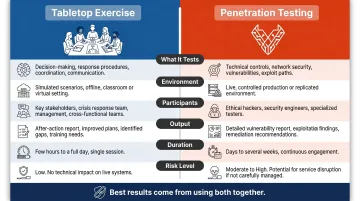
| Dimension | Tabletop Exercise | Penetration Testing |
|---|---|---|
| What it tests | People, process, communication, decision-making | Systems, networks, application vulnerabilities |
| Environment | Conference room; no systems touched | Live or test systems; active exploitation |
| Participants | IT, legal, HR, comms, finance, executives | Security engineers, ethical hackers |
| Output | Gaps in plans, roles, and communication | Technical vulnerability report with exploitability ratings |
| Duration | 2–8 hours | Days to weeks |
| Risk | No operational risk | Can disrupt systems if improperly scoped |
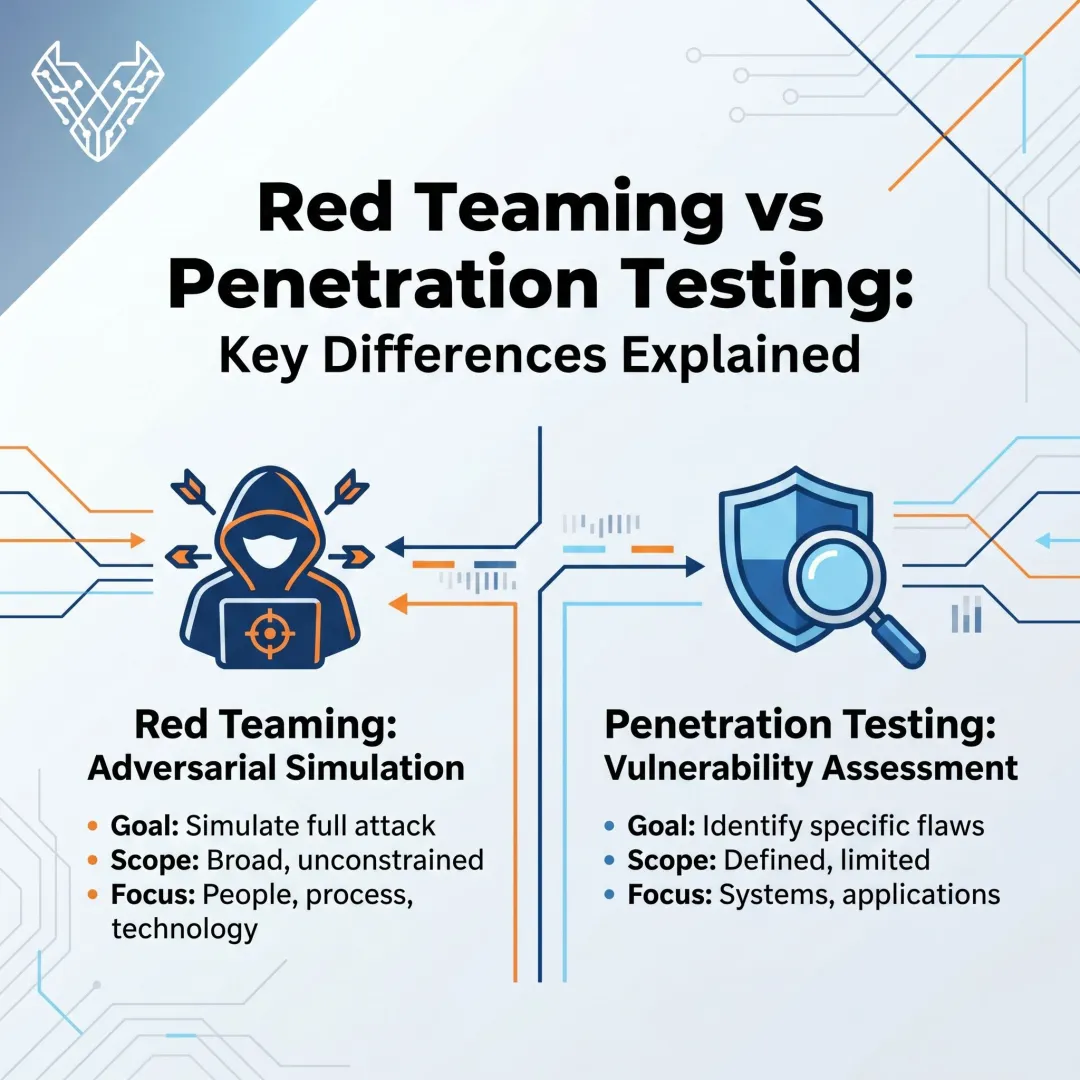
Tabletop exercises reveal what happens after a breach begins. Penetration testing reveals how the breach happens in the first place.
Running only tabletop exercises leaves undetected technical vulnerabilities that attackers can exploit before your team ever responds. Running only penetration tests identifies those gaps but leaves teams without practice at coordinating a response under real pressure.
CrowdStrike's 2025 ransomware survey found that 78% of organizations hit by ransomware had believed they were well-prepared beforehand — suggesting that technical controls alone, including penetration testing results, don't translate into effective incident response without process-level validation.
The two practices work best together. Penetration testing that surfaces realistic attack paths and business logic flaws gives security teams the credible, scenario-specific material they need to design meaningful tabletop exercises. Without that grounding, tabletop scenarios risk being too abstract to translate into genuine response readiness. Vynox Security's manual-first, threat-led approach is built around this connection — producing audit-ready findings that teams can directly feed into their tabletop exercise planning.
Frequently Asked Questions
What is the objective of a tabletop exercise in cybersecurity?
The primary objective is to evaluate and improve an organization's incident response plan by simulating a cyber crisis in a low-risk environment. It exposes gaps in how teams make decisions, communicate, and coordinate under pressure before a real incident occurs — when fixing them costs far less.
What is an IR tabletop exercise?
An IR (Incident Response) tabletop exercise focuses specifically on testing a formal incident response plan. Participants walk through the detection, containment, eradication, recovery, and communication steps of a simulated incident to validate that the plan works and that everyone knows their role.
What are examples of tabletop exercises?
The most common scenarios are ransomware with data exfiltration, phishing and business email compromise, insider data theft, supply chain compromise, cloud account takeover, and zero-day exploit response. Scenarios should be tailored to your specific threat environment and industry.
How long does a cybersecurity tabletop exercise typically take?
Most tabletop exercises last 2 to 4 hours. Simpler, single-scenario drills can run in under 2 hours; more complex, multi-phase exercises may extend to a half day.
How often should organizations run tabletop exercises?
At minimum, once per year — as required by PCI DSS v4.0 and DORA. Organizations in regulated industries or with elevated risk exposure should run exercises quarterly.
What is the difference between a tabletop exercise and a penetration test?
A tabletop exercise tests human response, communication, and decision-making through structured discussion — no systems are touched. A penetration test is a technical, hands-on assessment where security professionals attempt to exploit real vulnerabilities. The two practices are complementary: one tests your people and processes; the other probes your technical defenses.