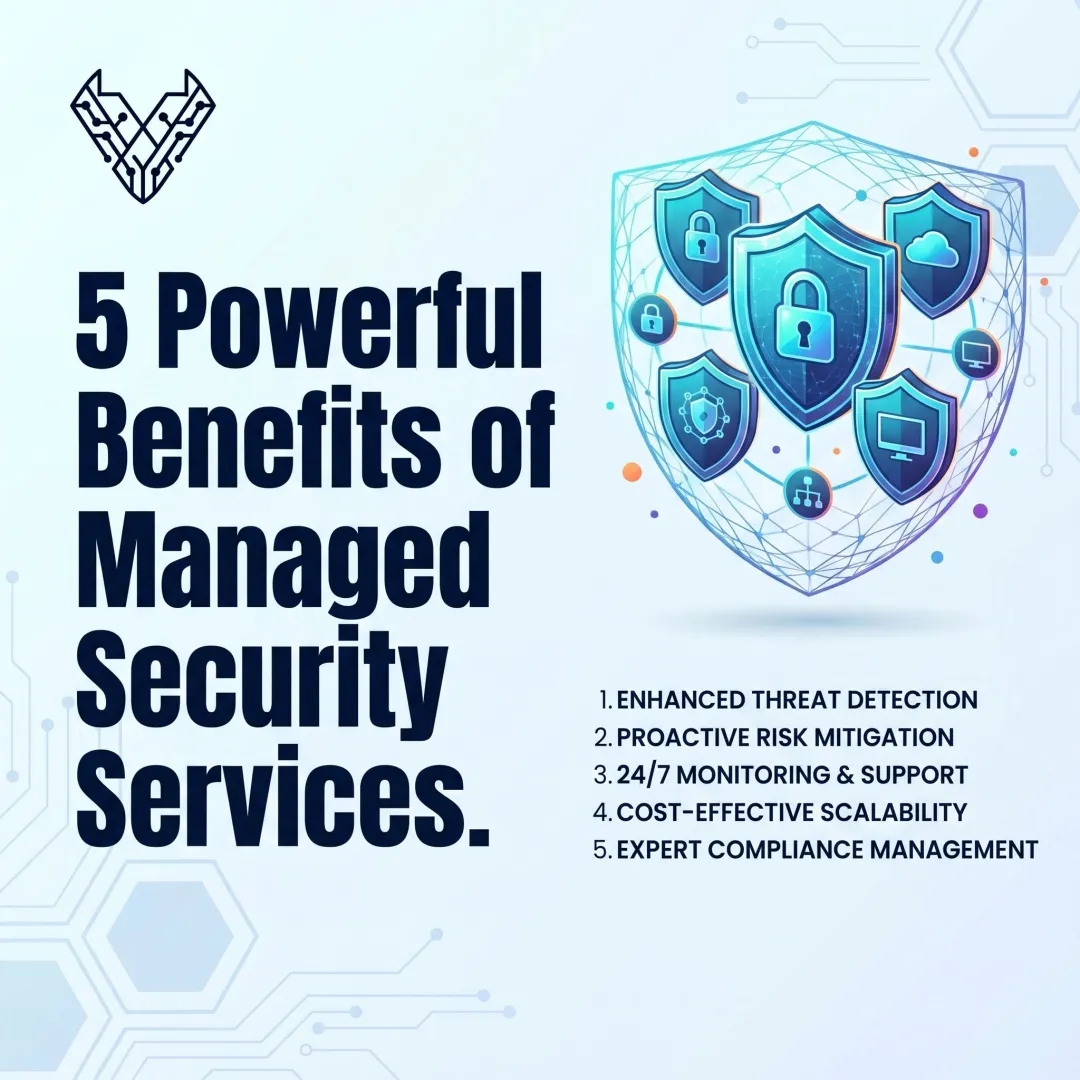
This is exactly the scenario MSSPs exist to prevent. A Managed Security Service Provider (MSSP) is a third-party organization that manages and monitors an organization's security systems under contract — with defined SLAs, dedicated analyst teams, and 24/7 coverage. The goal is continuous protection without requiring the client to staff a full security operation internally.
This post covers what MSSPs actually do, which services they provide, how they differ from MSPs, their real benefits and limitations, and what to look for when choosing one.
TL;DR
- MSSPs provide 24/7 security monitoring, threat detection, and compliance reporting under contract
- The global cybersecurity workforce gap sits at roughly 4 million professionals — MSSPs fill that gap without the hiring cost
- US data breaches now average $10.22 million — MSSP involvement can meaningfully reduce that exposure
- MSSPs detect threats; they don't proactively test for them — periodic penetration testing fills that gap
- When evaluating an MSSP, SLA response times and scope and compliance readiness matter more than marketing claims
Why Are Organizations Turning to MSSPs?
The Talent and Cost Problem
Hiring your way to security coverage is expensive — and increasingly impractical. According to ISACA's 2025 State of Cybersecurity report, 55% of cybersecurity teams are understaffed and 65% carry unfilled positions. The ISC2 2023 Workforce Study put the global gap at approximately 4 million professionals needed.
The cost of building that capability internally adds up fast:
- $124,910 median salary for information security analysts (Bureau of Labor Statistics)
- $175,000–$215,000 for senior practitioners and directors
- $5.3 million annually — Ponemon Institute's estimate for the average enterprise SOC
For most mid-market organizations, full internal coverage isn't realistic. MSSPs offer fractional access to that same capability at a predictable monthly cost.
The Breach Cost Equation
The IBM Cost of a Data Breach Report 2025 puts a hard number on what's at risk:
- US average breach cost: $10.22 million (a record high)
- Global average: $4.44 million
- MSSP involvement reduced average breach cost by $128,087
- Average breach lifecycle: 241 days to identify and contain
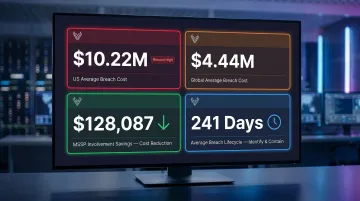
That 241-day window is where continuous monitoring matters most. Internal teams without 24/7 coverage routinely miss the early signals.
Alert Fatigue Is Real
Organizations receive an average of 22,111 security alerts per week, according to Ponemon Institute research. In 74% of breaches, alerts were generated but went ignored — analysts were simply overwhelmed.
MSSPs address this directly through trained triage analysts and AI-based filtering that separates genuine threats from noise. The best providers maintain false positive rates below 10%; many organizations without managed services tolerate rates of 90% or higher.
Compliance Pressure
Healthcare, finance, and SaaS companies operate under frameworks — HIPAA, PCI DSS, SOC 2, ISO 27001, GDPR — that require continuous monitoring, documented controls, and audit-ready reporting. Lean IT teams can't sustain that documentation burden alone. MSSPs are structured to handle it: continuous log collection, pre-mapped control frameworks, and evidence packages ready when auditors come calling.
What Services Do MSSPs Typically Provide?
24/7 SOC Monitoring
The core offering. MSSPs staff Security Operations Centers around the clock, monitoring SIEM, EDR, and XDR tools to catch threats during off-hours, weekends, and holidays. Few internal teams can replicate this without substantial headcount and infrastructure investment.
Managed Firewall and Perimeter Security
MSSPs configure and maintain firewalls, VPNs, and intrusion detection/prevention systems (IDS/IPS). Continuous rule tuning is part of the job — blocking unauthorized traffic while keeping legitimate access intact. As your environment changes, firewall rules and IDS/IPS policies need to change with it. Effective perimeter management is an ongoing process, not a one-time configuration.
Vulnerability Scanning and Patch Management
Regular scans across network and endpoints surface known weaknesses. MSSPs prioritize findings by risk level, then coordinate patch deployment before attackers can exploit open gaps. Worth confirming early: not all MSSPs apply patches directly. Clarify the division of responsibility during evaluation — ownership ambiguity here creates real exposure.
Managed Detection and Response (MDR)
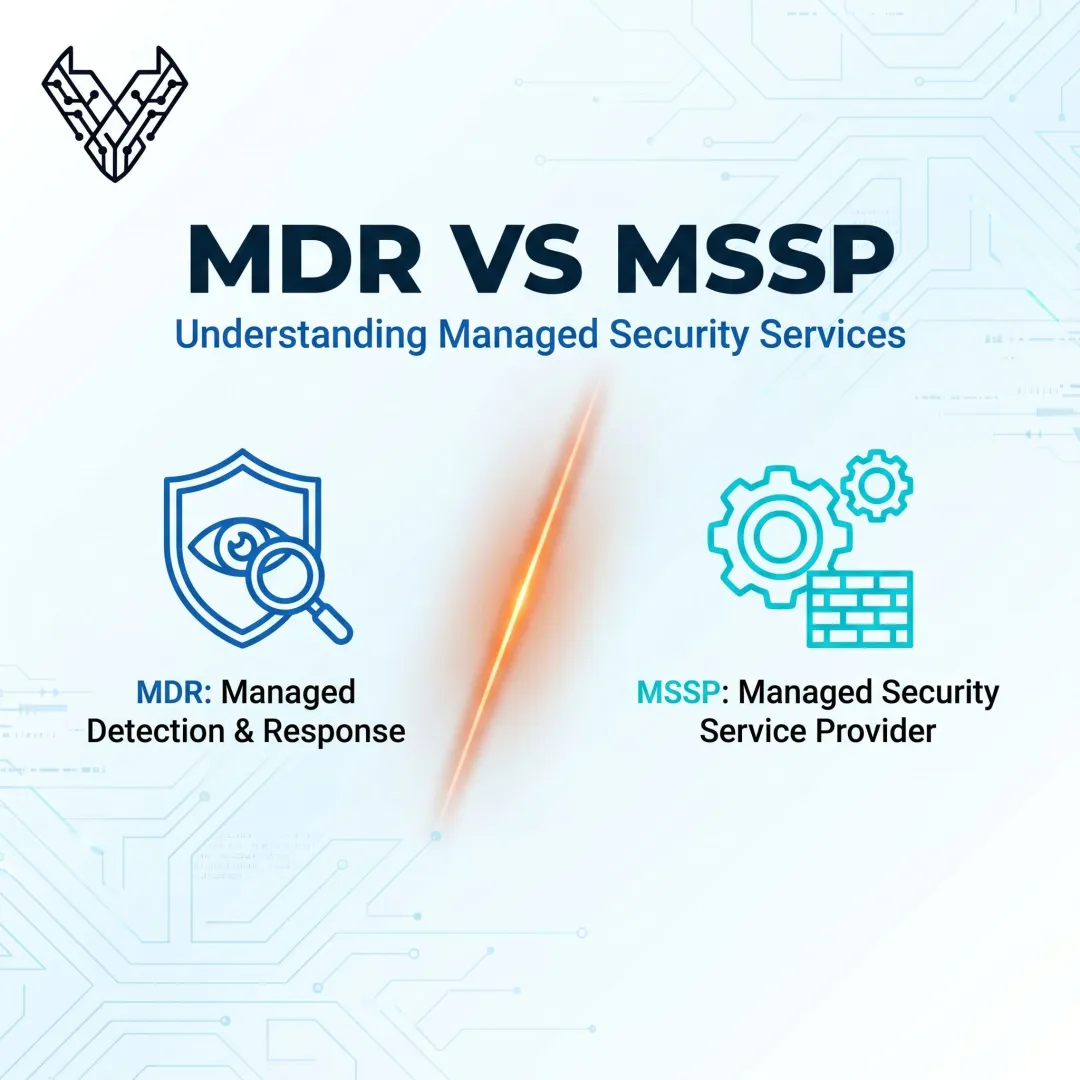
Capability gaps between providers show up most clearly in MDR. Basic MSSP monitoring generates alerts and hands them to the client. MDR goes further — the provider actively investigates, contains, and remediates threats in real time.
Gartner describes MDR as "remotely delivered, human-led, turnkey, modern SOC functions" that deliver "cyberattack disruption and containment." The MDR market grew nearly 49% year-over-year from 2020 to 2021, reflecting genuine demand for response capability, not just alert generation.
When evaluating an MSSP, confirm explicitly which model applies:
- Alert-only: Flags threats and passes them to your team
- Deeper investigation: Provider analyzes and escalates with context
- Full containment: Provider actively contains and remediates in real time
Compliance Monitoring and Reporting
MSSPs generate audit-ready documentation, map controls to frameworks like SOC 2 or PCI DSS, and produce regular reports for auditors, customers, and regulators. For organizations approaching certification or renewal, this reporting function alone justifies the engagement cost.
MSSP vs. MSP: What's the Difference?
| MSP | MSSP | |
|---|---|---|
| Primary focus | IT infrastructure management | Cybersecurity |
| Goal | Uptime, efficiency, IT operations | Threat detection, risk reduction |
| Operations center | NOC (Network Operations Center) | SOC (Security Operations Center) |
| Security depth | Baseline, as an add-on | Comprehensive and dedicated |
| Tools | RMM platforms, ticketing systems | SIEM, EDR/XDR, threat intelligence feeds |
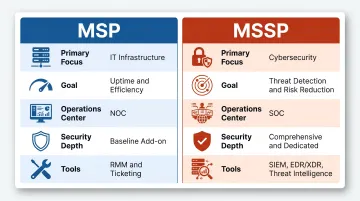
An MSP manages the broad IT environment: servers, networks, helpdesk, and software updates. Security is one component of a wider scope, not the primary mission.
An MSSP's entire toolset, team, and SLA structure is built around threat detection and response. For organizations whose primary concern is protection rather than IT operations, that difference is decisive.
When each makes sense:
- Organizations with mature IT operations needing dedicated security coverage: choose an MSSP
- Companies requiring both IT management and baseline security: an MSP with security add-ons may suffice
- Organizations with complex compliance requirements (SOC 2, PCI DSS): an MSSP's SOC-grade coverage is typically necessary
Many MSPs now market MSSP-like services as demand has grown. Scrutinize those offerings carefully: the label alone doesn't guarantee a functioning SOC, dedicated security analysts, or 24/7 monitoring capability.
Key Benefits of Partnering with an MSSP
For most organizations, the case for an MSSP comes down to three practical realities: cost, capability, and flexibility.
- Reduces total security spend — Building in-house 24/7 coverage requires staffing, tooling licenses, infrastructure, and ongoing training. Mid-market MSSP tiers typically run $5,000–$15,000/month, compared to Ponemon's $5.3 million annual figure for enterprise SOC operations.
- Provides immediate access to specialized talent — MSSPs employ threat hunters, incident responders, and security analysts who are expensive and difficult to hire independently. One contract gives you that entire bench without the recruiting overhead.
- Scales with business growth — Whether you're adding cloud environments, entering regulated markets, or expanding to new regions, MSSP coverage adjusts to match. No need to rebuild internal security from scratch at each stage.
What MSSPs Don't Always Cover — and Where Penetration Testing Fits In
MSSPs are built for continuous monitoring. That's a reactive posture — detecting threats as they occur. What most MSSPs don't do is proactively simulate attacks to find vulnerabilities before attackers reach them.
The Monitoring Gap
Continuous monitoring catches known threats in real time. It won't find logic flaws in your application workflows, privilege escalation paths that require chained exploitation, or authentication bypasses that only reveal themselves under adversarial conditions.
OWASP is explicit on this point: business logic vulnerabilities "can't be scanned for automatically" because they involve legitimate use of application functionality, not broken controls. Automated scanners surface known CVEs from signature databases — they don't think like attackers.
What Penetration Testing Adds
This is where manual-first penetration testing complements MSSP coverage. Vynox Security's approach targets precisely the gaps continuous monitoring leaves open: authentication flows, authorization logic, chained attack paths, and business rule abuse — the vulnerabilities that don't appear in scanner output.
For organizations relying on an MSSP for day-to-day monitoring, periodic penetration testing validates that the environment being defended doesn't contain exploitable gaps the MSSP's tools can't see. Findings are manually validated and compliance-aligned reports are delivered within 48 hours — making it practical to run pen tests alongside ongoing MSSP coverage without disrupting operations.
That validation is what makes the two services complementary rather than redundant. The MSSP monitors the perimeter; penetration testing finds what's still exposed inside it.
How to Choose the Right MSSP for Your Business
Evaluate Scope and SLA Depth
Ask prospective MSSPs three specific questions:
- What's included vs. guidance-only vs. out of scope?
- What are your guaranteed detection and response times?
- Do you offer alert-only, investigation, or full containment?
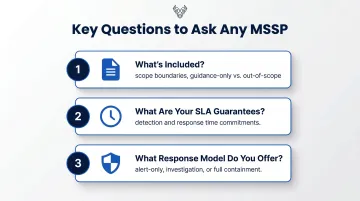
Each level carries different access requirements and cost implications. Vague SLAs are a red flag.
Assess Industry Experience and Tool Compatibility
A strong MSSP should demonstrate experience in your industry, familiarity with your tech stack, and API-level integration with your existing tools — not just generic monitoring capability. In practice, API-level integration means the provider can pull telemetry directly from your SIEM, cloud environment, or endpoint platform — not just receive email alerts.
Ask for references from organizations in your sector specifically. A healthcare company and a SaaS startup face fundamentally different threat profiles; an MSSP that handles one well may not be equipped for the other.
Check Compliance Readiness and Trust Signals
Look for:
- SOC 2 Type II or ISO 27001 certification for the provider's own operations
- Ability to map their services to your specific regulatory frameworks (HIPAA, PCI DSS, GDPR)
- Exportable evidence packages for audits
- Verifiable customer references — not just logos
The managed security services market has expanded rapidly, and more providers now compete for the same buyers. That growth means more options — and more vendors making similar-sounding promises. Certifications like SOC 2 Type II are independently verified; marketing pages are not. Prioritize documented proof over polished positioning.
Frequently Asked Questions
How much does an MSSP usually cost?
Pricing varies by scope, organization size, and service tier. Entry-level (SMB-focused) providers typically run $3,000–$5,000/month; mid-market MDR providers range $5,000–$15,000/month; enterprise contracts often exceed $15,000/month. Per-device and per-user pricing models are common at all tiers.
What are managed security service providers?
MSSPs are third-party organizations that manage and monitor an organization's cybersecurity operations under contract. Core services include 24/7 SOC monitoring, threat detection, incident response, and compliance reporting — typically delivered with defined SLAs.
What is an MSSP vs. MSP?
MSPs manage broad IT infrastructure (servers, networks, helpdesk) with security as one component. MSSPs focus exclusively on cybersecurity, with dedicated tools, trained analysts, and security-specific SLAs. The primary difference is scope and mission.
What is the difference between an MSP and a SOC?
An MSP manages overall IT operations. A SOC (Security Operations Center) is a dedicated team focused on monitoring, detecting, and responding to security threats. MSSPs run a SOC as a core function — clients get that capability without building it in-house.
What are examples of managed security services?
Common managed security services include:
- 24/7 network monitoring and managed firewall/IDS/IPS
- Vulnerability scanning and patch coordination
- Managed detection and response (MDR)
- SIEM and endpoint detection and response (EDR) management
- Compliance reporting