The natural response is to outsource. But outsource what, exactly?
MDR and MSSP are the two dominant models, and vendors frequently use them interchangeably. That's a problem. Choosing the wrong model doesn't just waste budget — it creates gaps that attackers are happy to walk through. One model responds to threats; the other mostly tells you about them.
Here's what you actually need to know to make the right call.
TL;DR
- MDR (Managed Detection and Response) = active threat hunting, investigation, and containment by human analysts
- MSSP (Managed Security Service Provider) = infrastructure monitoring and management; alerts your team, but your team responds
- MDR suits organizations without a mature internal SOC or those facing sophisticated threats
- MSSP suits organizations with an existing IT team that can handle escalations, primarily needing monitoring and compliance support
- Both can be used together: MSSP for broad monitoring coverage, MDR layered on top for active threat response
MDR vs MSSP: Quick Comparison
| Dimension | MDR | MSSP |
|---|---|---|
| Response Approach | Active — analysts investigate and contain threats directly | Alert-based — validated alerts sent to your team for action |
| Scope of Service | Narrow and deep — detection, hunting, and response | Broad and wide — monitoring, patching, compliance, device management |
| Human Oversight | High — dedicated threat hunters and incident responders | Limited — primarily automated rules and alerting |
| 24/7 Coverage | Included by default | Varies by contract tier |
| Cost | Higher — reflects specialized expertise and active response | Lower — standardized services at scale |
What Is MDR?
Managed Detection and Response is a fully outsourced security service that combines AI, machine learning, and threat intelligence with human analyst expertise. It continuously monitors endpoints, cloud environments, SaaS platforms, and network traffic — then acts on what it finds. Unlike tools that stop at alerting, MDR investigates, contains, and helps remediate.
How MDR Delivery Works
Gartner's Market Guide for Managed Detection and Response describes two primary delivery models:
- Fully managed: The provider monitors 24/7 and takes autonomous response actions — isolating a host, terminating a process — without waiting for your approval
- Co-managed: A shared interface where your team retains some operational control and can perform custom searches alongside the provider
The key differentiator across both is response authority — whether the provider can act without asking your permission first.
What MDR Catches That Other Tools Miss
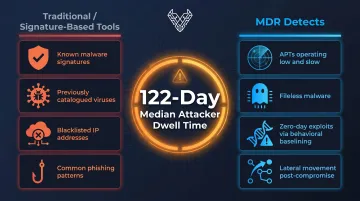
Rule-based and signature-based systems catch known, catalogued threats. MDR providers are specifically built to detect what those tools overlook:
- Advanced persistent threats (APTs) operating low and slow
- Fileless malware that leaves no disk-based artifacts
- Zero-day exploits identified through behavioral baselining
- Lateral movement inside a network after initial compromise
This gap has real consequences. Mandiant's M-Trends 2025 report found that cyber espionage incidents showed median dwell times of 122 days. Attackers who bypass perimeter tools can remain undetected for months without active hunting.
Core MDR Capabilities
- Proactive threat hunting across endpoints, network, and cloud telemetry
- Incident triage, containment, and root cause analysis
- Remediation support and post-incident reporting
- 24/7 SOC operations run on the client's behalf
Trade-offs to Consider
MDR is not without friction:
- Higher cost than passive monitoring services
- Integration with your existing security stack takes time to configure
- Even fully managed deployments require internal coordination — someone still receives escalations and authorizes major response actions
MDR Use Cases
MDR is the right fit for:
- Organizations without a mature in-house SOC
- Fintech, healthcare, and SaaS companies with high breach exposure — healthcare breaches average $9.77 million per incident, per IBM's Cost of a Data Breach Report 2024
- Companies under strict compliance obligations (HIPAA, SOC 2, PCI DSS)
- Growing businesses that can't scale a security team fast enough to match their attack surface
What Is MSSP?
A Managed Security Service Provider is a third-party vendor that monitors and manages your security infrastructure — firewalls, intrusion detection systems, antivirus, VPNs, vulnerability scanners — typically through a subscription delivered from a virtual SOC.
The critical distinction from MDR: MSSPs identify and alert, but your team responds. When an MSSP flags a suspicious event, the expectation is that your internal staff investigates and takes action.
What MSSP Services Typically Cover
- Firewall and endpoint management
- Patch management and vulnerability scanning
- Compliance reporting (SOC 2, ISO 27001, PCI DSS)
- Basic security event monitoring and log aggregation
- VPN and network device management
MSSP is an umbrella term, and service quality varies widely by vendor and contract tier. A 2024 survey of nearly 2,000 MSSP professionals found that 60% cited effective client communication as their biggest operational challenge, and 53% said reporting consumes excessive time — suggesting the model's value often breaks down in practice through execution gaps rather than technical ones.
The Alert Fatigue Problem
The alert-only model has a structural weakness: approximately 42% of security alerts go entirely uninvestigated due to volume and fatigue, and 73% of organizations cite false positives as their primary detection challenge. An MSSP that generates alerts your team can't action doesn't improve your security posture — it creates noise.
Some MSSPs also provide limited telemetry visibility back to clients, making it difficult to maintain internal situational awareness. Gartner's MDR Market Guide notes this directly, pointing out that MDR providers offer far greater visibility into detection logic and response activity than most MSSPs return to clients.
MSSP Trade-offs
These structural gaps feed into the broader trade-offs buyers face:
- Limited customization relative to your specific environment
- Variable service quality across vendors and contract tiers
- Response remains the client's responsibility — the MSSP won't contain an active breach
MSSP Use Cases
MSSP is the right fit for:
- Small to mid-size businesses building out IT security functions
- Companies with an internal IT team capable of handling escalations but lacking 24/7 monitoring tooling
- Organizations focused primarily on compliance management and infrastructure oversight
- Budget-constrained teams where predictable subscription costs matter
76% of SMBs now spend more than $50,000 annually on outsourced security, and cost-effectiveness ranks as the top driver for outsourcing. For teams that need coverage without building a full in-house SOC, MSSP's fixed-cost structure is a practical starting point — though it may leave response gaps as threats grow more sophisticated.
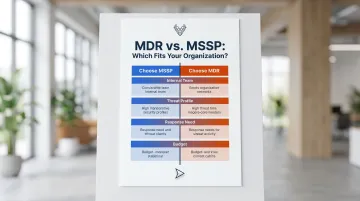
MDR vs MSSP: Which Is Right for Your Organization?
The right answer depends on four factors — and where you land on each one will point clearly toward one model or the other.
Decision Factors
| Factor | Points to MSSP | Points to MDR |
|---|---|---|
| Internal team | Has IT staff capable of incident response | No dedicated security team or SOC |
| Threat profile | Standard business risk, common threats | Regulated industry, high-value data, sophisticated adversaries |
| Response need | Monitoring + alerting is sufficient | Active containment required |
| Budget | Cost predictability is the priority | Willing to pay more for guaranteed response SLAs |
When to Use Both
Many mid-market and enterprise organizations don't choose between MDR and MSSP — they layer them.
MSSP handles foundational coverage: device management, patch cycles, compliance reporting, firewall oversight. MDR sits on top for detection and active response. The two services serve different functions across the security stack, and combining them is defense in depth by design.
Know Your Gaps Before You Sign Anything
One step organizations consistently skip: understanding their actual security posture before committing to either model. Common mismatches include:
- Signing an MSSP contract while critical web application vulnerabilities remain unpatched
- Deploying MDR over a cloud environment with misconfigured IAM policies
- Choosing a service model based on budget rather than actual attack surface
A manual-first penetration test surfaces the specific vulnerabilities and attack vectors that determine which service model your risk profile actually requires. Vynox Security conducts this type of assessment across web applications, APIs, cloud environments, and network infrastructure — with 100% manual validation of findings. That means you're working from real risk data, not tool-generated noise, when you make the vendor decision.
Situational Scenarios
Scenario 1 — Resource-constrained SMB: No in-house SOC, limited security budget, primary concerns are compliance and basic monitoring. An MSSP is the logical starting point. It provides infrastructure coverage at a manageable subscription cost while your IT generalists handle escalated incidents.
Scenario 2 — Scaling SaaS company: Growing attack surface across cloud environments and third-party integrations, regulatory pressure from enterprise customers demanding SOC 2 compliance, no time to build an internal security team. MDR is the right fit. CrowdStrike data shows average attacker breakout time — from initial access to lateral movement — has compressed to roughly 29 minutes. Alert-only monitoring leaves a vanishingly small window for human response. MDR with active containment closes that gap.
Conclusion
MDR and MSSP solve different problems. Treating them as interchangeable is where most buying decisions go wrong.
MDR offers depth: active threat hunting, human-led investigation, and guaranteed response. It's built for organizations that need someone to act when a threat is detected. MSSP offers breadth: infrastructure management, compliance support, and monitoring at scale. It's built for organizations that need coverage across their security estate and have internal capacity to handle escalations.
Neither is universally superior. The right choice depends on your threat environment, your team's capacity to investigate alerts, and whether you need someone to respond — or someone to monitor.
Before engaging either model, audit your real risk profile. Understanding which vulnerabilities exist, which attack vectors are exposed, and whether your current controls hold up under pressure puts you in a stronger position to pick a partner that addresses actual gaps.
That's where a manual-first penetration test earns its place — as the foundation for every security investment that follows, not a compliance checkbox you complete once and forget.
Frequently Asked Questions
What is the difference between MDR and MSSP?
MDR provides active, human-led threat detection, hunting, and incident response — the provider's analysts investigate and contain threats on your behalf. MSSP monitors and manages security infrastructure and sends alerts to your team for action. The core distinction is who responds when something goes wrong.
What is an MSSP in cybersecurity?
An MSSP (Managed Security Service Provider) is a third-party vendor that manages and monitors an organization's security tools — firewalls, intrusion detection systems, vulnerability scanners — on a subscription basis. They handle device management and alerting, but incident response typically stays with the client.
What's the difference between an MSP and MSSP?
An MSP (Managed Service Provider) handles general IT operations: helpdesk support, infrastructure management, cloud services. An MSSP focuses exclusively on cybersecurity — security monitoring, threat management, and compliance. Where an MSP keeps your systems operational, an MSSP is specifically accountable for keeping them protected.
What is the difference between MDR, MSSP, and SIEM?
A SIEM is a technology tool that aggregates and correlates security event data. An MSSP is a vendor that manages security infrastructure and may operate a SIEM on your behalf. MDR is a fully managed service layered on top — adding human-led threat hunting and active incident response that a SIEM or MSSP alone won't provide.
What is the difference between a managed SOC and MDR?
A managed SOC is the operational structure — the team and facility that handles security monitoring. MDR is the service model those analysts deliver. Many MDR providers operate their own SOC on behalf of clients, meaning MDR is what you buy and the managed SOC is how it gets delivered.
Is MDR a managed service?
Yes. MDR is a subset of managed security services that goes beyond basic monitoring to include active threat detection, investigation, and incident response — all delivered by an external provider. The key distinction from broader managed security services is accountability: MDR providers are responsible for response outcomes, not just alerting your team.