Choosing the wrong framework doesn't just waste months of effort. It creates a credibility gap with the exact customers you're trying to win. Choose right, and compliance becomes a sales accelerator. Choose wrong, and you're rebuilding from scratch under deadline pressure.
This guide breaks down what each framework actually requires, where they differ, and how to decide which one — or both — makes sense for your business.
TL;DR
- SOC 2 is a US-centric attestation report; ISO 27001 is a globally recognized ISMS certification
- Control overlap between the two frameworks runs 60–80%, so achieving one puts you most of the way toward the other
- SOC 2 suits US-market SaaS companies; ISO 27001 better fits international or enterprise-focused organizations
- Both frameworks effectively require penetration testing as audit evidence
- Pursuing both certifications together can cut total compliance costs by 30–40% for companies targeting US and global markets
SOC 2 vs ISO 27001: At a Glance
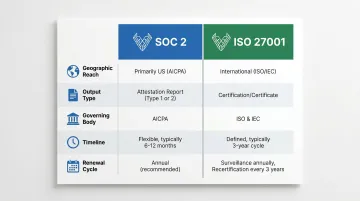
Here's how SOC 2 and ISO 27001 compare across the dimensions that matter most for your decision:
| Dimension | SOC 2 | ISO 27001 |
|---|---|---|
| Geographic reach | Primarily North America | Global / International |
| Output type | Attestation report | Formal certificate |
| Governing body | AICPA (licensed CPA firm required) | ISO/IEC (accredited registrar required) |
| Timeline | Type 2: 6–12 months | 6–18 months |
| Renewal cycle | Annual | 3-year cycle + annual surveillance audits |
What Is SOC 2?
SOC 2 — System and Organization Controls 2 — is an attestation framework developed by the AICPA that evaluates how a service organization protects customer data. One critical distinction: SOC 2 produces a report, not a certificate. That matters when procurement teams ask what you hold.
The Five Trust Services Criteria
SOC 2 audits are structured around five Trust Services Criteria (TSC):
- Security (mandatory for every audit)
- Availability
- Confidentiality
- Processing Integrity
- Privacy
Only Security is required. The rest are optional, which lets companies tailor audit scope to their actual services. A payment processor might add Processing Integrity; a healthcare SaaS might add Privacy.
Who SOC 2 Is Built For
SOC 2 is the go-to standard for US-based SaaS companies, cloud service providers, and tech startups whose enterprise customers — particularly in North America — require proof of data security controls before signing contracts. 15,000–20,000 SOC 2 reports are issued annually, with roughly 75–80% originating from US-based organizations.
Meeting that bar requires solid audit evidence. SOC 2 doesn't mandate penetration testing by name, but auditors routinely expect it under CC4.1 (ongoing monitoring) and CC7.x controls covering vulnerability identification. A manual, third-party test — not an automated scan — is what auditors actually scrutinize.
SOC 2 Type 1 vs Type 2
| Type 1 | Type 2 | |
|---|---|---|
| What it assesses | Control design at a point in time | Control effectiveness over a defined period |
| Timeline | As little as 45 days | 6–12 months observation period |
| Credibility | Useful fast signal for early-stage companies | Industry standard for B2B enterprise deals |
Type 1 is a starting point. Enterprise buyers almost always ask for Type 2.
What Is ISO 27001?
ISO 27001 is an international standard published by ISO/IEC that defines requirements for establishing, operating, and continuously improving an Information Security Management System (ISMS). Unlike SOC 2, it results in a formal certificate valid for three years.
The ISMS Concept
An ISMS isn't a one-time audit project — it's an ongoing operational framework governing how an organization identifies, assesses, and treats information security risks across people, processes, and technology. Annual surveillance audits maintain the certification between three-year recertification cycles.
That continuity requirement is where ISO 27001 earns its reputation — and where organizations that treat it as a checkbox exercise consistently run into trouble at surveillance audits.
Who ISO 27001 Is Built For
ISO 27001 tends to be the right fit when your market, clients, or sector demand it:
- Companies entering European, APAC, or Middle Eastern markets
- Enterprises in regulated sectors — fintech, healthcare, government supply chains
- Any organization whose international clients contractually require it
Adoption is accelerating fast. Valid certificates nearly doubled from 48,671 in 2023 to 96,709 in 2024, with strong uptake in China, India, Japan, the UK, and the US.
Annex A Controls and Penetration Testing
ISO 27001:2022 contains 93 controls across four themes (Organizational, People, Physical, Technological). Organizations must implement applicable controls or formally justify exclusions in a Statement of Applicability (SoA).
Annex A.8.8 addresses management of technical vulnerabilities — including penetration testing and vulnerability assessments. Unlike SOC 2's implied expectation, this is a direct requirement.
ISO 27001:2022 vs the Previous Version
The 2022 update restructured Annex A from 114 to 93 controls and added new controls for cloud security, threat intelligence, and data privacy. Organizations certified under the 2013 version must transition by October 31, 2025 — a deadline relevant to anyone holding older certifications.
Key Differences Between SOC 2 and ISO 27001
Geographic Reach and Market Acceptance
Geography largely determines which framework your customers will request:
- US buyers expect SOC 2 — it's embedded in procurement workflows across SaaS, fintech, and cloud services
- European and APAC buyers prefer or contractually require ISO 27001
With nearly 97,000 valid ISO 27001 certificates worldwide and 20,000+ SOC 2 reports issued annually, both standards have real market weight — in different regions.
Certification vs Attestation — A Distinction That Matters in Sales
The distinction plays out differently depending on what your sales team needs:
- ISO 27001 issues a publicly displayable certificate — you can put it on your website security page
- SOC 2 produces a confidential report typically shared under NDA — it provides detailed audit evidence but isn't publicly brandable
For companies wanting a visible trust signal on their homepage, ISO 27001 has a practical advantage. For US procurement teams who need detailed evidence of specific controls, SOC 2's report format wins.
Flexibility vs Prescriptiveness
- SOC 2: Only the Security TSC is mandatory. Companies choose which additional criteria apply. Faster and lighter for early-stage programs.
- ISO 27001: All 93 Annex A controls must be addressed — either implemented or explicitly excluded with documented justification. More structured, but builds a more mature and auditable security program.
Cost and Timeline
| SOC 2 Type 1 | SOC 2 Type 2 | ISO 27001 (first year, SME) | |
|---|---|---|---|
| Cost range | $7,500–$60,000 | $12,000–$100,000 | $25,000–$80,000 |
| Timeline | 45–90 days | 6–15 months | 6–18 months |
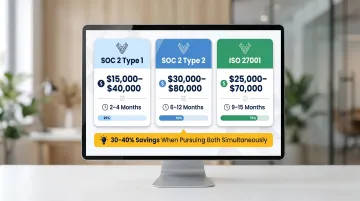
SOC 2 audit fees are lower upfront. ISO 27001's higher first-year cost reflects the ISMS implementation requirements beyond the audit itself.
Pursuing both simultaneously can reduce total costs by 30–40% through shared evidence, overlapping controls, and consolidated audit preparation.
Shared Requirement: Penetration Testing
Both frameworks require penetration testing evidence — just differently:
- SOC 2: Expected under CC4.1 and CC7.x; not explicitly named but auditors routinely ask for it
- ISO 27001: Explicitly required under Annex A.8.8 as part of technical vulnerability management
Automated scanning alone doesn't satisfy either framework. Auditors expect a manual, third-party assessment that tests for business logic flaws and attack chains that tools miss. Vynox Security's manual-first penetration testing delivers reports mapped to SOC 2 Trust Services Criteria and ISO 27001 Annex A controls, giving auditors the structured evidence each framework requires.
Which Standard Should You Choose?
A Simple Decision Framework
Follow your customer geography first:
- Most customers in the US → Start with SOC 2
- International expansion is a priority → Prioritize ISO 27001, or pursue both
Match organizational maturity:
- Early-stage startup with a lean security team → SOC 2 Type 1 is a manageable entry point
- Organization ready to invest in a sustained program → ISO 27001 builds the infrastructure for long-term compliance
Honor contractual requirements:
- If a prospect explicitly requires one over the other, the contract decides. No framework choice overrides a specific customer requirement.
Should You Do Both?
For companies serving US and international markets, yes — and the sequencing matters.
Recommended sequence:
- Start with SOC 2 — it unlocks US enterprise deals faster, typically within 6–12 months.
- Build toward ISO 27001 next — the ~60–80% control overlap means far less incremental effort than starting from scratch.
- Pursue both simultaneously if budget allows — consolidated audits reduce total spend by 30–40%.
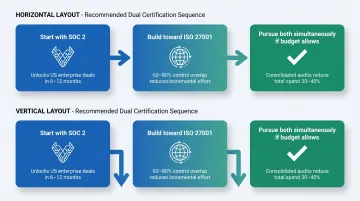
A company that builds a solid SOC 2 Type 2 program has already done the heavy lifting for most of ISO 27001. ISMS documentation and a risk treatment plan are the primary additions.
The Pre-Audit Step Most Companies Skip
Once you've chosen a framework, the next question is whether you're actually ready for the audit. A security gap assessment — including a penetration test — identifies which controls need remediation before the audit clock starts. Beginning an audit with unresolved vulnerabilities wastes both time and money.
Vynox Security works with SaaS startups and cloud-native companies to identify these gaps through manual-first penetration testing. Reports are mapped to SOC 2 and ISO 27001 controls and structured so findings translate directly into audit evidence — usable by both technical teams and auditors.
Conclusion
SOC 2 and ISO 27001 aren't competitors — they serve different markets and different stages of security program maturity. SOC 2 opens US enterprise doors faster. ISO 27001 builds the global credibility and systematic ISMS that international markets require.
The right choice depends on three things: where your customers are, what they contractually require, and how much security infrastructure you're prepared to sustain. For companies scaling past Series A or expanding into European and APAC markets, pursuing both is often the practical outcome — not a stretch goal.
Whichever path you choose, compliance work starts well before the audit does. Certification reveals your controls — it doesn't build them. A manual penetration test gives you an honest baseline and exposes the gaps auditors will flag anyway. Finding them first puts you in control of the remediation timeline, not scrambling to respond to findings during the audit cycle.
Frequently Asked Questions
What is the difference between ISO 27001 and SOC 2?
SOC 2 is a US-focused attestation report from a licensed CPA firm evaluating specific security controls against the AICPA's Trust Services Criteria. ISO 27001 is an internationally recognized certification requiring organizations to build and maintain a full Information Security Management System. Both address security, but they serve different markets and have different outputs.
Which is better, SOC 2 or ISO 27001?
Neither is objectively better — the right choice depends on your target market, customer requirements, and organizational maturity. SOC 2 is typically the better starting point for US-centric SaaS companies; ISO 27001 better suits international or enterprise-focused organizations. Many growing companies ultimately pursue both.
Does ISO 27001 cover SOC 2?
No — they are not interchangeable. A customer requesting a SOC 2 report will not accept an ISO 27001 certificate as a substitute, and vice versa. That said, the 60–80% control overlap means achieving one standard puts you significantly closer to the other.
What is ISO 27001 certification and SOC 2 Type II compliance?
ISO 27001 certification is issued by an accredited registrar, confirming your ISMS meets the standard — valid for three years with annual surveillance audits. SOC 2 Type II is a CPA-attested report confirming your controls operated effectively over a defined review period, typically 6–12 months.
Is it hard to get SOC 2 certified?
SOC 2 is technically an attestation, not a certification. Difficulty depends on your current security maturity. Type 1 can be achieved in as little as 45 days for well-prepared organizations; Type 2 requires 6–12 months of demonstrated control effectiveness before the audit even begins.
How much does ISO 27001 certification cost?
For SMEs with 25–200 employees, total first-year costs typically range from $30,000 to $80,000, covering implementation support and the certification audit. This runs higher than SOC 2 due to ISMS program requirements — though pursuing both frameworks together can cut total spend through shared evidence and controls.