The problem is that many organizations respond to this pressure by treating penetration testing as something to "get done" before an audit window closes. They run a tool scan, receive a CVE list, and submit it as evidence. Auditors see this pattern constantly, and it creates real consequences: qualified opinions, open nonconformities, and remediation cycles that push certification timelines back by months.
This article explains why pen testing is not just one more compliance checkbox — and what the frameworks actually require, what auditors actually accept, and what happens when organizations cut corners.
TL;DR
- SOC 2 doesn't explicitly mandate pen testing, but it's the primary evidence auditors accept for CC4.1 (monitoring and evaluating controls)
- ISO 27001:2022 explicitly addresses technical vulnerability management under Annex A Control 8.8; pen testing is the industry-standard method for satisfying it
- Automated scans identify known CVEs — they can't simulate attack chains, test business logic, or prove exploitability
- One properly scoped manual pen test can satisfy both SOC 2 and ISO 27001 requirements simultaneously
- Recurring testing builds compounding value — tracking improvement, feeding risk registers, and proving security maturity to auditors and enterprise buyers
What Penetration Testing Means in a Compliance Context
Penetration testing is a structured, simulated cyberattack performed by qualified security professionals to identify vulnerabilities that can actually be exploited — not just detected. That distinction separates it from automated vulnerability scanning, which compares systems against databases of known CVEs without attempting exploitation or following attacker logic.
NIST SP 800-115 draws this line explicitly: scanning identifies potential vulnerabilities; penetration testing uses human-led exploitation attempts to validate feasibility and real-world impact.
In a compliance context, these two activities serve different evidentiary functions:
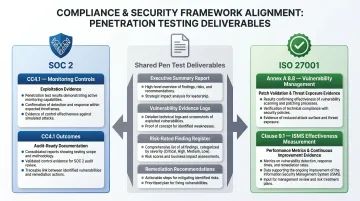
- SOC 2 CC4.1 calls for "separate evaluations" that determine whether internal controls are "present and functioning." A pen test report demonstrating active exploitation attempts — and their outcomes — is the most direct evidence auditors accept for this criterion.
- ISO 27001 Annex A 8.8 requires systematic identification and treatment of technical vulnerabilities — pen test findings feed directly into the risk register.
- ISO 27001 Clause 9.1 requires monitoring and measurement of ISMS effectiveness, which pen test outputs inform during management review.
In practice, pen testing shifts the compliance conversation from "do we have controls?" to "do those controls hold under real attack conditions?" That distinction is what auditors — and attackers — actually care about.
Why Penetration Testing Is Critical for SOC 2 and ISO 27001 Compliance
Three concrete advantages explain why pen testing is non-negotiable in both frameworks. Each maps directly to outcomes auditors measure, enterprise buyers evaluate, and security teams are held accountable for.
Advantage 1: It Proves Your Controls Actually Work, Not Just That They Exist
There's a persistent gap between having a control documented and having a control that holds under real attack conditions. Policy documents, audit checklists, and automated scans can confirm a control exists. Only pen testing can confirm it functions.
When testers actively attempt to exploit firewalls, bypass access controls, abuse authentication mechanisms, and abuse misconfigurations, they reveal whether controls that appear compliant on paper actually stop an attacker. The Verizon 2025 Data Breach Investigations Report found vulnerability exploitation was a factor in roughly 20% of breaches — up 34% year over year — with edge and VPN devices targeted in 22% of exploitation incidents. Controls existed in many of those environments. They just didn't function under pressure.
Why this matters for each framework:
- SOC 2 CC4.1 specifically calls for evaluations that determine whether controls are "present and functioning." A pen test report showing exploitation attempts, outcomes, and remediation is the most direct auditor-accepted evidence of this requirement.
- ISO 27001 Clause 9.1 requires monitoring and measurement of ISMS effectiveness. Pen test results directly feed this evaluation — but only if findings are used to update the risk register and trigger corrective actions.
KPIs this affects: audit finding rate, time-to-certification, control effectiveness score, number of undetected exploitable vulnerabilities in production.
When it matters most: preparing for a SOC 2 Type II audit covering a 12-month period, pursuing initial ISO 27001 Stage 2 certification, or after major infrastructure changes such as cloud migrations, new application launches, or M&A activity.
Advantage 2: It Uncovers What Automated Scans Cannot
Automated scanners are useful tools — but they have a hard ceiling. They identify known CVEs and surface-level misconfigurations by matching systems against vulnerability databases. They cannot simulate attack chains, test business logic flaws, or model how a real attacker moves through an environment after initial access.
OWASP's guidance on business logic vulnerabilities is direct: these flaws are often undetectable by automated tools because they require understanding application workflows, user roles, session management, and backend integrations — context that scanners don't have.
Vynox Security was built around this failure mode. Its founders repeatedly saw organizations rely on automated scans that missed critical business logic flaws, authorization gaps, and multi-step attack chains — giving teams a false sense of security. Their manual-first methodology addresses this directly:
- Chaining vulnerabilities — combining multiple minor issues to demonstrate how an attacker achieves unauthorized access
- Testing privilege escalation paths — validating whether role boundaries actually hold under exploitation attempts
- Manually validating every finding — eliminating false positives and confirming real exploitability before reporting
Because testing follows actual attacker logic rather than predefined tool signatures, Vynox's methodology consistently surfaces vulnerabilities that tool-only scans miss entirely.
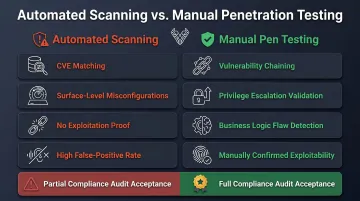
For compliance purposes, this distinction matters because SOC 2 auditors and ISO 27001 certification bodies look for evidence of realistic, risk-based testing — not just scan outputs. A report listing CVEs without exploitation proof is a common audit red flag.
Key metrics affected: number of critical business-logic vulnerabilities identified, mean time to detect real attack paths, audit acceptance rate of the pen test report.
When it matters most: SaaS platforms with complex APIs and authentication flows, organizations that relied solely on automated scanning in prior audit cycles, and multi-cloud environments where attack surface visibility is inherently limited.
Advantage 3: It Generates the Audit Evidence Your Auditors and Buyers Actually Need
A quality pen test produces a structured report that functions as a formal artifact in two separate compliance workflows at once.
Vynox Security's compliance-ready reports are designed to serve both frameworks:
- For SOC 2: Evidence of operating effectiveness under CC4.1, with findings, risk ratings, management responses, and remediation tracking that auditors expect to see across the review period
- For ISO 27001: Inputs to the risk register and Statement of Applicability (SoA), findings mapped to Annex A controls, and corrective action documentation that satisfies Clause 9.1 and management review requirements
Notessa Inc.'s CTO noted that Vynox's reports "not only strengthened our systems but also helped us align with SOC 2 compliance requirements" — a direct example of pen test output crossing over from security improvement into compliance readiness.
The sales dimension is equally real. Enterprise buyers in financial services, healthcare, and government routinely request current pen test reports alongside SOC 2 Type II reports and ISO 27001 certificates during vendor security reviews. A well-documented pen test program mapped to both frameworks cuts security questionnaire back-and-forth and speeds enterprise deal cycles.
One properly scoped engagement can satisfy both frameworks simultaneously — eliminating the cost and inconsistency of running separate tests for each audit cycle.
KPIs this affects: time to audit completion, volume of auditor evidence requests fulfilled, deal closure rate in enterprise sales, cost of compliance.
Most applicable when: organizations pursuing both certifications at the same time, startups closing their first enterprise contracts, and mature organizations managing annual surveillance audits where evidence continuity is scrutinized.
What Happens When Pen Testing Is Skipped or Inadequate
The pattern auditors and security teams see repeatedly: organizations run low-quality, tool-only tests, or submit reports from 18 months ago, and walk into audit with weak evidence. The consequences are concrete.
Audit failures and nonconformities:
- SOC 2 auditors may qualify their opinion if CC4.1 evidence is insufficient or doesn't cover the review period
- ISO 27001 certification bodies issue major nonconformities when technical vulnerability management lacks documented risk treatment and corrective actions
Security incidents that could have been prevented:
The IBM 2025 Cost of a Data Breach Report puts the global average breach cost at $4.88 million. Organizations with extensive security automation saw roughly $1.9 million lower costs — consistent with faster detection and containment. Vulnerabilities that manual testing would have caught stay open in production until a real attacker finds them first.
Lost enterprise deals:
Prospects in regulated industries increasingly walk away from vendors who can't produce credible, recent pen test reports during security review. The compliance report becomes a liability rather than an asset.
How to Get the Most Value from Compliance Pen Testing
The difference between a checkbox pen test and one that delivers lasting compliance value comes down to how it's scoped, executed, and followed through.
Scope for both frameworks simultaneously. Aligning the pen test scope to both the SOC 2 system description and the ISO 27001 ISMS boundary in a single engagement cuts redundant work and produces consistent, audit-ready evidence for both frameworks at once.
Three operational practices that separate high-value tests from checkbox exercises:
- Use a qualified third-party tester whose credentials satisfy ISO 27001 Clause 7.2 competence requirements and who produces documentation auditors actually accept — not a tool-generated PDF that lacks the narrative evidence auditors require
- Trigger the correct downstream workflow for each framework: SOC 2 requires evidence packaging and management responses; ISO 27001 requires risk register updates, SoA alignment, and formal corrective actions
- Time the test 60–90 days before your audit window closes — this gives teams enough runway for remediation, retesting, and corrective action documentation before auditors begin review
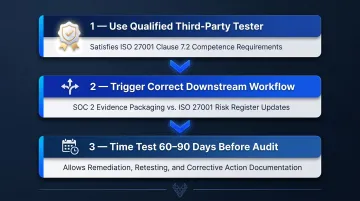
Those three practices are the foundation. What builds on top of them is consistency.
Treat pen testing as a program, not a point-in-time event. Annual testing satisfies most auditor expectations, but recurring tests across multiple cycles produce something more valuable: an auditable trail of improvement. Auditors and enterprise buyers aren't just evaluating your current security posture — they're looking for evidence that your organization identifies weaknesses and closes them systematically. That documented improvement cycle is what separates credible compliance from a certification sprint.
Conclusion
Penetration testing earns its place in SOC 2 and ISO 27001 compliance not because auditors require it, but because it answers a question no checklist can: do your controls actually hold when someone pushes against them? A well-executed test confirms that risks are identified and treated systematically, and that security is a working practice rather than a documentation exercise.
Organizations that treat pen testing as a continuous, manual-led program don't just move through audits faster. They build the kind of verified, evidence-backed security that enterprise buyers trust, regulators accept, and threat actors actually have to work against.
Frequently Asked Questions
Does SOC 2 require a penetration test?
SOC 2 doesn't explicitly mandate pen testing, but it is the primary evidence auditors accept for CC4.1 (monitoring and evaluating controls). Most enterprise buyers and auditors expect at least annual third-party pen tests to appear in a Type II report, and weak or absent evidence under CC4.1 can result in a qualified opinion.
Does ISO 27001 require penetration testing?
ISO 27001:2022 Annex A Control 8.8 explicitly addresses technical vulnerability management, and pen testing is the industry-standard mechanism for satisfying that control. Certification auditors expect evidence of systematic technical vulnerability identification, and a CVE scan without exploitation proof rarely clears that threshold.
What are the 5 stages of penetration testing?
The standard phases are reconnaissance, scanning and enumeration, exploitation, post-exploitation (lateral movement and privilege escalation), and reporting. For compliance purposes, the reporting and remediation phases carry as much weight as the technical testing, since those are the artifacts auditors actually review.
How often should you run a penetration test for SOC 2 or ISO 27001 compliance?
Annual testing is the minimum most auditors and enterprise buyers expect. Additional tests are recommended after significant infrastructure changes, new application launches, or cloud migrations. Some regulated sectors expect semi-annual testing, particularly for high-risk systems.
What is the difference between a penetration test and a vulnerability scan?
A vulnerability scan is an automated process that identifies known CVEs and misconfigurations passively. A penetration test involves qualified professionals actively exploiting vulnerabilities, chaining attack paths, and simulating real-world attacker behavior. Auditors treat them as distinct evidence types; scans do not substitute for pen tests.
How do ISO 27001, SOC 2, GDPR, and PCI DSS differ in their penetration testing expectations?
Each framework takes a different approach:
- SOC 2: Treats pen testing as evidence of control effectiveness (outcomes-based)
- ISO 27001: Treats it as a risk identification and treatment input (risk-based)
- PCI DSS: Explicitly mandates annual pen testing of the cardholder data environment
- GDPR: Doesn't prescribe pen testing directly, but requires regular testing of security measure effectiveness — pen testing is the standard way organizations demonstrate that obligation is met