ISO 27001:2022 doesn't prescribe a specific testing methodology, but it does require proportionate risk treatment and credible evidence that controls work. For organizations running complex networks, custom applications, or cloud infrastructure, a scan report rarely satisfies that bar.
This article breaks down exactly where penetration testing fits into the ISO 27001 framework, which Annex A controls it evidences most directly, and how to feed findings back into the ISMS improvement cycle.
TL;DR
- ISO 27001 doesn't universally mandate pen testing, but Annex A controls A.8.8 and A.8.29 are best satisfied through active exploitation testing — not automated scans
- Automated scanners cannot detect business logic flaws, chained attack paths, or broken access control that works on paper but fails in practice
- Pen test findings must tie to the risk register, risk treatment plan, and corrective action log to satisfy Clause 10.2
- Annual testing is the minimum baseline; high-risk environments (SaaS platforms, fintech, regulated data) warrant more frequent testing
- Retesting after remediation closes the Plan-Do-Check-Act loop ISO 27001 auditors expect to see
What ISO 27001 Actually Requires — and Where Pen Testing Fits
ISO 27001:2022 is a risk-based standard. Clauses 4–10 establish a framework for identifying, treating, and continuously improving responses to information security risks — but they don't hand you a checklist of specific technical tests to run.
Clause 6.1 requires organizations to plan actions to address identified risks and select appropriate controls, documented in a Statement of Applicability (SoA). Clause 9.1 then demands evidence those controls are actually working — measured, monitored, and documented. Neither clause names penetration testing explicitly, but both create a clear expectation: if technical vulnerability exploitation is a plausible risk, you need credible evidence you've tested for it.
The Misconception Worth Addressing
Penetration testing is not a mandatory ISO 27001 control. For a small organization with a simple, standardized IT environment and low-sensitivity data, a well-structured vulnerability management program with automated scanning may satisfy the intent of relevant controls.
For most organizations reading this — those with custom web applications, multi-cloud infrastructure, SaaS platforms, or regulated data — that standard doesn't hold. Auditors now expect more than a scan report when the risk profile warrants it.
How Pen Testing Slots Into the ISMS Framework
Pen testing isn't a standalone compliance activity. Its outputs feed directly into three core ISMS processes:
- Clause 8.2 (Risk Assessment) — findings reveal new or underestimated risks that may not have appeared in the initial risk register
- Clause 8.3 (Risk Treatment) — findings drive updates to the risk treatment plan, triggering new or modified controls
- Clause 9.1 (Performance Evaluation) — pen test results serve as objective evidence that technical controls are performing as intended
How often you test should follow directly from what those findings reveal about your risk exposure. Annual testing is the baseline. Organizations running SaaS platforms, handling payment card data, or processing regulated personal data should schedule more frequent cycles — and always trigger an out-of-cycle test after significant infrastructure changes or security incidents.
Mapping Pen Testing to ISO 27001:2022 Annex A Controls
The 2022 revision restructured Annex A from 114 controls across 14 domains down to 93 controls across 4 themes. If you're working from older documentation, the control numbering has changed — references to A.12.6 (vulnerability management) now map to A.8.8, for example.
Pen testing doesn't sit under a single Annex A control. Depending on test type and scope, findings serve as direct evidence across at least seven controls.
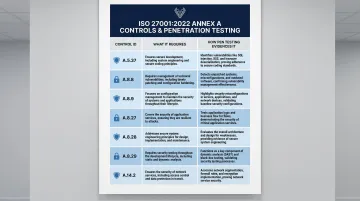
| Annex A Control | What It Requires | How Pen Testing Evidences It |
|---|---|---|
| A.8.8 — Technical Vulnerability Management | Identify, evaluate, and treat technical vulnerabilities in a timely manner | Findings validate whether vulnerabilities are genuinely exploitable, not just theoretically present |
| A.8.29 — Security Testing in Development | Structured security testing before systems enter production | Test plans, active exploitation results, and fix validation at dev/acceptance gates |
| A.8.25 — Secure Development Lifecycle | Security integrated throughout the SDLC | Application pen tests expose weaknesses in coding and design, validating that secure dev practices are working |
| A.8.16 — Monitoring Activities | Detect anomalous behavior and potential incidents | Detection gaps found during testing trigger tuning of monitoring use cases |
| A.5.35 — Independent Review of Information Security | Independent assessment of the ISMS | External pen testing satisfies the independence requirement and provides third-party evidence |
| A.5.23 — Cloud Services Security | Define and manage security requirements for cloud use | Cloud configuration reviews and cloud-hosted application tests demonstrate control effectiveness |
| A.6.3 — Security Awareness & Training | Ongoing security awareness | Social engineering and phishing simulations measure training effectiveness and inform content |
A.8.29: Security Testing as a Development Gate, Not an Audit Checkbox
For development-heavy organizations and SaaS providers, A.8.29 explicitly references penetration testing as a method to catch coding and design weaknesses before systems reach production. The control expects security testing to be embedded in acceptance gates — run continuously as part of your development process, not scheduled once ahead of an audit.
Automated Scans vs. Manual Pen Testing: Why the Distinction Matters
Automated vulnerability scanners run signature-based checks against known CVEs and common misconfigurations. They're fast, consistent, and useful for baselining. What they cannot do:
- Chain together multiple low-severity findings into an exploitable attack path
- Test whether an authentication flow that looks correct in code actually prevents unauthorized access in practice
- Identify business logic flaws that involve legitimate functionality used in unintended ways
- Validate whether a privilege escalation path exists in a specific environment's configuration
OWASP explicitly notes that business logic vulnerabilities are difficult to detect automatically because they involve how legitimate functions interact — not signatures that scanners recognize. NIST SP 800-115 draws a clear line between automated scanning and penetration testing that attempts exploitation to validate actual impact.
Where This Matters for ISO 27001
For a simple, standardized network, an automated scan may satisfy the basic intent of A.8.8. Once you introduce custom applications, complex internal network segments, or multi-cloud environments, automated tools will miss the vulnerability classes that lead to real breaches.
That gap is what Vynox Security was built to close. Their founders observed that critical business logic flaws, authorization gaps, and chained attack paths were routinely missed when clients relied solely on automated scanning.
Their approach combines AI-assisted reconnaissance with human expert validation for all exploitation and impact analysis. Findings reflect genuine risk, not theoretical weaknesses flagged by a scanner with no context.
Types of Pen Tests That Support ISO 27001 Compliance
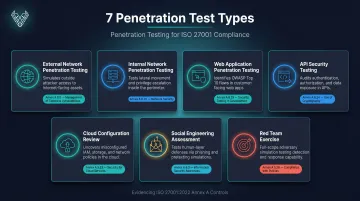
Matching test type to ISMS scope ensures findings are relevant to the controls you need to evidence.
- External network pen test — validates perimeter controls against internet-facing infrastructure; primary evidence for A.8.8 in externally exposed environments
- Internal network pen test — simulates a compromised endpoint or insider threat, testing lateral movement controls and privilege escalation paths
- Web application pen test — directly evidences A.8.29 and A.8.26 (Application Security Requirements); essential for SaaS providers
- API security testing — essential for API-first architectures where broken object-level authorization remains a leading vulnerability class
- Cloud configuration review — assesses IAM, network segmentation, storage exposure, and logging for AWS, Azure, or GCP environments; primary evidence for A.5.23
- Social engineering / phishing simulation — measures human control effectiveness and informs A.6.3 training content
- Red team / adversary simulation — best suited for organizations with documented incident response processes; tests detection and response capability holistically
Black, Gray, or White Box?
Once you've identified which test types apply, the next question is how much context to give your testers. For ISO 27001 contexts, gray box testing is the most efficient approach. Share authenticated credentials, network diagrams, and relevant application documentation upfront. This lets testers focus effort on areas within the ISMS scope rather than burning engagement time on reconnaissance that produces little compliance value.
The ISMS scope boundary should drive the pen test scope. Whatever systems and infrastructure fall within the ISMS boundary should be covered over a defined testing cycle.
Building Pen Test Findings Into the ISMS Continuous Improvement Cycle
Receiving a pen test report is not the end of the compliance process. For most organizations, it's the beginning of the part that actually matters to auditors.
Clause 10.2 requires that identified nonconformities be formally logged, root-caused, remediated, and closed with retained evidence. A pen test finding that sits in a PDF without triggering a formal corrective action is not a compliance activity — it's an audit gap.
The Linkage Auditors Look For
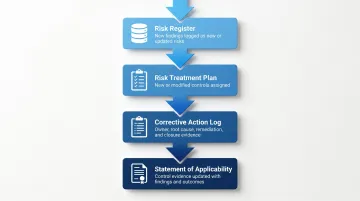
When an ISO 27001 auditor reviews your ISMS at Stage 2, they want to see that pen test findings connect to your broader ISMS documentation:
- Risk register — new findings logged as new risks, or used to update existing risk ratings
- Risk treatment plan — new or modified controls assigned in response to confirmed findings
- Corrective action log — each finding logged with owner, root cause, remediation action, and closure evidence
- SoA — control implementation evidence updated to reference the pen test findings and remediation outcomes
If you're working with Vynox Security, this linkage is built into the engagement. Findings map to specific Annex A controls, and reports are structured so your technical team and your auditor can both act on them — without translation work in between.
The Retest Requirement
Documentation closure is only half the loop. After remediation, a retest confirms vulnerabilities are genuinely resolved, not just patched on the surface.
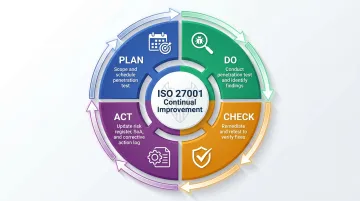
This test-find-fix-retest cycle is the practical implementation of the Plan-Do-Check-Act model at the heart of ISO 27001's continual improvement requirement. Skipping the retest leaves you with remediation claims and no verification evidence. Auditors will flag that — and rightly so.
Best Practices for ISO 27001-Aligned Penetration Testing
Scope Formally Before Testing Begins
Align the pen test scope with the ISMS boundary, document it in writing, and obtain explicit management authorization. This creates the documented evidence auditors expect and establishes clear rules of engagement.
Use External, Qualified Testers
Annex A 5.35 calls for independent review. Internal teams conducting their own pen tests create objectivity concerns — external testers bring the independence auditors look for, with findings mapped directly to Annex A controls rather than raw vulnerability lists.
Define Testing Cadence in the ISMS
Annual testing is the baseline. Trigger out-of-cycle tests after significant infrastructure changes, new application deployments, or security incidents. Document the rationale for your chosen frequency in the risk treatment plan — this is where auditors look to confirm risk-proportionate decisions.
Out-of-cycle triggers worth documenting include:
- Major cloud infrastructure changes or migrations
- New application or API deployments
- Post-incident reviews requiring scope re-evaluation
- Significant changes to the ISMS boundary
Treat Retesting as Mandatory, Not Optional
Remediation without verification is incomplete. Build retest cycles into the engagement plan from day one, and retain evidence of both the initial findings and the confirmed closure. Auditors want to see the full loop — not just that vulnerabilities were found, but that fixes held.
Frequently Asked Questions
Does ISO 27001 require penetration testing?
ISO 27001 does not explicitly mandate pen testing as a universal requirement. However, for organizations with complex environments, Annex A controls — particularly A.8.8 and A.8.29 — are most credibly evidenced through active exploitation testing rather than automated scanning alone. For most mid-size and enterprise organizations, the risk-based case for pen testing is effectively mandatory.
What is the ISO standard for penetration testing?
No single ISO standard covers penetration testing exclusively. ISO 27001, ISO 27002, and ISO 27005 collectively address security testing and risk management, while external methodologies — NIST SP 800-115, PTES, and the OWASP Testing Guide — are commonly used alongside them to structure engagements.
Is security testing part of system testing?
Under ISO 27001:2022 Annex A 8.29, security testing is a required component of the system development and acceptance testing process. It should be embedded in the development lifecycle, not treated as a separate one-off activity — particularly for organizations building or significantly modifying information systems.
What are the mandatory requirements of ISO 27001?
Clauses 4–10 define the mandatory requirements, covering ISMS scope, risk assessment and treatment, security objectives, internal audits, and continual improvement. Pen testing provides direct evidence for risk treatment (Clause 8.3) and performance evaluation (Clause 9.1).
Does ISO 27001 cover cloud security?
Yes. ISO 27001:2022 introduced Annex A 5.23 specifically to address cloud environments, covering requirements for cloud provider selection, control allocation, and incident management. Pen testing of cloud configurations and cloud-hosted applications is a practical way to demonstrate compliance with this control.
What is ISO 27001 requirement 6.1.3?
Clause 6.1.3 requires a Statement of Applicability (SoA) — a document listing which Annex A controls apply, why they were selected or excluded, and how they are implemented. Pen test results serve as direct implementation evidence for multiple controls, making them a key input to the SoA.