Introduction
If you're a SaaS company or startup trying to close enterprise deals, you've probably hit the ISO 27001 wall — a security questionnaire arrives, procurement stalls, and suddenly a certificate you don't have becomes the blocker.
The pressure is real. According to Secureframe's 2025 compliance research, 81% of organizations reported current or planned ISO 27001 certification in 2025, up from 67% the year before. That gap between "nice to have" and "deal requirement" closed fast — and enterprise buyers now treat certification as a baseline, not a bonus.
This guide gives you a phase-by-phase compliance checklist: what to prepare, how to execute each step, and how to gauge your readiness before an auditor walks in. Whether you're building your ISMS for the first time or closing control gaps ahead of a Stage 2 audit, you'll find a clear path forward here.
TL;DR
- ISO 27001:2022 includes 22 management requirements (Clauses 4–10) and 93 Annex A controls organized across four categories
- Compliance runs in three phases: Foundation → Risk and Controls → Audit Readiness
- Missing mandatory documents or skipping the internal audit are the most common certification blockers
- Documented policies don't equal working controls; auditors verify that both exist and function
- Surveillance audits happen annually; full recertification every three years
What You Need Before Starting ISO 27001 Compliance
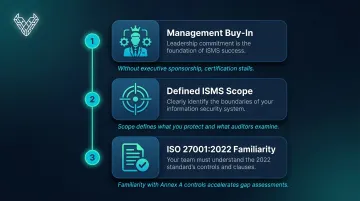
Three prerequisites must be in place before running any checklist.
- Management buy-in — ISO 27001 requires visible executive commitment, not passive approval. Someone at the leadership level must allocate budget, assign people, and sign off on the information security policy.
- A defined ISMS scope — The organization must decide which business units, systems, locations, and data types fall inside the ISMS boundary before any work begins. Scope drives everything downstream: what gets assessed, what gets controlled, what auditors examine.
- Familiarity with ISO 27001:2022 — The transition deadline passed on October 31, 2025. Every new certification now runs against the 2022 version, which reorganized 114 controls (across 14 domains) into 93 controls across four categories. Teams still referencing the 2013 structure will fail to map controls correctly against current audit criteria.
With those foundations confirmed, gather the practical resources the ISMS work will depend on.
Tools and Resources Required
- A purchased copy of the ISO 27001:2022 standard
- Documented risk assessment methodology
- Asset inventory template (information, software, hardware, human assets)
- Policy templates: information security policy, access control policy, incident response procedure, acceptable use policy
- A document management system or dedicated ISMS platform to track versions and evidence
ISMS Team and Role Assignments
At minimum, a functional ISMS team needs:
- ISMS Owner / CISO — reports to senior management, owns the program
- ISMS Administrator — handles documentation, evidence collection, day-to-day operations
- Technical Security Lead — owns control implementation across systems
- Internal Auditor — must be independent of ISMS development (this is non-negotiable)
Smaller organizations can combine the first three roles. The one separation that cannot be compromised: whoever builds the ISMS cannot audit it. During Stage 1 audit, the certification body will verify auditor independence before reviewing anything else.
The ISO 27001 Compliance Checklist: Phase by Phase
Complete each phase in sequence. Auditors verify both outputs and the documented procedures behind them — skip ahead and evidence gaps tend to surface at the worst possible moment.
Phase 1 — Foundation: Scope, Assets, and Team
Define ISMS scope formally. Document which departments, systems, locations, and data types are in-scope. Explicitly justify any exclusions in writing. A scope that covers one product line while the organization processes client data across all business units is a common probe point for Stage 1 auditors.
Build a classified asset inventory covering four asset types:
| Asset Type | Examples |
|---|---|
| Information assets | Databases, customer records, contracts |
| Software assets | SaaS tools, cloud services, applications |
| Hardware assets | Endpoints, servers, networking equipment |
| Human assets | Employees, contractors, third-party vendors |
Assign an owner and classification level (e.g., Confidential, Internal, Public) to every asset.
Conduct an initial gap assessment. Compare current security measures against ISO 27001:2022 controls to identify major deficiencies, prioritize remediation, and set a realistic certification timeline. Timelines vary by size: small organizations (under 20 people) typically certify in 3–6 months, while larger enterprises often take 8–20 months.
Phase 2 — Risk Management and Controls Implementation
Establish a risk management procedure. Identify threats and vulnerabilities across in-scope assets. Evaluate each risk by likelihood and impact. Produce a documented risk register — every control selection and treatment decision traces back to it. An incomplete risk assessment is the most frequently cited nonconformity in ISO 27001 certification audits.
Develop a risk treatment plan. For each risk above your acceptable threshold, assign one of four treatments: mitigate, transfer, accept, or avoid. Every treatment action needs an owner and a deadline. From an auditor's perspective, an unassigned action is an unresolved risk.
Complete the Statement of Applicability (SoA). Review all 93 Annex A controls. For each one:
- State whether it applies
- Describe how it's implemented
- Justify any exclusions with risk-based reasoning (not budget reasons)
The SoA is typically the first document an auditor opens. Vague justifications or controls marked "implemented" without evidence are immediate red flags.
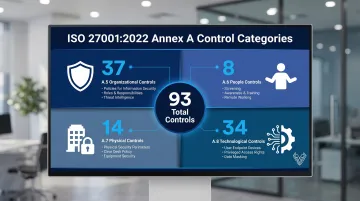
Implement technical controls and validate them. The four Annex A categories each require active implementation:
- A.5 Organizational Controls (37 controls) — policies, supplier relationships, incident management
- A.6 People Controls (8 controls) — screening, training, disciplinary process
- A.7 Physical Controls (14 controls) — access to facilities, equipment security, clear desk
- A.8 Technological Controls (34 controls) — access management, encryption, vulnerability management
For technical controls like A.8.8 (Technical Vulnerability Management) and A.8.29 (Security Testing in Development), documentation alone doesn't satisfy auditors — they need evidence that controls work under real conditions. Manual penetration testing is one of the most direct ways to generate that evidence.
Vynox Security's VAPT engagements map findings directly to ISO 27001 Annex A controls, producing reports that support both the SoA and the risk treatment plan. One SaaS client engaged Vynox for a full-scope VAPT before their external audit. Testing uncovered unpatched software, weak cloud configurations, and overly permissive access controls that weren't visible in policy documents. After remediation, the client passed with zero nonconformities, using the penetration test report as direct evidence during Stage 2 verification.
Create and distribute employee security guidelines covering:
- Acceptable use
- Access control expectations
- Phishing awareness
- Remote work security
- Incident reporting procedures
- Physical security (clear desk, screen lock)
Track acknowledgment. Evidence of distribution and completion is required.
Phase 3 — Audit Preparation
With controls implemented and documented, the focus shifts to audit readiness. Assemble mandatory documentation. Auditors request these at the start of Stage 1:
| Document | Clause |
|---|---|
| ISMS Scope Statement | 4.3 |
| Information Security Policy | 5.2 |
| Risk Assessment Process | 6.1.2 |
| Risk Treatment Plan | 6.1.3, 8.3 |
| Statement of Applicability | 6.1.3 |
| Internal Audit Program & Results | 9.2 |
| Management Review Results | 9.3 |
| Records of Nonconformities & Corrective Actions | 10.2 |
Conduct a formal management review. Present risk management outcomes, audit findings, policy effectiveness, and incident trends to senior leadership. Document decisions and improvement actions. At least one completed management review must be on record before certification — there are no workarounds for this requirement.
Perform the internal audit. The auditor must be independent of ISMS development. The audit should verify every applicable Annex A control is implemented and operating as documented. Log all nonconformities and close them before the external audit. Organizations that treat the internal audit as a formality routinely arrive at Stage 2 with unresolved findings — and those become certification blockers.
Engage an accredited certification body and complete:
- Stage 1 — Documentation review (typically 4–6 weeks before Stage 2)
- Stage 2 — On-site testing of live ISMS operations
Major nonconformities must be resolved within 90 days before certification can be granted. Minor nonconformities can be addressed through an accepted corrective action plan, often reviewed at the first surveillance audit.
How to Assess Your ISO 27001 Readiness Level
Readiness isn't binary. Most organizations fall into one of three states before the external audit — knowing which one you're in determines how much runway you need.
Audit-Ready
- All mandatory documents are complete and current
- SoA is finalized with evidence for every applicable control
- At least one internal audit and one management review are on record
- All identified nonconformities are closed
Next step: Schedule Stage 1 with your certification body.
Partially Ready — Minor Gaps
- Documentation exists but has incomplete sections (e.g., risk treatment plan lacks assigned owners, SoA justifications are vague)
- Some controls are implemented but not consistently evidenced
Next step: Allocate 4–8 weeks to close documentation gaps and collect evidence of operational control before booking the external audit.
Not Audit-Ready — Major Gaps
- No formal risk assessment has been performed
- No SoA drafted
- No internal audit conducted
Next step: Treat this as a Phase 1 restart. Prioritize scope definition and risk assessment. Implementation from this state typically takes 3–6+ months depending on organization size. An external consultant or vCISO engagement can accelerate the process significantly — Vynox Security's vCISO service, for instance, handles risk framework implementation, policy development, and compliance readiness support tailored to ISO 27001 requirements.
Common ISO 27001 Compliance Mistakes to Avoid
The most costly mistakes aren't technical — they're process and documentation failures that auditors identify quickly.
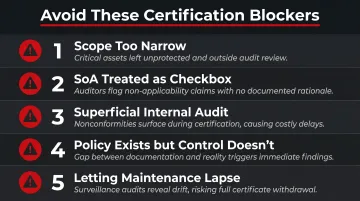
Scope too narrow — Covering one product while client data flows across all business units will be challenged. Auditors probe scope boundaries and look specifically for artificial narrowing.
SoA treated as a checkbox — Marking controls "implemented" without evidence, or excluding controls on cost grounds rather than technical irrelevance, are both flagged quickly. Auditors verify SoA claims against real-world evidence at Stage 2.
Superficial internal audit — Coverage gaps or a lack of auditor independence create a false sense of readiness. Unresolved findings from a weak internal audit become certification blockers at Stage 2.
Policy exists, control doesn't — An access control policy doesn't mean access controls are enforced. Auditors interview staff and inspect configurations; this gap between documentation and practice is consistently cited as the primary reason ISO 27001 audits fail.
Letting maintenance lapse — ISO 27001 runs on a three-year cycle with annual surveillance audits. Stale risk registers, skipped internal audits, or missed management reviews routinely cause surveillance failures within year one.
Best Practices for Staying ISO 27001 Compliant
Earning certification is only the beginning. Maintaining compliance means treating the ISMS as a living operational program — one that evolves alongside your infrastructure, vendors, and risk landscape.
Four practices separate organizations that sustain compliance from those that scramble before every audit:
- Update the risk register continuously — after new infrastructure is deployed, vendors are onboarded, products launch, or teams restructure. Risk reviews belong on the standing ISMS meeting agenda, not crammed into an annual sprint.
- Build a regular ISMS rhythm with monthly or quarterly reviews, automated reminders for document expiry, and structured management review cycles. Without this cadence, your ISMS quietly becomes a snapshot of the environment from 18 months ago.
- Tie security into change management so every new system, vendor integration, or product feature triggers an impact assessment against in-scope assets and controls. A cloud service onboarded without updating the risk register or SoA will surface as a gap at the next surveillance audit.
- Run penetration testing on a consistent schedule — at minimum annually, before surveillance audits, and after major system changes. Continuous vulnerability monitoring and monthly security reviews, like those offered through Vynox Security's Managed Security Services, create the ongoing evidence record auditors expect between formal cycles.
Conclusion
ISO 27001 compliance follows a clear sequence — and each phase depends on the one before it:
- Define your ISMS scope and boundaries
- Assess risk against your asset inventory
- Implement controls and collect evidence of operation
- Run internal audits before your external assessment
- Face the certification body with a documented, repeatable program
Shortcutting any phase doesn't save time — it creates audit risk that surfaces at the worst possible moment.
The organizations that consistently pass surveillance audits and build a genuine security posture are the ones treating the ISMS as a living program. Updated risk registers, documented evidence of control operation, and regular internal reviews aren't overhead — they're the difference between a certificate on the wall and a security program that holds up under scrutiny.
Frequently Asked Questions
What is ISO 27001 compliance?
ISO 27001 compliance means an organization has implemented an Information Security Management System (ISMS) that meets the standard's requirements — covering risk management, Annex A controls, and continuous improvement. Certification requires documented processes and verifiable evidence at every stage.
What is the ISO 27001 checklist?
The ISO 27001 checklist is a structured set of steps covering everything from scope definition and risk assessment through control implementation, internal audit, and external certification. Every step must be completed and evidenced — not just documented — to achieve and maintain certification.
How do you pass an ISO 27001 audit?
Three things matter most. First, all mandatory documents must be complete and accessible before Stage 1. Second, controls must be evidenced and consistently followed — not just written in policies — before Stage 2. Third, all internal audit nonconformities must be resolved before the external auditor arrives.
What are the 14 controls of ISO 27001?
The "14 control domains" refers to the ISO 27001:2013 version. The current ISO 27001:2022 standard reorganized these into 93 controls across four categories — Organizational (37), People (8), Physical (14), and Technological (34). The 2013 version is no longer valid for new certifications as of October 2025.
Does ISO 27001 include physical security?
Yes. Annex A Section 7 (Physical Controls) contains 14 controls covering physical perimeters, entry controls, securing offices and equipment, clear desk and clear screen policies, protection against environmental threats, and equipment maintenance and protection off-premises.
What are the 3 P's of ISO 27001?
The 3 P's of ISO 27001 are People, Processes, and Products/Technology — the three dimensions an ISMS must address. People covers human behavior and awareness training; Processes covers documented and enforced procedures; Products/Technology covers the technical and physical systems used to implement controls.