The frustrating part is that most ISO 27001 content focuses on frameworks, clauses, and abstract risk management theory. What SaaS founders and security leaders actually need to know is simpler: does certification move the needle on deals, reduce breach exposure, and cut compliance overhead? The answer to all three is yes — and the data behind each is concrete enough to build a business case around.
This article covers the specific, measurable advantages ISO 27001 delivers for SaaS companies, what it costs to skip it, and how to extract its full value once you have it.
TL;DR
- ISO 27001 is the international standard for building and maintaining an Information Security Management System (ISMS) — structured controls, not just policies
- Certification removes security objections that stall enterprise procurement, compressing sales cycles by weeks or months
- Structured risk controls reduce breach exposure; the technology sector averages $4.79M per breach according to IBM's 2025 report
- ~70% control overlap between ISO 27001 and SOC 2, and roughly 80% alignment with GDPR Article 32 — one framework, fewer separate audits to manage
- Without certification, SaaS companies typically face steeper cyber insurance premiums and lose enterprise deals before they even reach a sales conversation
What Is ISO 27001?
ISO/IEC 27001:2022 is the international standard that defines how organizations build, operate, and continuously improve an Information Security Management System (ISMS). For SaaS companies, it's the most widely recognized framework for proving that security is structured and repeatable — not improvised. The current edition (published October 2022) contains 93 Annex A controls across four categories:
| Category | Reference | Controls |
|---|---|---|
| Organizational controls | A.5 | 37 |
| People controls | A.6 | 8 |
| Physical controls | A.7 | 14 |
| Technological controls | A.8 | 34 |
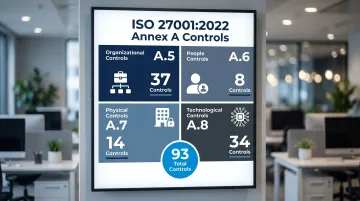
For SaaS companies, the A.5 organizational and A.8 technological controls are where most of the practical work happens — access management, cloud configuration, vulnerability handling, and secure development practices.
Certification is issued by an accredited third-party body after a formal two-stage audit. Accreditation bodies in the US (ANAB), UK (UKAS), and other countries are signatories to the IAF Multilateral Recognition Arrangement, which means an ISO 27001 certificate issued in one country is recognized as equivalent globally. That portability is one reason it carries more weight than SOC 2 for companies selling internationally.
Unlike a point-in-time audit, ISO 27001 requires ongoing risk reviews, control testing, and incident tracking. That continuous cycle is what gives the certification its durability — and what makes it genuinely useful beyond the certificate itself.
Key Advantages of ISO 27001 Certification for SaaS Companies
The advantages below connect directly to business metrics SaaS companies track: deal velocity, retention, breach costs, and compliance overhead. None of them are theoretical.
Advantage 1: Winning Enterprise Deals and Shortening Sales Cycles
Security reviews have become a standard — and increasingly painful — part of enterprise procurement. According to a TrustMind survey of 142 security leaders, SaaS vendors now receive a median of 24 security questionnaires per quarter, up from 8 in 2022. Each takes approximately 9.4 hours of staff time. Security is on the critical path for 38% of deals, and 11% of enterprise deals are lost or pushed into future quarters specifically because of slow questionnaire turnaround.
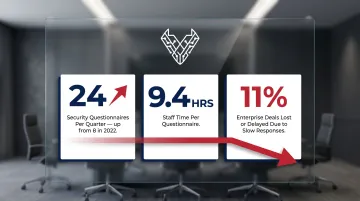
ISO 27001 certification cuts through this. When a buyer's procurement team sees an accredited certificate, the 40-page security questionnaire often gets replaced by a short review of the certificate and scope documentation. What previously consumed weeks of back-and-forth becomes a single verification step.
The revenue math is straightforward:
- Shorter security reviews → faster contract signing → faster MRR conversion
- Fewer hours per deal spent on security responses → lower cost of sale
- Certified vendors clear the procurement gate that disqualifies uncertified competitors
Security delays cause average procurement slowdowns of 2 to 4 months in enterprise deals. For a SaaS company with a 90-day average sales cycle, eliminating two months of security review friction is a material change in annual revenue throughput.
This advantage is highest-impact for:
- SaaS companies selling into financial services, healthcare, or government
- Vendors targeting mid-market and enterprise buyers with formalized vendor risk programs
- Companies where security questionnaires currently sit on the critical path of multiple active deals
Advantage 2: Reducing Security Risk and the Cost of Breaches
ISO 27001 forces a structured approach to risk — not reacting after an incident, but identifying and treating high-probability risks before they become costly ones.
The ISMS framework mandates operational controls across access management, incident response, change management, and vulnerability handling. For SaaS companies running cloud infrastructure, those controls directly address the attack vectors responsible for most breaches.
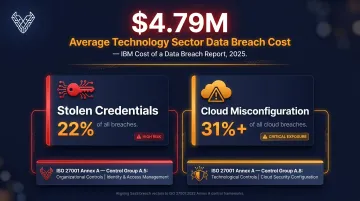
According to IBM's 2025 Cost of a Data Breach Report, the technology sector averages $4.79M per breach. Public cloud breaches average $4.68M. The two most common contributing vectors:
- Stolen credentials: Used in 22% of all breaches (Verizon DBIR 2025)
- Cloud misconfiguration: Responsible for more than 31% of cloud breaches, per multiple 2024 cloud security research reports
ISO 27001's Annex A controls address both directly — A.5 organizational controls govern access management and identity policies; A.8 technological controls cover configuration management and secure development practices.
Beyond direct breach costs, uncertified SaaS companies also face GDPR fines, customer churn, and reputational damage that affects fundraising. ISO 27001 certification can also reduce cyber insurance premiums by 15–25%, which strengthens the overall financial case for certification across the business.
One area worth flagging: ISO 27001 Annex A Control A.8.29 requires security testing as part of the development and acceptance lifecycle — meaning controls need to be validated, not just documented. This is where penetration testing does the work that self-attestation cannot. Vynox Security's threat-led VAPT service is designed to validate Annex A controls and map findings directly to the risk register and Statement of Applicability. Documentation showing controls hold up against realistic attack scenarios carries significantly more weight during certification audits than a completed checklist.
This advantage is most critical for:
- Multi-tenant SaaS platforms where a single misconfiguration can expose multiple customers
- Companies handling PII, financial records, or health data
- Cloud-native architectures running on AWS, Azure, or GCP
Advantage 3: Streamlining Compliance Across Multiple Regulatory Requirements
SaaS companies selling globally face an expanding compliance stack: GDPR for European data subjects, SOC 2 for US enterprise buyers, HIPAA for healthcare, and various regional frameworks depending on geography. Managing each independently creates duplicated effort, fragmented documentation, and compliance teams perpetually fighting the last audit.
ISO 27001 changes the economics of compliance by serving as the common foundation.
The overlap is substantial:
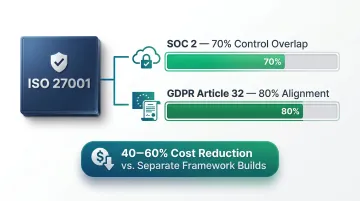
- Approximately 70% control-level overlap between ISO 27001 Annex A and SOC 2 Trust Service Criteria
- ISO 27001 covers approximately 80% of GDPR Article 32 requirements for technical and organizational measures
- The AICPA publishes an official mapping document connecting ISO 27001 requirements directly to SOC 2 Trust Services Criteria
Organizations using an integrated compliance approach built around ISO 27001 typically achieve 40–60% cost savings compared to pursuing each framework as a separate ground-up project. Evidence collected for ISO 27001 surveillance audits — risk registers, access control logs, incident records, penetration testing reports — directly satisfies auditor requests under SOC 2 and GDPR data processing agreement reviews.
In practice, this means:
- A SaaS company certified under ISO 27001 responding to a GDPR data processing inquiry can point to existing Annex A documentation rather than building a parallel response
- SOC 2 Type II readiness becomes an incremental step, not a new project
- Additional regulatory requirements from new market entry are absorbed by the existing ISMS rather than triggering another ground-up compliance build
Each new geography or vertical adds regulatory requirements. With an active ISO 27001 ISMS already in place, those requirements become incremental additions — not separate projects starting from scratch.
What Happens When ISO 27001 Is Overlooked
The cost of not having ISO 27001 is rarely visible as a single line item. It shows up in deal losses, delayed contracts, and higher operating costs, often misattributed to other causes.
The practical consequences:
- Procurement disqualification: SaaS startups regularly lose Fortune 500 evaluations on missing certifications and incomplete audit trails, not product quality. Research shows 11% of enterprise deals slip or are lost specifically due to slow security questionnaire responses.
- Extended reviews: Without certification, security reviews take 2–4 months on average; some stall for 6 months.
- Higher insurance costs: Uncertified companies pay 15–25% more on cyber insurance premiums than certified peers.
- Investor scrutiny: ISO 27001 is increasingly a standard ask during Series A due diligence, where it signals that security infrastructure is mature and scalable, not something to retrofit post-funding.
Without a structured ISMS, security becomes reactive. Incidents are handled ad hoc, controls are inconsistently applied, and when a regulatory investigation or enterprise audit arrives, there's no documented evidence to present. That gap turns a manageable situation into a serious one.
Scale makes this worse. A SaaS company that was low-risk at 10 employees operates a fundamentally different risk profile at 100 employees and three cloud regions. Without ISO 27001's ongoing risk management discipline, that expanding surface accumulates untracked exposure quietly — until it doesn't.
How to Get the Most Value from ISO 27001 Certification
Certification is the beginning, not the finish line. The companies that compound ISO 27001's benefits treat it as an active operating practice, not a periodic audit obligation.
What ongoing operation looks like in practice:
- Risk registers updated when infrastructure changes, not just before surveillance audits
- Controls reviewed against new threat intelligence, not just against the original risk assessment
- Surveillance audits used as genuine improvement checkpoints — submit findings, remediation evidence, and updated SoA documentation rather than repackaging last year's work
- Cross-functional ownership of controls across engineering, operations, HR, and sales (not just an IT project)
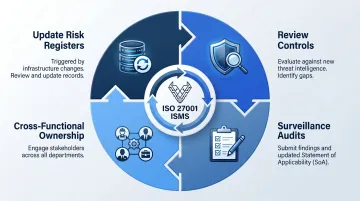
The team alignment piece matters more than most companies expect. Security awareness training, documented procedures, and clear ownership of controls across departments are what make an ISMS durable as the company scales and headcount turns over.
That operational foundation also shapes how well you perform when auditors arrive. Before a certification audit, validating technical controls matters as much as documentation. Policies on paper are necessary but not sufficient — auditors look for evidence that controls actually function under realistic conditions.
Penetration testing aligned to ISO 27001 Annex A controls is the most direct way to close that gap. Findings should map to the risk register and Statement of Applicability, with audit-ready reports that auditors can reference directly. Vynox Security delivers this kind of compliance-mapped testing — covering cloud infrastructure (AWS, Azure, GCP), application layers, and API surfaces — within 48 hours of engagement completion.
Scope matters, too. Multi-tenant SaaS architectures carry outsized risk: a single misconfiguration can create cross-customer exposure. All customer-facing layers should be in scope, not just internal systems.
The recommended cadence: annually at minimum, after major infrastructure changes, and before certification or surveillance audits.
Conclusion
ISO 27001 certification delivers three compounding advantages for SaaS companies: faster enterprise revenue through removed procurement friction, reduced financial exposure from structured breach prevention, and a compliance foundation that absorbs new regulatory requirements as the company scales.
Each advantage builds on the others. The ISMS that accelerates your first enterprise deal also produces the risk register evidence that satisfies your GDPR DPA, which overlaps with the controls your SOC 2 auditor will review. An actively maintained ISMS compounds in value — each audit cycle adds evidence, each control update closes a real gap, and the framework grows with the business rather than aging out of relevance.
The SaaS companies that get the most from ISO 27001 treat it as an operational system, not a one-time project. They update controls when their stack changes, validate them through realistic testing, and use audit cycles to surface gaps before customers or regulators do. Done consistently, the certification stops being a compliance checkbox and starts functioning as verifiable proof that security keeps pace with growth.
Frequently Asked Questions
What are the benefits of ISO 27001 certification for SaaS companies?
ISO 27001 removes security objections that block enterprise procurement, compressing deal cycles by weeks or months. It also reduces breach risk through structured controls, and creates a compliance foundation that simultaneously addresses GDPR, SOC 2, and other regulatory requirements — without rebuilding independently for each framework.
Is it worth it for a SaaS company to get ISO 27001 certified?
For companies targeting mid-market and enterprise buyers, it has become a procurement prerequisite, not a differentiator. The ROI case is concrete: faster deal cycles, 15–25% lower cyber insurance premiums, and reduced exposure to breach costs that average $4.79M in the technology sector.
How much does ISO 27001 certification cost?
Total first-year costs typically range from $25,000 to $42,000, covering gap assessment, implementation, and the initial two-stage audit. Over a three-year certification cycle — including annual surveillance audits around $5,000 each — total investment runs $35,000 to $75,000+ depending on company size, scope, and consultant use.
What are the 4 categories of ISO 27001?
ISO 27001:2022 Annex A organizes its 93 controls into four categories: Organizational (A.5), People (A.6), Physical (A.7), and Technological (A.8). Cloud-native SaaS companies focus most heavily on A.5 and A.8, which cover access management, configuration, and secure development practices.
Is SOC 2 only for SaaS companies?
No. SOC 2 applies to any service organization handling customer data, though US enterprise buyers request it most frequently. ISO 27001 carries broader geographic portability through IAF mutual recognition. The two standards share roughly 70% control overlap, making it practical to pursue both from a shared evidence base.
Which companies need ISO 27001?
ISO 27001 isn't legally mandated in most jurisdictions, but it's effectively required for SaaS vendors selling to enterprise buyers, regulated industries (finance, healthcare, government), or any organization whose customers operate under frameworks that mandate documented security management. For companies at Series A and beyond, it also appears routinely in investor due diligence.