The reality is simpler. Compliance frameworks like SOC 2, ISO 27001, and GDPR are fundamentally audits of whether an organization manages risk responsibly. A well-structured, consistently operated risk management program already generates the controls, documentation, and evidence auditors require. The audit becomes evidence retrieval, not evidence creation.
This post covers the core risk management process, how it maps to major frameworks, what good programs look like in practice, and where most organizations go wrong.
TL;DR
- Risk management and compliance share the same foundation — one well-run program satisfies both
- Four core steps drive the entire process: identify, assess, treat, and monitor
- SOC 2, ISO 27001, and GDPR all mandate formal, documented risk assessment — not optional
- Audit readiness follows from consistent risk practices — no separate workstream required
- Manual validation catches what automated tools miss — misconfigurations, logic flaws, and attack chains that scanners skip
What Is Cybersecurity Risk Management?
Cybersecurity risk management is the ongoing process of identifying, assessing, treating, and monitoring risks to an organization's systems, data, and operations. The goal is to reduce the likelihood and impact of security incidents while keeping the business running and meeting its regulatory obligations.
The critical word is ongoing. NIST CSF 2.0 explicitly states that "cybersecurity risks are expanding constantly, and managing those risks must be a continuous process." Where an organization falls on that spectrum matters: NIST Tier 1 handles risk reactively — ad hoc, case-by-case, largely undocumented. Tier 3 and above treat it as formal policy: regularly updated, consistently applied, and organization-wide.
That distinction — continuous program versus periodic exercise — is exactly what separates organizations that move through compliance audits smoothly from those that spend weeks scrambling before each one.
The Cybersecurity Risk Management Process
Most recognized frameworks align around four core steps. Skipping or shortcutting any one of them creates the gaps that both auditors and attackers exploit.
Step 1: Risk Identification
Start by cataloging everything: hardware, software, data, cloud services, third-party integrations, and people. Then map the threats and vulnerabilities associated with each asset.
Asset visibility gaps are one of the most common reasons compliance efforts stall. Trend Micro's 2025 global study of over 2,000 cybersecurity leaders found that 74% experienced security incidents caused by unknown or unmanaged assets. You cannot protect or document what you have not mapped.
Step 2: Risk Assessment
Risk assessment evaluates identified risks by likelihood and potential business impact, producing a prioritized risk register. It's also where most programs stall, because the automation gap hits hardest here.
Automated scanning tools surface CVEs but miss business logic flaws, chained attack paths, and context-specific vulnerabilities. DAST tools carry an 82% false positive rate per the OWASP Benchmark, meaning the majority of automated findings require manual triage before they're worth acting on.
That gap is why manual validation matters: auditors and risk registers need evidence of real exploitability, not just a list of scanner output.
Step 3: Risk Treatment
Four options exist for each identified risk:
- Mitigate — implement controls to reduce likelihood or impact
- Transfer — shift risk through insurance or contractual terms
- Avoid — discontinue the activity that creates the risk
- Accept — document the risk and tolerate it within defined risk tolerance
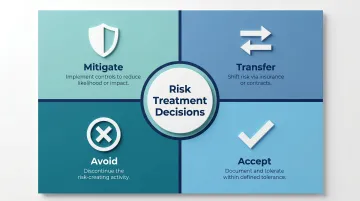
Documenting the rationale for each treatment decision is as important as the decision itself. That documentation becomes audit evidence. Many organizations fail audits not because controls are missing, but because they cannot explain why certain risks were accepted or what compensating controls are in place.
Step 4: Continuous Monitoring and Review
The threat landscape, IT environment, vendor relationships, and regulatory requirements all change. Risk management cannot be a point-in-time exercise. Monitoring means tracking control effectiveness, watching for regulatory changes, and reassessing risks as the environment evolves.
Frameworks like SOC 2 Type II are designed to evaluate precisely this loop — not a snapshot, but evidence of sustained operation over time.
Compliance Frameworks That Require Risk-Based Thinking
The major frameworks are not arbitrary checklists. They are structured expressions of risk management logic. Understanding what each one actually requires makes it clear why a well-run risk program satisfies all of them.
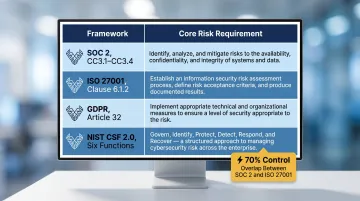
| Framework | Core Risk Requirement |
|---|---|
| SOC 2 | CC3.1–CC3.4 require documented risk identification, analysis, and response planning |
| ISO 27001 | Clause 6.1.2 mandates a formal, repeatable process with risk owners and prioritized treatment |
| GDPR | Article 32 requires measures "appropriate to the risk" — making risk assessment legally mandatory |
| NIST CSF 2.0 | Six functions (Govern, Identify, Protect, Detect, Respond, Recover) map directly onto risk management |
Key context worth knowing:
- SOC 2 risk assessment documentation is the #1 audit exception auditors flag
- ISO 27001's Clause 6.1.2 requires documented likelihood/consequence analysis — not just a list of risks
- NIST CSF 2.0 is increasingly cited in vendor contracts and security questionnaires
The cross-framework overlap is where the real efficiency lives. Approximately 70% of SOC 2 and ISO 27001 controls overlap, and implementing ISO 27001 can satisfy 60–80% of the requirements for both SOC 2 and GDPR. Organizations that build their risk program around a recognized framework like NIST CSF satisfy multiple compliance obligations from a single set of documented controls — dramatically cutting audit preparation time.
How Structured Risk Management Simplifies Compliance
When risk management runs consistently and is documented thoroughly, compliance shifts from a sprint to a steady state.
The Risk Register as a Compliance Artifact
A well-maintained risk register demonstrates to SOC 2 and ISO 27001 auditors that the organization continuously identifies, evaluates, and responds to risks. This satisfies some of the most substantive requirements in both frameworks — not through a separate compliance exercise, but as a natural output of ongoing operations.
Documented Treatment Decisions as Audit Evidence
Auditors routinely ask about residual risk and due diligence. Documented risk treatment decisions — particularly accepted risks with written rationale — answer those questions directly. Organizations that cannot explain why a risk was accepted or what compensating controls exist often fail audits despite having adequate technical controls in place.
Third-Party Validated Testing as High-Credibility Evidence
Continuous monitoring outputs — control test results, vulnerability scans, penetration test findings — function as ongoing compliance evidence. Third-party security assessments carry particular weight with auditors because they are externally validated rather than self-attested.
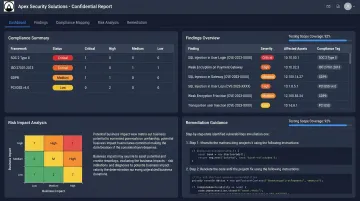
Vynox Security's penetration test reports are structured specifically for this purpose, with each report including:
- Findings mapped to SOC 2, ISO 27001, GDPR, and PCI DSS controls
- Proof-of-concept documentation and risk impact analysis
- Remediation guidance delivered within 48 hours
One SaaS client preparing for ISO 27001 certification engaged Vynox for a full-scope VAPT, discovered unpatched software and overly permissive cloud access controls, remediated both before the audit, and passed with zero non-conformities.
Vendor Risk as a Built-In Requirement
SOC 2 and ISO 27001 both require organizations to assess the security posture of vendors with access to sensitive data. Building third-party risk reviews into the standard risk management cycle means this compliance requirement is met as part of normal operations, rather than a reactive exercise before each audit.
Best Practices to Build an Audit-Ready Risk Program
1. Establish Governance First
Define who owns risk management across the organization — not just the security team. Compliance, legal, and executive leadership all have roles. Set risk tolerance in writing and document it in a formal risk management policy. Without this foundation, risk decisions are ad hoc and undocumentable, which is exactly what auditors flag.
2. Adopt a Recognized Framework
Build your control set around NIST CSF, ISO 27001, or SOC 2's Trust Services Criteria rather than creating a custom program from scratch. This ensures your program produces outputs that auditors recognize and reduces the incremental work required as you add certifications or respond to customer security questionnaires.
3. Assess on a Defined Schedule
Conduct formal risk assessments at least annually, supplemented by event-triggered reassessments when significant changes occur:
- New vendors or third-party integrations
- New product features or cloud migrations
- Regulatory changes affecting your industry
- Security incidents or near-misses
ISO 27001 Clause 8.2 requires reassessment "when significant changes are proposed or occur." SOC 2 expects annual formal assessments with evidence of ongoing monitoring. Define your frequency in writing — it becomes part of your audit evidence.
4. Validate Controls with Independent, Manual Testing
Automated vulnerability scans provide breadth but miss attack chains, business logic flaws, and privilege escalation paths that require human judgment. Manual penetration testing produces validated, documented findings that demonstrate control effectiveness to auditors and give remediation teams clear, actionable priorities.
Vynox Security's manual-first penetration testing covers web applications, APIs, cloud infrastructure (AWS, Azure, GCP), mobile applications, and network environments, with reports structured to serve both technical teams and auditors.
5. Document Everything with Audit Evidence in Mind
Risk registers, assessment reports, treatment decisions, control test results, and remediation records should be stored in a format you can pull up instantly during an audit. A functional security program becomes a compliant one through the discipline of documentation.
Common Risk Management Mistakes That Complicate Compliance
Treating Risk Management as a Pre-Audit Activity
Organizations that conduct risk assessments only in the weeks before a SOC 2 or ISO 27001 audit generate point-in-time snapshots that satisfy neither auditors nor their actual security posture. This approach forces repeated remediation crunches and undermines the credibility of compliance claims.
Auditors evaluating SOC 2 Type II are specifically assessing whether controls operated consistently over the entire review period — a last-minute assessment cannot demonstrate that.
Over-Relying on Automated Scanning Tools
Automated tools produce long lists of vulnerabilities without business context. The Verizon 2025 Data Breach Investigations Report found that vulnerability exploitation accounts for 20% of initial access vectors — up 34% year-over-year — and only 54% of exploited vulnerabilities were fully remediated, with a median remediation time of 32 days.
That gap between identified and remediated vulnerabilities comes down to prioritization — tool output without human triage leaves teams drowning in alerts rather than fixing what matters. Vulnerabilities that require application context simply don't surface in automated reports: business logic flaws, BOLA vulnerabilities, and chained attack paths all depend on understanding intended behavior, something automated tools cannot evaluate.
Siloing Risk Management Within IT or Security
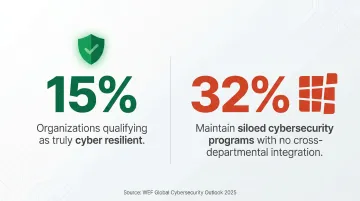
The WEF Global Cybersecurity Outlook 2025 puts the scale of this problem in stark terms:
- Only 15% of organizations qualify as truly cyber resilient
- 32% maintain siloed cybersecurity programs with no cross-departmental integration
ISO 27001 and SOC 2 explicitly evaluate organizational governance, not just technical controls. When legal, HR, operations, and executive leadership are excluded from the risk conversation, entire categories of risk — contractual, regulatory, people-related — go unaddressed and surface as audit findings.
Frequently Asked Questions
What is cybersecurity risk management?
It is the continuous process of identifying, assessing, treating, and monitoring risks to an organization's information systems and data. The goal is to reduce the likelihood and impact of security incidents while meeting regulatory requirements. It is an ongoing operational discipline, not a periodic exercise.
What is the 80/20 rule in cybersecurity?
The 80/20 principle holds that roughly 20% of an organization's vulnerabilities account for 80% of its actual risk exposure. Effective risk management focuses remediation effort on this high-impact minority rather than trying to address every finding equally, which matters most when automated scans return hundreds of findings at once.
What are the 7 KPIs used for risk management?
The most commonly referenced KPIs are: mean time to detect (MTTD), mean time to remediate (MTTR), number of open critical risks, percentage of controls tested, third-party risk assessment completion rate, audit findings count, and risk register currency (age of last update).
What are the 5 P's of risk management?
One practitioner framework (attributed to Blackink IT) defines them as Plan, Protect, Prove, Promote, and Partner. It is a simplified mnemonic for a proactive, full-lifecycle approach to risk, useful for communicating program scope to business leadership. It is not an official NIST or ISO standard.
How does cybersecurity risk management simplify compliance?
Compliance frameworks like SOC 2, ISO 27001, and GDPR are audits of risk management quality. An organization with a well-documented, continuously operated risk program already generates the evidence, controls, and policies that auditors require. When audit time arrives, the evidence already exists — preparation is simply a matter of retrieval.
How often should a cybersecurity risk assessment be conducted?
Most frameworks require at least annual formal assessments, with additional reviews triggered by significant changes such as new vendors, cloud migrations, or new regulations. The frequency should be documented in a written risk management policy to show the schedule is intentional, not improvised.