Introduction
The average cost of a data breach in the US hit $10.22 million in 2025, according to IBM's Cost of a Data Breach Report. Globally, 2024 set a record high of $4.88 million — up roughly 10% year-over-year. Behind many of those breaches: unassessed risks that organizations didn't know existed.
Yet most security teams treat risk assessment as a compliance formality — something to finish before an audit and forget. The result: known attack surfaces go unaddressed, and the next breach traces back to a risk no one documented.
This guide covers what a cybersecurity risk assessment actually is, why it matters beyond checkbox compliance, the key components, a practical step-by-step process, and the major frameworks organizations use.
Whether you're running your first assessment or tightening an existing program, you'll leave with a clear process you can act on.
TL;DR
- A cybersecurity risk assessment identifies, scores, and prioritizes threats to your systems as a repeatable process, not a one-time audit
- Without one, security spending is reactive and misaligned with actual business risk
- The core process covers asset identification, threat and vulnerability analysis, likelihood/impact scoring, and risk treatment decisions
- Key frameworks include NIST CSF 2.0, NIST SP 800-30, ISO 27001/27005, and FAIR
- Automated scanning misses business logic flaws and chained attack paths, making manual expert testing essential for complete coverage
What Is a Cybersecurity Risk Assessment?
A cybersecurity risk assessment is a systematic process of identifying, evaluating, and prioritizing threats and vulnerabilities to an organization's information systems and digital assets. The goal is to understand your actual risk exposure — and make informed, defensible decisions about how to reduce it.
Before diving into how the process works, two misconceptions consistently get in the way.
Two Common Misconceptions
Misconception 1: It's a compliance checkbox. A risk assessment completed once to satisfy an audit cycle and then ignored provides a false sense of security. Threats evolve, technology stacks change, and the business grows — the assessment must evolve with them.
Misconception 2: It's interchangeable with a security audit. These terms get conflated often, but they serve fundamentally different purposes:
| Risk Assessment | Security Audit | |
|---|---|---|
| Direction | Forward-looking | Backward-looking |
| Focus | Identifying potential exposures | Evaluating whether controls were followed |
| Output | Risk register, treatment decisions | Compliance findings, policy gaps |
| Frequency | Ongoing, event-triggered | Scheduled, point-in-time |
Neither replaces the other — a mature security program requires both running in parallel.
Why Cybersecurity Risk Assessments Matter
Business and Financial Impact
Without a formal risk assessment, security investment tends to follow the loudest incident — reactive, misaligned, and expensive. The numbers support this directly.
Verizon's 2025 DBIR found vulnerability exploitation as an initial access vector in 20% of breaches, with ransomware present in 44%. Third-party involvement in breaches doubled from 15% to 30% year-over-year. These are the specific scenarios a risk assessment is designed to surface before they become incidents.
Vynox Security's advisory clients report 70% risk reduction following structured risk assessment and remediation programs. That outcome requires knowing what to fix and in what order — which is exactly what a risk assessment provides.
Compliance and Regulatory Requirements
Documented risk assessments aren't optional for most regulated industries. They're explicitly required:
- HIPAA: Mandates a formal risk analysis under 45 C.F.R. § 164.308(a)(1)(ii)(A)
- PCI DSS: Requirement 12.2 requires annual risk assessments and reassessment after significant changes
- GDPR: Article 35 requires a Data Protection Impact Assessment for high-risk processing; fines reach up to €20M or 4% of global annual turnover
- ISO 27001: Clause 6.1 requires risk assessment planning as part of the ISMS certification process
- SOC 2: The AICPA Common Criteria (CC3.2) include risk assessment as a required component
Regulators don't accept ad hoc reviews. They expect formal, repeatable, documented processes.
Shifting from Reactive to Strategic Security
A risk assessment changes how an organization makes security decisions. Instead of responding to whatever broke last week, security teams can:
- Prioritize remediation by business impact, not just technical severity
- Justify security budget with evidence rather than fear
- Accept certain risks deliberately, with documented leadership sign-off
- Build a security posture rather than just a security response
Organizations that go through this process stop guessing where their biggest exposures are. The next step is understanding how a risk assessment is actually structured — and what each phase produces.
Key Components of a Cybersecurity Risk Assessment
Asset Identification and Classification
Every assessment starts here. You cannot assess risk on assets you haven't catalogued.
A complete inventory includes: hardware, software, cloud workloads, SaaS integrations, APIs, data repositories, and third-party dependencies. Include data flows — knowing where sensitive information moves is as important as knowing where it lives.
Not all assets carry equal risk. Organizations should classify assets by:
- Sensitivity: Does this asset hold PII, financial data, or proprietary IP?
- Operational criticality: Would a compromise or outage halt core business functions?
Assets that score high on both dimensions get prioritized for deeper assessment and stronger controls — they're the ones where a breach causes the most damage.
Threat and Vulnerability Analysis
With your asset inventory in hand, the next step is understanding what could go wrong. Threats and vulnerabilities are not the same thing — both must be analyzed independently before risks can be derived from their intersection.
- Threats: External actors, ransomware groups, phishing campaigns, insider misuse
- Vulnerabilities: Misconfigurations, unpatched software, excessive permissions, weak access controls
Vulnerability discovery requires a layered approach:
- Automated scanning — surfaces known CVEs quickly and efficiently
- Configuration reviews — catches infrastructure and settings-level exposure
- Penetration testing — uncovers business logic flaws, chained attack paths, and context-specific weaknesses that automated tools consistently miss
- Security audits — evaluates control design and operational effectiveness
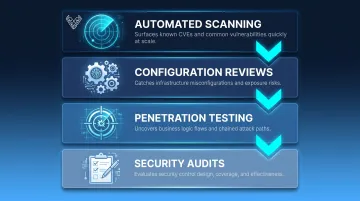
Automated tools are necessary but not sufficient. Business logic flaws — like broken authorization patterns where changing a single parameter grants access to another user's data — don't generate CVE entries and won't appear in any scan report.
Finding them requires human analysis: a tester who understands how the application is supposed to behave, and can probe the ways it doesn't. This is where manual-first testing, like the approach Vynox Security uses, catches what tool-only scans miss.
Likelihood and Impact Scoring
For each identified risk scenario, security teams estimate two variables:
| Variable | What It Measures |
|---|---|
| Likelihood | How probable is exploitation, given the threat actor's capability, the asset's exposure, and the vulnerability's exploitability? |
| Impact | What's the business consequence — financial loss, operational downtime, regulatory fines, or reputational damage? |
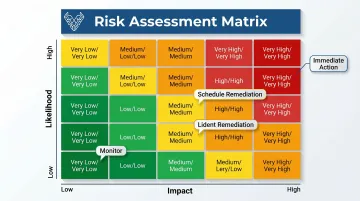
These two variables combine into a risk score, typically visualized in a risk matrix (low/medium/high or a numeric scale).
Two scores matter here:
- Inherent risk: The exposure level before any controls exist
- Residual risk: What remains after controls are applied
- The gap between them: This tells you whether your controls are actually reducing exposure — or just creating the appearance of it.
Risk Treatment Decisions
Once risks are scored and prioritized, four treatment options exist:
| Treatment | When to Use |
|---|---|
| Mitigate | Implement controls to reduce likelihood or impact |
| Transfer | Shift financial exposure via cyber insurance or contract terms |
| Accept | Document that leadership acknowledges and accepts a tolerable risk |
| Avoid | Eliminate the risky activity or asset entirely |
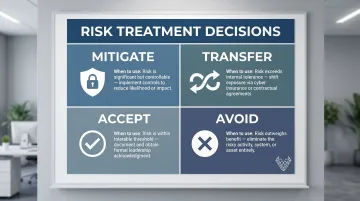
All treatment decisions belong in a risk register — a living document tracking each risk, its owner, its score, the chosen treatment, and remediation status. The register is the accountability mechanism that keeps assessment findings from collecting dust.
How to Perform a Cybersecurity Risk Assessment: Step by Step
Step 1 — Define Scope and Objectives
Set clear boundaries before anything else. Scope should be anchored to business function and criticality — not just your technical perimeter.
Decide whether this assessment covers the entire organization, a specific business unit, a product, a compliance domain, or a combination. Document what's explicitly excluded and why. Ambiguous scope leads to either unmanageable assessments or dangerous blind spots.
Assign governance upfront:
- Who owns the assessment?
- Who approves risk acceptance decisions?
- Which business unit leaders must be involved?
Without accountability, findings sit in a report unaddressed.
Step 2 — Build an Asset Inventory
Map all in-scope assets and include data flows so you understand how sensitive information moves, where it's stored, and where it's exposed. Don't limit this to your official CMDB — shadow IT routinely goes unregistered. Common blind spots include:
- Cloud resources and SaaS tools provisioned outside IT
- Third-party integrations with access to internal data
- Developer environments or staging systems with production credentials
- Undocumented APIs or legacy systems still in use
Step 3 — Identify Threats and Vulnerabilities
Apply threat intelligence to the specific environment. Use MITRE ATT&CK to map realistic attack paths for your industry and reference the National Vulnerability Database to identify and prioritize known weaknesses by CVSS score.
Prioritize threats actively exploited in your industry and geography — not just theoretically possible ones.
For vulnerability discovery, combine automated scanning with manual penetration testing. Automated tools catch known CVEs efficiently, but manual testing is what surfaces business logic flaws, privilege escalation paths, and chained attack scenarios — the weaknesses that actually get exploited in targeted attacks and that tool-only scans consistently miss.
Step 4 — Analyze and Score Risk
For each risk scenario:
- Assign a likelihood rating using your predefined scale
- Assign an impact rating using the same scale
- Plot results on a risk matrix
The matrix gives you a visual portfolio of your full risk landscape — which risks require immediate action, which can be scheduled, and which can be monitored.
Step 5 — Implement Controls and Prioritize Remediation
Translate findings into specific remediation tasks with assigned owners, timelines, and success metrics. Prioritize by business risk — a medium-severity vulnerability on a PII-handling system may outrank a high-severity CVE on a non-production server.
Security controls fall into three categories:
- Technical: MFA, encryption, patching, endpoint protection, network segmentation
- Administrative: Access policies, security awareness training, vendor contracts
- Physical: Facility access controls, device security
Each control should map back to a specific identified risk. Controls without a corresponding risk are overhead without purpose.
Step 6 — Document, Report, and Reassess
Capture everything in a risk register: identified risks, scores, treatment decisions, control owners, and remediation status. Tailor reporting to the audience:
- Executives: Business-impact summary, prioritized risk list, residual risk levels, and investment recommendations
- Security and engineering teams: Technical specifics, reproduction steps, remediation paths, and retesting results
Establish a reassessment cadence. Reassess at least annually, and trigger additional reviews for:
- New infrastructure deployments or cloud migrations
- Acquisitions or major organizational changes
- Significant regulatory changes
- Following a security incident
Risk assessments are snapshots. Your threat landscape, asset inventory, and business context all shift — and a risk register that isn't regularly updated becomes a false sense of security rather than a useful tool.
Cybersecurity Risk Assessment Frameworks
Frameworks provide standardized structure: what to assess, how to categorize risk, and how to document findings. Rather than building methodology from scratch, choose a framework aligned with your regulatory context, industry, and security maturity.
NIST CSF 2.0 and NIST SP 800-30
NIST released CSF 2.0 in February 2024, adding a sixth core function, Govern, to the original five: Identify, Protect, Detect, Respond, and Recover. The addition reflects a growing recognition that security governance must sit at the executive level, not just within the security team.
NIST SP 800-30 is the companion document specifically addressing the risk assessment process — defining methodology, outputs, and how findings inform risk response decisions. It's the primary US federal guidance for conducting formal risk assessments and is widely adopted outside the public sector as well. Both documents scale to organizations of any size, from early-stage startups to large enterprises.
ISO/IEC 27001 and ISO 27005
ISO 27001 is the international standard for establishing a formal Information Security Management System (ISMS). Documented risk assessments are required as a condition of certification under Clause 6.1. ISO 27005 provides the risk management methodology that feeds into the ISMS, covering how to identify, analyze, evaluate, and treat information security risks.
This pairing is the go-to choice for global organizations pursuing formal certification, building client trust through audit evidence, or operating under European regulatory requirements.
FAIR (Factor Analysis of Information Risk)
FAIR translates cybersecurity risk into financial terms — expressing exposure as expected monetary loss rather than abstract severity ratings like "high" or "critical." This makes it particularly useful for:
- Board-level risk reporting
- Cyber insurance negotiations (global premiums reached nearly $15 billion in 2024)
- Cost-benefit analysis of security investments
FAIR is best suited for mature programs with sufficient historical data to support quantitative modeling. FAIR is an Open Group standard used by organizations across the Fortune 1000.
Choosing the Right Framework
Most organizations benefit from a hybrid approach:
- Use NIST CSF or ISO 27001 for operational structure and compliance alignment
- Layer in FAIR for executive-level financial communication when needed
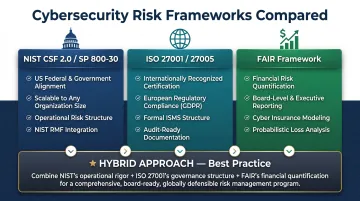
The right combination depends on your regulatory requirements, geographic jurisdiction, client expectations, and current security maturity. No framework automatically produces accurate findings — that still requires experienced human judgment applied to your specific environment.
Common Mistakes to Avoid
Treating It as a One-Time Exercise
A risk assessment completed once and shelved creates false confidence. Reassess after cloud migrations, product launches, M&A activity, and security incidents — not just on an annual calendar cycle.
Over-Relying on Automated Scanning Tools
Automated tools efficiently surface known CVEs and common misconfigurations. But they cannot identify business logic flaws, chained attack scenarios, or context-dependent vulnerabilities.
The Verizon 2025 DBIR found that only 54% of perimeter vulnerabilities were fully remediated, with a median patch time of 32 days — meaning the discovery gap is compounded by a remediation gap. Manual expert review is essential for complete coverage.
Scoping Too Broadly or Too Narrowly
A scope that covers "everything" produces diluted, unfocused findings. One that's too narrow misses critical attack surfaces — particularly third-party dependencies and newly onboarded cloud services. Effective scoping ties boundaries directly to business-critical functions and data sensitivity levels.
Frequently Asked Questions
What are the key components of a security risk assessment?
A complete assessment covers five components: asset identification and classification, threat analysis, vulnerability analysis, likelihood and impact scoring, and risk treatment decisions. All five must be addressed — skipping any one produces an incomplete picture of actual exposure.
What frameworks are used for cybersecurity risk assessment?
The most widely used frameworks are NIST CSF 2.0, NIST SP 800-30, ISO/IEC 27001/27005, and FAIR. The right choice depends on regulatory requirements, where your organization operates, and your security maturity level — many organizations combine more than one.
What is a high-level risk assessment?
A high-level risk assessment is a broad, less granular evaluation used to quickly identify the most significant risk areas across an organization. It's typically used as a starting point before conducting a deeper, more detailed assessment on high-risk assets or business functions.
What are the top five cybersecurity risks?
The most consistently identified risks across DBIR 2025 and ENISA's 2024 Threat Landscape are: ransomware and extortion, phishing and social engineering, credential theft and account compromise, cloud misconfigurations, and insider threats — both malicious and accidental.
What should a cybersecurity risk assessment summary include?
A summary should cover the following:
- Scope and methodology used
- Prioritized risk list with scores
- Current control effectiveness
- Remediation actions with owners and timelines
- Residual risk levels after planned controls are applied
How much does a cybersecurity risk assessment cost?
Costs depend on scope, organization size, and whether the work is done internally or by a third party. Either way, a structured assessment costs far less than the $10.22 million average cost of a US data breach. Contact Vynox Security at sales@vynoxsecurity.com for a scoped quote.