Introduction
Small businesses handling customer data face a sobering reality: 43% of all cyberattacks target small businesses, and the average breach costs organizations with fewer than 500 employees $3.31 million. For many, that figure is existential — 60% of small companies close within six months of a significant attack.
SOC 2 exists precisely because of this risk landscape. The stakes extend beyond breach prevention: enterprise procurement teams now routinely require SOC 2 reports before onboarding vendors, and small businesses without one lose deals before the conversation even starts.
The challenge is that SOC 2 preparedness assumes resources most small businesses don't have: dedicated security staff, mature documentation practices, and months of runway before an audit. This guide walks through how small teams can close that gap — without the overhead enterprises take for granted.
TL;DR
- SOC 2 has five Trust Service Criteria; Security is the only mandatory one
- Preparedness requires documented controls across HR, access, monitoring, and risk—technology alone won't pass the audit
- Always complete a readiness assessment before scheduling the formal audit
- Start with Type 1 before pursuing Type 2—this sequence cuts both time and cost for first-timers
- Most audit failures trace back to missing documentation, not missing controls
Why SOC 2 Compliance Matters for Small Businesses and Startups
SOC 2 is technically voluntary. No law requires it. But over 70% of enterprise buyers require SOC 2 reports from technology vendors before onboarding — which makes "voluntary" a misleading label for any B2B SaaS company, cloud service provider, or IT vendor targeting enterprise clients.
When SOC 2 Makes Business Sense
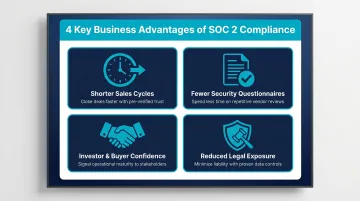
The business case is concrete:
- Shortens sales cycles — a SOC 2 report answers security due diligence questions before they're asked, replacing weeks of back-and-forth with a single document
- Eliminates repetitive security questionnaires — compliance vendors report reductions of 75–80% in questionnaire volume after obtaining SOC 2 certification
- Builds investor and buyer confidence — enterprise clients and VCs use SOC 2 as a concrete checkpoint: without it, deals stall or require costly third-party assessments
- Reduces legal exposure — documented controls create a defensible record if a security incident occurs
Among Series B and later SaaS companies, 65–80% hold SOC 2 reports. Even at the early-stage SaaS level, roughly 35–45% have completed the process. That gap narrows quickly once enterprise deals enter the pipeline.
When SOC 2 Is Premature
SOC 2 is likely the wrong investment right now if your situation fits any of these:
- Pre-revenue or early-stage — no enterprise deals in the pipeline means no immediate return on a months-long audit process
- No sensitive customer data yet — SOC 2 controls are built around protecting data; if you're not handling it, the framework doesn't apply meaningfully
- No internal processes to document — auditors assess what's already in place; a company that hasn't formalized access controls, logging, or incident response will spend the audit firefighting, not passing
At that stage, the practical move is formalizing those internal processes first — access policies, change management, logging. That work becomes the foundation of a SOC 2 audit when the timing is right.
What SOC 2 Auditors Actually Evaluate
The Five Trust Service Criteria
SOC 2 reports are structured around five Trust Service Criteria (TSCs):
| Criterion | What It Covers | Required? |
|---|---|---|
| Security | Protection against unauthorized access | Yes — mandatory |
| Availability | System uptime meets commitments | Optional |
| Processing Integrity | Data processing is complete and accurate | Optional |
| Confidentiality | Confidential data is protected as agreed | Optional |
| Privacy | Personal data collection and use follows policy | Optional |
Most small businesses start with Security only. Adding Availability or Confidentiality makes sense if your customers are contractually requiring it or if your service has specific uptime obligations. Adding all five criteria for a first audit is almost never the right call.
Type 1 vs. Type 2
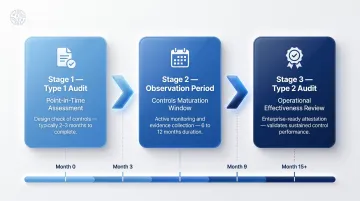
- Type 1 — point-in-time assessment of whether your controls are designed correctly. No observation period required. Can be completed in 2–3 months.
- Type 2 — assessment of whether controls operated effectively over a defined period, typically 6–12 months. Required for most enterprise procurement requirements.
The standard approach: get a Type 1 report first, then use the observation period to mature your controls — patching gaps in access management, logging, and incident response — before pursuing Type 2. That sequencing also makes auditor selection more straightforward, since you'll know what scope you're committing to.
Choosing the Right Auditor
Only AICPA-affiliated CPA firms can conduct a SOC 2 audit. When evaluating firms, ask:
- Have you audited companies our size and in our industry?
- Is a readiness assessment included in your Type 1 engagement, or is it billed separately?
- What does your evidence collection process look like — do you use a portal or manual requests?
- How many exceptions did your last five Type 1 clients receive? (A high number may signal either a tough firm or one that sets poor expectations upfront.)
- Do you use automation tools that would reduce the burden on our team?
Core Control Areas Every Small Business Must Address
SOC 2 preparedness is cross-functional. Controls span HR, engineering, IT, and management — and someone with actual authority needs to own the process internally.
HR and Personnel Controls
Auditors look for evidence that people-related risks are managed consistently:
- Formal onboarding and offboarding documentation with defined timelines
- Signed security policy acknowledgments for every employee and contractor
- Annual security awareness training with completion logs
- Background check processes for staff with access to production systems
The most common gap here isn't that companies skip these steps — it's that they do them informally and have no documentation to show the auditor.
Access Controls and Data Protection
Access control weaknesses account for roughly 40% of deviations found in SOC 2 reports, making this the highest-risk area for most small businesses. Auditors expect:
- Role-based access authorization documented before system access is granted
- Timely deprovisioning — access removed within a defined window after termination
- Periodic access reviews (typically quarterly or semi-annually)
- Privileged access monitoring with logs
- Encryption of data in transit and at rest
More than half of organizations identify periodic user access reviews as their greatest IAM challenge. Start here.
Monitoring, Vulnerability Management, and Incident Response
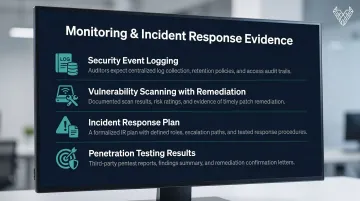
Auditors want to see that your organization actively monitors its environment — not just that monitoring tools exist. Required evidence typically includes:
- Security event logging with defined retention
- Regular vulnerability scanning with documented remediation timelines
- A formalized incident response plan (not just a draft, but one that's been reviewed and tested)
- Penetration testing results, particularly for Type 2 audits
On penetration testing: while the AICPA's criteria don't explicitly mandate it, most auditors treat it as expected evidence under CC4.1 (Monitoring Activities) and CC7.1–CC7.4 (System Operations). A 2024 academic study confirmed that manual penetration testing identifies vulnerabilities that automated scanners routinely miss, particularly business logic flaws and chained attack scenarios that automated output typically misses.
Pre-audit manual testing is where this matters most in practice. One SaaS client preparing for its first SOC 2 Type 2 audit discovered critical cloud IAM misconfigurations through Vynox Security's pre-audit testing, remediated them before the observation period began, and passed without material findings.
Documentation, Change Management, and Risk Management
The remaining areas auditors evaluate:
- Written information security policies — documented, version-controlled, and acknowledged by staff
- Change management — formal SDLC with documented approvals for all production changes, including code review records
- Segregation of duties — no single person should control an entire process end-to-end
- Annual risk assessment with a maintained risk register
- Vendor management — documented process for assessing third-party security posture, including written agreements
The SOC 2 Readiness Assessment
A readiness assessment is a structured pre-audit review, conducted internally or with an external advisor, that simulates the audit process before it officially begins. It produces no final SOC 2 report — only a clear picture of where your controls stand, so you can fix gaps before the auditor finds them.
What the Gap Analysis Covers
The core output is a gap analysis: mapping your current controls against the chosen TSCs and identifying what's missing, underdocumented, or inconsistently applied. Prioritize gaps in this order:
- Security criterion gaps first — it's mandatory, and gaps here are disqualifying
- Quick wins — controls that exist informally but just need documentation
- Larger remediation items — controls that need to be built from scratch
What Evidence Collection Looks Like
Auditors request specific documentation types. Common examples:
- Security policy documents (signed, dated, version-controlled)
- Backup logs and recovery test records
- Vendor agreements with security clauses
- Access review records with reviewer sign-off
- Training completion logs by employee
Centralize this evidence in one location before the audit begins — a shared drive, GRC tool, or even a well-organized folder structure. The format matters less than the accessibility.
Timeline Expectations
| Phase | Typical Duration |
|---|---|
| Readiness assessment | 4–8 weeks |
| Gap remediation | 1–6 months (depends on maturity) |
| Type 1 audit (if pursued) | 2–3 months total |
| Type 2 observation period | 6–12 months |
| Fieldwork and report delivery | 4–6 weeks after observation ends |
Plan for the full window. Small businesses that expect a three-month process and discover it takes nine are the ones most likely to rush remediation — and rushed remediation is what creates audit findings.
Common SOC 2 Audit Preparation Mistakes
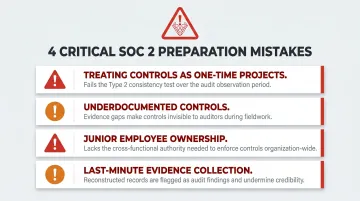
Most SOC 2 audit failures don't come from absent controls. They come from absent documentation. Per SOC 2 auditor Troy Fine of Schneider Downs, the most damaging preparation mistakes are consistent across organizations of all sizes:
- Controls treated as a one-time project fail during the Type 2 observation period. The audit tests whether controls operated consistently over time — not whether they existed the week before the auditor arrived.
- Underdocumented controls are effectively invisible. If an auditor can't test it, it doesn't exist. Many findings come from controls that were operating correctly but left no evidence trail.
- Assigning ownership to a junior employee creates a bottleneck. SOC 2 preparation requires cross-functional authority — someone in a support role cannot compel engineering, HR, and IT to change their processes simultaneously.
- Collecting evidence at the last minute is a red flag. Access logs, training records, and change approval records must exist in real time, not be reconstructed before the audit.
Scope Creep Is a Real Risk
These mistakes become even more costly when scope is poorly managed. Adding too many optional TSCs or pulling in systems that don't need to be included raises cost and complexity without meaningful benefit. For a first audit, narrow scope is almost always the right call. Expand in subsequent reports once you've shown your controls are working.
What Not to Do During the Audit Itself
When the auditor is on-site or conducting interviews:
- Only speak to what you own and can demonstrate
- Don't speculate about controls outside your area of responsibility
- Never describe an informal workaround as standard practice — if it's not documented, it's not a control
- Direct any questions you can't answer to the designated internal audit owner
Conclusion
The businesses that pass SOC 2 cleanly are the ones that treated control documentation and security monitoring as ongoing operational habits, not last-minute audit prep. Four decisions consistently separate clean audits from complicated ones:
- Start early, well before the observation period begins
- Define a narrow, defensible scope
- Complete a readiness assessment before engaging an auditor
- Remediate identified gaps before the audit clock starts
If you're uncertain about your current security posture, the right first step is an honest gap assessment, not a commitment to an audit timeline.
Vynox Security's penetration testing services help small businesses identify security weaknesses before they become audit findings. Engagements include compliance-ready reports mapped to SOC 2 requirements and built-in remediation support. Reach out at sales@vynoxsecurity.com to discuss your SOC 2 readiness timeline.
Frequently Asked Questions
What is a SOC 2 audit for a small business?
A SOC 2 audit is an independent examination by an AICPA-affiliated CPA firm that verifies whether your controls for protecting customer data are designed and operating effectively. It produces an attestation report — not a certification — that enterprise clients use to evaluate vendor security posture.
Do small businesses need to be SOC 2 compliant?
SOC 2 compliance is voluntary. But for small businesses selling to enterprise clients or handling sensitive customer data in SaaS, cloud, or IT service contexts, it has become a practical prerequisite for vendor onboarding and is often required contractually.
What is a SOC 2 readiness assessment?
A readiness assessment is a pre-audit review that maps your current controls against SOC 2 requirements to identify gaps before the formal audit begins. It gives you the chance to fix issues on your own timeline rather than discovering them during the audit itself.
How long does a SOC 2 readiness assessment take?
The assessment itself typically takes four to eight weeks. Remediating the gaps it uncovers can extend preparation by several months, depending on how many control areas need work and your team's capacity to address them.
What are the 5 pillars of SOC 2?
The five Trust Service Criteria are Security, Availability, Processing Integrity, Confidentiality, and Privacy. Security is the only mandatory pillar — the others are scoped based on your organization's services and what your customers contractually require.
What should employees avoid saying during a SOC 2 audit?
Avoid speculating about controls outside your direct responsibility, describing informal workarounds as documented processes, or volunteering information beyond what's asked. Anything you can't answer with confidence should go to your designated audit owner.