Yet most companies approach budgeting for SOC 2 by only asking one question: what does the audit cost? That's the wrong question.
Audit fees are just one piece of the total spend. A lean startup might complete its first Type 1 for under $15,000 in auditor fees — but when you factor in readiness work, security tooling, penetration testing, and internal staff time, that number climbs fast. On the enterprise end, total first-year compliance costs can exceed $200,000.
This article breaks down what you'll actually pay in 2026: audit fee ranges by firm tier, the hidden costs most budgets miss, the Type 1 vs. Type 2 decision, and a practical framework for building a number you can defend.
TL;DR
- Type 1 audit fees range from $7,500–$20,000; Type 2 audit fees range from $12,000–$100,000+
- Total first-year cost runs from ~$25,000 for small startups to $200,000+ for enterprises
- Biggest cost drivers: audit type, Trust Services Criteria in scope, org size, and auditor firm tier
- Internal team time is the largest hidden cost, often 200–500+ hours for a first audit cycle
How Much Does a SOC 2 Audit Cost? (Pricing Overview)
SOC 2 has no fixed price. Any auditor quoting a firm number before asking about your systems, scope, and control maturity is likely to revise that number mid-engagement.
The two most common budgeting mistakes: underestimating total cost by focusing only on the audit fee, and overscoping the initial audit by adding Trust Services Criteria no customer has actually requested.
Here's where fees typically land:
| Audit Type | Audit Fee Only | Total First-Year (All-In) |
|---|---|---|
| SOC 2 Type 1 | $7,500–$20,000 | $25,000–$100,000 |
| SOC 2 Type 2 | $12,000–$100,000+ | $50,000–$200,000+ |
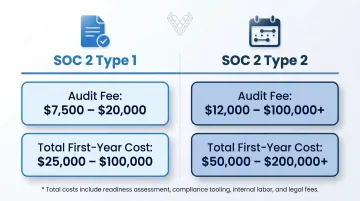
Sources: Drata, soc2auditors.org (May 2026). All-in figures include readiness, tooling, internal labor, and legal.
Startup / First-Time Audit ($25,000–$80,000 all-in)
Typical scope includes:
- Boutique CPA firm with Security TSC only
- Basic readiness assessment and limited systems in scope
- Type 1 or short-window Type 2 audit
The right fit for early-stage SaaS companies needing SOC 2 to unblock an enterprise pilot. Assumes a reasonably documented control environment and internal bandwidth for evidence collection.
Mid-Size / Growing SaaS Company ($80,000–$150,000 all-in)
Typical scope includes:
- Mid-tier audit firm covering Security plus Availability or Confidentiality TSCs
- Full readiness and gap assessment with a compliance platform
- Penetration test and a 6–12 month Type 2 observation window
Best for companies scaling into enterprise sales — typically 50–250 employees — where security questionnaires and procurement reviews create regular friction.
Enterprise / Full Compliance Program ($150,000–$250,000+ all-in)
Typical scope includes:
- Big 4 or top-tier CPA firm across multiple TSCs
- Extensive systems scope with consultant-led remediation
- High-touch audit management throughout the engagement
Suited to organizations with complex infrastructure, global operations, or enterprise customers that require a recognized firm's name on the report.
Key Factors That Affect the Cost of a SOC 2 Audit
SOC 2 audit pricing reflects auditor effort — which depends directly on the complexity of what they're assessing. Five variables move the number most.
Type of Audit: Type 1 vs. Type 2
A Type 1 report evaluates whether controls are designed correctly at a single point in time. A Type 2 report evaluates whether they operated effectively over a 3–12 month period. The extended observation window in Type 2 means significantly more auditor hours, which translates directly to a higher fee — typically 30–50% more than a comparable Type 1 engagement.
Number of Trust Services Criteria in Scope
The Security (Common Criteria) category is mandatory in every SOC 2 report. The other four are optional, and each expands the audit scope:
- Availability — service uptime and performance commitments
- Confidentiality — data handling and access restrictions
- Processing Integrity — accuracy and completeness of processing
- Privacy — the most expensive add-on, given its overlap with data protection regulations
Including all five TSCs can add 50–75% to the base Security-only fee.
The practical rule: only include TSCs that your customers are actually asking for.
Organization Size and Complexity
Larger organizations with more systems, departments, and locations require more auditor time for interviews, evidence collection, and control testing.
Control documentation maturity matters just as much. An informal or undocumented control environment forces auditors to spend extra time identifying what controls even exist. A readiness assessment fixes this before the audit clock starts — and typically costs far less than the billable hours it saves.
Auditor Firm Tier
This is the single biggest pricing lever. Here's what the market looks like in 2026:
| Firm Type | Type 1 Range | Type 2 Range |
|---|---|---|
| Specialist / boutique CPA | $10,000–$30,000 | $15,000–$70,000 |
| Regional CPA firms | $12,000–$35,000 | $18,000–$60,000 |
| Mid-tier firms | $18,000–$55,000 | $25,000–$110,000 |
| Big 4 | $30,000–$150,000 | $45,000–$430,000+ |
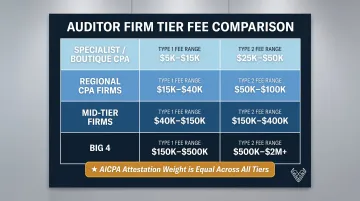
Source: soc2auditors.org SOC 2 Audit Cost Guide, May 2026
A SOC 2 report from a specialist CPA firm carries the same AICPA attestation weight as one from a Big 4 firm. The price difference reflects brand overhead and target market, not report quality. For most B2B SaaS companies, a well-regarded specialist firm is the right choice.
Subservice Providers and Cloud Environments
When your product runs on AWS, Azure, or GCP or relies on third-party vendors performing controls on your behalf, auditors must account for those dependencies. More subservice relationships means more complexity in scoping, more explanatory language in the report, and higher fees.
Before the audit begins, it's worth mapping which cloud controls you own versus which ones your provider handles. This distinction directly affects what auditors test and how much time they spend doing it.
Full Cost Breakdown: What You're Really Paying For
The auditor's fee is just one line item. Here's what the full budget actually looks like:
Readiness Assessment ($10,000–$20,000 | One-Time)
A structured gap analysis that compares your current controls against the relevant TSCs before the formal audit begins. Skipping this step risks a qualified opinion — which wastes the entire audit investment and typically means paying for a second engagement. Treat it as insurance against a failed audit, not an optional line item.
Security Tools and Compliance Platform ($5,000–$50,000 | One-Time + Recurring)
Most companies need to purchase or upgrade tools for endpoint monitoring, access management, log management, and vulnerability scanning to meet SOC 2 requirements. Compliance automation platforms (Vanta, Drata, Secureframe) run $7,500–$60,000 per year and can reduce internal evidence collection effort by 50–70%. Platform adoption has surged to 70–80% of organizations pursuing SOC 2, up from ~40% in 2020.
Penetration Testing ($8,000–$30,000 | Recurring Annual)
Penetration testing isn't explicitly mandated by AICPA standards, but auditors routinely expect it as evidence that the Security TSC controls are actually working. The quality of the pentest matters here.
Automated scanner-only tests miss two critical vulnerability categories:
- Business logic flaws — workflow-based vulnerabilities that require understanding how an application is supposed to work versus how it can be abused
- Complex attack chains — sequences of individually minor weaknesses that combine into critical exploitable paths
Those gaps are exactly why methodology matters to auditors. Vynox Security's manual-first, threat-led approach achieves 3× deeper coverage than tool-only scans, with 100% manual validation to eliminate false positives. A verified, business-logic-aware pentest report carries far more weight in an audit than raw scanner output full of unvalidated findings. Notessa Inc. CTO Joey Kim noted after their engagement that Vynox's detailed reports "not only strengthened our systems but also helped us align with SOC 2 compliance requirements."
Internal Team Time (Largest Hidden Cost | One-Time + Recurring)
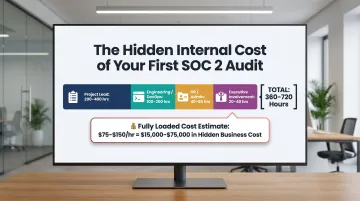
This is what most budgets miss entirely. First-time SOC 2 audits consume 200–500+ hours of internal staff time across project leads, engineering, HR, legal, and executive involvement — just for a small to mid-size company.
At fully loaded rates of $75–$150/hour, that's $15,000–$75,000 in real business cost that never appears on any invoice.
At a mid-size company (50–250 employees), the breakdown typically looks like:
- Project lead: 200–400 hours
- Engineering / DevOps: 100–200 hours
- HR / Admin: 40–80 hours
- Executive involvement: 20–40 hours
Legal Review and Annual Maintenance ($5,000–$15,000+ | Recurring)
Legal costs arise from reviewing data processing agreements, vendor contracts, and employee policies to ensure they support SOC 2 assertions. SOC 2 reports are valid for one year, so annual maintenance is unavoidable. Recurring costs typically include:
- Re-audit fees
- Compliance platform renewals
- Updated security training
- Ongoing control monitoring
Budget $15,000–$40,000 annually in recurring costs after year one.
SOC 2 Type 1 vs. Type 2 — What's the Cost Difference?
| Type 1 | Type 2 | |
|---|---|---|
| What it evaluates | Control design at a single point in time | Control effectiveness over an observation period |
| Observation period | None | 3–12 months |
| Typical timeline | 1–3 months | 6–12 months |
| Audit fee range | $7,500–$60,000 | $12,000–$100,000+ |
| Best for | Unblocking an immediate deal quickly | Long-term enterprise credibility |
Type 2 audits typically cost 30–50% more in auditor fees alone, and the longer observation period increases internal preparation costs as well.
The "which one first" question comes up constantly. Historically, companies started with Type 1 and progressed to Type 2 — a path that still makes sense for startups needing a quick win to unblock a single deal.
The calculus shifts for everyone else. Enterprise buyers increasingly request Type 2 directly, and paying for two separate audit cycles costs more than going straight to Type 2 if your timeline allows it.
The ROI case for Type 2 sharpens that decision further. Organizations with SOC 2 reports see the security review timeline drop by 50–75% — from a typical 4–8 weeks down to 1–2 weeks — and a 40–60% reduction in security questionnaire response time. That translates to 4–6 weeks of earlier revenue recognition per enterprise deal. For most companies, that alone covers the cost difference between Type 1 and Type 2.
How to Estimate and Manage Your SOC 2 Budget
Define Scope Before Requesting Quotes
Map your systems in scope, identify which TSCs your customers actually require, and assess how mature your control documentation is. Any auditor who quotes a firm number before asking these questions will likely revise it mid-engagement — treat that as a red flag.
Build a Full Budget, Not Just an Audit Budget
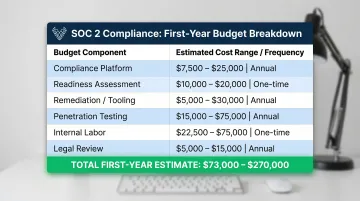
Use this framework to estimate your real number:
| Cost Component | Low Estimate | High Estimate | Type |
|---|---|---|---|
| Compliance platform | $7,500 | $25,000 | Annual |
| Readiness assessment | $10,000 | $20,000 | One-time |
| Remediation / tooling | $5,000 | $30,000 | One-time |
| Penetration testing | $8,000 | $30,000 | Annual |
| SOC 2 audit fee (Type 2) | $15,000 | $75,000 | Annual |
| Internal labor (300–500 hrs) | $22,500 | $75,000 | One-time |
| Legal review | $5,000 | $15,000 | Annual |
| Total first-year estimate | $73,000 | $270,000 | — |
Common Mistakes to Avoid
- Choose auditors based on firm experience and report quality, not just the lowest quote
- Complete a readiness assessment first — skipping it often creates expensive surprises during the formal audit
- Budget for annual recurrence from the start; SOC 2 is an ongoing commitment, not a one-time expense
- Limit your first audit's scope to TSCs customers have actually requested
Build a budget that reflects your actual organization size, scope, and what your target customers need to see. A well-planned SOC 2 investment shortens sales cycles, cuts security questionnaire volume, and grows more valuable with each enterprise renewal.
Frequently Asked Questions
How much does a SOC 2 audit cost?
Audit fees alone range from $7,500–$20,000 for Type 1 and $12,000–$100,000+ for Type 2. Total first-year compliance costs — including readiness, tools, penetration testing, and internal time — typically run from $25,000 for a small startup to $200,000+ for enterprises.
How much does SOC 2 Type 2 cost?
A SOC 2 Type 2 audit fee ranges from $12,000–$20,000 for small to mid-size companies and $30,000–$100,000+ for larger organizations. The higher cost reflects the 3–12 month observation period and the depth of control testing required compared to Type 1.
How much does it cost to be SOC 2 compliant?
The audit fee is what you pay the auditor — but total compliance cost includes readiness, tools, legal, and internal labor. After year one, ongoing SOC 2 compliance typically runs $15,000–$40,000 annually in recurring expenses for re-audits, platform renewals, and continuous monitoring.
How long does a SOC 2 audit take?
A Type 1 process typically takes 1–3 months from readiness through report issuance. A Type 2 process takes 6–12 months due to the required observation period — longer if significant control gaps need remediation before the audit window can begin.
Can you fail a SOC 2 audit?
Auditors issue a qualified opinion when controls are found missing or ineffective. A qualified report can't be shared with customers as intended and signals material deficiencies that will raise immediate red flags in enterprise procurement reviews. Running a readiness assessment before the audit significantly reduces this risk.
Is SOC 2 worth it?
For B2B SaaS companies selling to mid-market or enterprise buyers, yes. SOC 2 unblocks deals, cuts security questionnaire volume by 40–60%, and signals a mature security posture to procurement teams — with enterprise security reviews shortening from weeks to days.