Yet one of the most common questions organizations ask before starting the process is simple: what will this actually cost?
There is no single answer. Total certification costs over a full three-year cycle range from roughly $10,000 for a small startup to $75,000+ for a larger or more complex organization. Most of that variance comes down to scope, preparation approach, and which expenses organizations forget to budget for. This article breaks down every cost component so you can build a realistic number before committing.
TL;DR
- Total cost range: ~$10,000–$75,000+ over three years, depending on organization size and approach
- Main cost buckets: gap analysis, implementation (tooling, training, pen testing), certification audit, surveillance audits, and recertification
- Who pays less: small companies with existing security controls using a compliance platform
- Who pays more: enterprises with complex ISMS, high-risk industries, or those building from scratch
- Biggest budget lever: your implementation approach — DIY, consultant-led (~$30,000+), or a compliance automation platform
How Much Does ISO 27001 Certification Cost?
If you've requested quotes from multiple certification bodies and received numbers that differ by tens of thousands of dollars, that's not unusual. ISO itself does not issue certificates or set audit prices. Accredited third-party certification bodies (CBs) conduct audits independently and price their services based on scope, auditor day rates, and organizational complexity — so two companies in the same industry can land in completely different budget territories.
The more common mistake isn't choosing the wrong CB. It's budgeting only for the external audit and ignoring everything that happens before the auditor arrives. Preparation, penetration testing, employee training, and annual surveillance fees are routinely left out of initial estimates — and that's what catches organizations off-guard mid-project.
Here's a breakdown of what realistic three-year totals look like across organization sizes.
Typical Cost Ranges
| Organization Type | Employees | Three-Year Total |
|---|---|---|
| Small / narrow ISMS scope | <50 | $10,000–$30,000 |
| Mid-range / moderate complexity | 50–250 | $30,000–$55,000 |
| Enterprise / multi-location | 250+ | $55,000–$75,000+ |
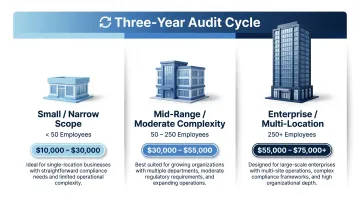
Entry-level ($10,000–$30,000): Covers gap analysis, basic security tooling, Stage 1 + 2 certification audit, and two surveillance audits. Best suited for startups and early-stage SaaS companies pursuing certification to unlock enterprise sales.
Mid-range ($30,000–$55,000): Adds consultant or platform support, penetration testing, and staff training to the full audit cycle. Common for scaling companies in regulated industries or those entering new markets.
High-end ($55,000–$75,000+): Involves extensive documentation, multiple pen tests, large-scale training programs, and premium certification body fees. Financial services firms, healthcare organizations, and large enterprises with complex infrastructure most often fall into this range.
Key Factors That Affect ISO 27001 Certification Cost
Two companies in the same industry can face very different cost profiles — scope decisions, maturity gaps, and auditor choice all move the number significantly.
Organization Size and ISMS Scope
Certification body auditors charge by the day — typically $1,500–$2,200 per day in the US, or £1,250–£1,500 per day in the UK. The number of audit days required scales with in-scope headcount, locations, and system complexity.
- A narrow-scope startup: 3–5 audit days
- A 50-person company: typically 8–10 audit days
- A complex enterprise ISMS: 10–15+ audit days
Defining your scope tightly before you begin is one of the most impactful cost decisions in the process. Resist the urge to certify everything at once.
ISMS Maturity and Existing Controls
Organizations with mature security postures — documented policies, functioning access controls, active monitoring — spend significantly less on remediation before the audit. Those building controls from scratch carry the highest implementation costs.
A gap analysis is the right starting point. It maps your current state against ISO 27001 requirements and surfaces the remediation work needed before certification. Skipping it usually costs more — remediation surprises mid-audit are far more expensive than a structured gap review upfront.
What a gap analysis typically surfaces:
- Missing or undocumented security policies
- Access control gaps and privilege sprawl
- Absent risk treatment plans or asset registers
- Monitoring and logging deficiencies
Choice of Certification Body and Auditor
Big Four firms (PwC, Deloitte, KPMG, EY) command a premium but carry brand recognition that enterprise procurement teams often require. Accredited boutique certification bodies deliver the same ISO-valid result at a lower cost and are often the practical choice for startups and mid-market companies.
Regardless of which CB you choose, verify their accreditation before engaging. Use the IAF CertSearch database to confirm the certification body is accredited by an IAF MLA signatory. In the UK, check the UKAS CertCheck tool to verify UKAS accreditation.
Full Cost Breakdown: Every Expense to Budget For
The certification audit fee is one line item. Most of the money — and most of the work — sits in the preparation and implementation phases that precede it.
Purchasing ISO Standards (~$350)
ISO 27001 (the requirements document) and ISO 27002 (the controls implementation guide) must be purchased separately from ISO's store. Combined cost is approximately $350–$380 USD. Small cost, but non-negotiable.
Gap Analysis and Internal Audit ($5,000–$15,000)
A professional external gap analysis typically costs $5,000–$8,000 and identifies where your current ISMS falls short of ISO 27001 requirements. An internal audit — required before the external certification audit — adds $0–$15,000 depending on whether an external party conducts it.
Shortcutting these steps creates real risk. Poor documentation is a leading cause of Stage 1 audit failures. A thorough gap analysis is cheaper than discovering nonconformities during Stage 2 and paying for emergency remediation plus audit delays.
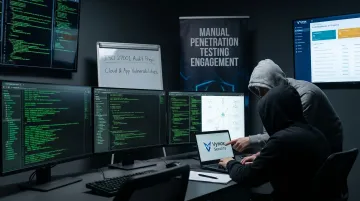
Penetration Testing ($5,000–$20,000)
Penetration testing is not explicitly mandated by the ISO 27001:2022 standard text, but auditors widely expect it as evidence that technical controls hold up under real-world conditions. The relevant control is Annex A.8.8 (Management of Technical Vulnerabilities), which requires organizations to identify exposure and take appropriate action. Pen testing is the accepted method for satisfying this requirement.
Costs range from $5,000 for a narrow-scope engagement to $20,000+ for complex environments.
Not all pen tests are equivalent. Automated scanning tools miss business logic flaws, broken authorization chains, and multi-step attack paths — the exact issues that surface during a thorough Stage 2 audit. Vynox Security's manual-first, threat-led approach validates whether controls actually work as intended, not just whether they exist on paper.
For one SaaS client preparing for ISO 27001 certification, Vynox's testing uncovered unpatched software, weak cloud configurations, and overly permissive access controls. All were remediated before the audit, resulting in zero non-conformities.
Choosing a quality pen testing partner early reduces the risk of control failures appearing during Stage 2, where fixing them is far more expensive.
Employee Training and Security Tooling ($10,000–$25,000)
ISO 27001 requires documented security awareness training for all employees:
- Platform-based training: $15–$35 per seat/year ($1,000–$5,000 total for most organizations)
- Consultant-led training: up to $15,000 for larger or more complex teams
Beyond training, most organizations need to procure or upgrade security tools:
- Endpoint management/MDM: $2,000–$10,000
- Vulnerability management tools: $3,000–$15,000
- Password managers, encryption, and firewalls: varies by existing stack
Budget $10,000+ for tooling if your current security stack has significant gaps.
Stage 1 and Stage 2 Certification Audits ($14,000–$50,000)
Stage 1 is a documentation review; Stage 2 is the full ISMS certification audit. Certification bodies typically bundle both:
- Small organizations (<50 employees): $14,000–$16,000 combined
- Mid-size organizations (50–250 employees): $20,000–$35,000
- Enterprise: $35,000–$50,000+
The audit fee equals auditor day rate × audit days. A 50-person company at $1,500–$2,200/day across 8–10 audit days lands at $12,000–$22,000 for audit fees alone.
Annual Surveillance Audits and Recertification ($6,000–$16,000/event)
ISO 27001 certification is valid for three years, but it requires:
- Year 1 surveillance audit: $6,000–$7,500
- Year 2 surveillance audit: $6,000–$7,500
- Year 3 recertification audit: $14,000–$50,000 (mirrors original Stage 2 cost)
Organizations consistently exclude these costs from initial budgets. Calculate a three-year total cost of ownership, not just the initial audit fee.
DIY vs. Consultant vs. Compliance Platform: Cost Comparison
The biggest single lever on your total ISO 27001 cost is the implementation approach you choose.
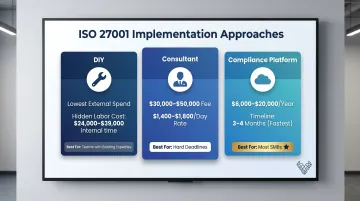
Option 1: Internal DIY
Lowest external spend, but highest hidden cost. Key cost factors to weigh:
- Internal labor: A senior engineer leading the project full-time diverts $24,000–$39,000 over a 2–4 month readiness period (based on a $118K annual salary)
- DIY toolkits: $500–$2,000 in external spend
- Best for: Teams with existing ISO 27001 expertise and dedicated compliance capacity — not a realistic path for most growing companies
Option 2: Hiring an ISO 27001 Consultant
Consultants handle policy writing, risk assessment, internal audit management, and audit prep — freeing internal staff for product work:
- Full engagement fee: $30,000–$50,000 for US small-to-mid-size companies
- Day rates: $1,400–$1,800/day
- Best for: Teams with low internal expertise or a hard deadline for certification
Option 3: Compliance Automation Platform
Platforms handle evidence collection, provide pre-built control frameworks, policy templates, and continuous monitoring. Vanta, Drata, and Sprinto are the leading options:
- Platform fees: $6,000–$20,000/year
- Sprinto ISO 27001-only plans: $9,000–$15,000/year
- Timeline: Automation can reduce readiness from 6–10 months to 3–4 months
For most small-to-mid-market organizations, a platform produces the lowest total cost once labor savings are accounted for. The table below maps each profile to the approach that fits best.
Choosing the Right Approach
| Profile | Best Approach |
|---|---|
| Small startup, tight budget, some internal expertise | Compliance automation platform |
| Scaling company entering enterprise sales | Consultant or consultant + platform hybrid |
| Large enterprise with compliance team | Internal team + platform support |
How to Keep ISO 27001 Costs Under Control
Most ISO 27001 cost overruns trace back to the same handful of decisions made early in the process. Getting these right from the start can meaningfully reduce what you spend across the full certification cycle:
- Narrow your ISMS scope intentionally. Define which systems, processes, and locations are truly in scope before starting. Certifying a narrower scope first is faster, cheaper, and still credible to enterprise customers.
- Invest in preparation to avoid rework. Organizations that skip gap analysis or rush internal audits routinely discover nonconformities during Stage 2. Emergency remediation plus audit delays cost more than a thorough upfront preparation would have.
- Choose penetration testing partners carefully. Look for partners who use a manual-first approach, not just automated scans — manual testing surfaces business logic flaws and attack chains that tools routinely miss. Finding those issues before the auditor does is far cheaper than finding them after. Vynox Security's threat-led methodology is built specifically around this kind of pre-audit discovery.
- Budget for the full three-year cycle. Surveillance audits, continuous monitoring, annual training refreshers, and tool renewals are real recurring expenses. Build them into your compliance budget from day one.
Frequently Asked Questions
Is ISO 27001 certification free?
No. ISO itself does not charge for certification and cannot issue certificates — accredited third-party certification bodies conduct and charge for audits. Even organizations using internal staff for preparation incur fees for auditors, security tools, and standards documents.
What is the cost of ISO 27001 certification for a small business?
Small businesses under 50 employees with a narrow ISMS scope typically spend $10,000–$30,000 over a three-year cycle. Stage 1 + 2 audit costs run $14,000–$16,000, with preparation costs reduced significantly if a compliance platform handles policy and evidence work.
How much do ISO 27001 consultants charge?
Full-service ISO 27001 consultants typically charge $30,000–$50,000 for small-to-mid-size engagements covering readiness, documentation, internal audit management, and audit preparation. Day rates average $1,400–$1,800, rising with ISMS complexity and organization size.
Is it worth getting ISO 27001 certified?
For most organizations, yes. ISO 27001 opens enterprise sales opportunities, shortens vendor security reviews, and reduces breach risk. The ROI is strongest for SaaS companies and service providers competing for regulated-industry clients, where certification is increasingly a procurement prerequisite.
How much does it cost to implement ISO 27001?
Expect $15,000–$40,000+ for the implementation phase alone — covering gap analysis, internal audit, penetration testing, employee training, and security tooling. Costs vary significantly based on organizational size and whether a consultant or compliance platform is used.
How much does ISO 27001 cost in the UK?
UK costs mirror the US structure but in GBP. UKAS-accredited auditor day rates run £1,250–£1,500/day, with total first-year costs for UK SMEs typically ranging from £6,000–£15,000 (plus £1,500–£3,000/year for surveillance audits). Verify any certification body via the UKAS CertCheck tool.