For most organizations, hiring a full-time CISO isn't realistic. The search takes 4–6 months. The compensation package runs well into six or seven figures. And the role sits vacant in the meantime while threats don't wait.
The virtual CISO model exists to solve exactly this problem. This article walks through ten concrete, operational benefits of hiring a vCISO — grounded in cost, compliance speed, and measurable risk reduction. No abstract security theory.
TL;DR
- A vCISO provides C-suite security leadership at 20–40% of what a full-time hire costs
- Organizations get immediate access to cross-industry expertise — no 3–6 month recruiting cycle
- Compliance with SOC 2, ISO 27001, and GDPR moves faster with someone who has run these programs before
- The engagement scales up or down as your security needs change — no re-hiring required
- No security leadership means risk accumulates quietly — and costs far more to fix than a vCISO engagement
What Is a Virtual CISO?
A virtual CISO is an experienced security executive who works with an organization on a fractional or contract basis, filling the same strategic role as an in-house CISO — without the full-time overhead.
In practice, a vCISO handles:
- Security strategy and roadmap development
- Policy creation and governance frameworks
- Compliance readiness (SOC 2, ISO 27001, GDPR, HIPAA)
- Risk management and executive reporting
- Incident response planning and tabletop exercises
- Vendor and architecture reviews
This model fits best in three situations: startups that can't justify a six-figure security hire, mid-market companies scaling their security programs ahead of enterprise sales, and SaaS businesses that need compliance-ready posture to close deals. For each, the vCISO delivers consistent, executive-level security leadership — and that's exactly what the benefits below reflect.
Top 10 Benefits of Hiring a Virtual CISO
Each benefit below ties to a measurable outcome — cost, speed, risk reduction, compliance, or business growth.
Benefit 1: Significant Cost Savings Compared to a Full-Time CISO
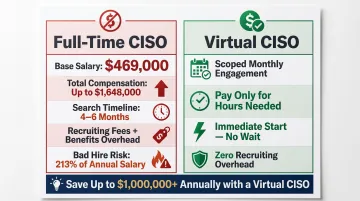
Full-time CISO compensation is out of reach for most organizations. According to Heidrick & Struggles' 2024 Global CISO Survey, the average US CISO base salary is $469,000 — with total compensation including bonuses and equity reaching $1,648,000. Even Glassdoor's broader estimate puts total CISO pay at $323,955 before benefits and recruiting costs.
Then factor in:
- A 4–6 month search timeline before anyone starts
- Recruiting fees, sign-on packages, and benefits overhead
- The cost of a bad executive hire, which can exceed 213% of annual salary
A vCISO converts that fixed liability into a scoped engagement. Organizations pay for the hours and services they actually need — whether that's a focused advisory retainer or a full security program build.
This matters most for startups, organizations in post-audit catch-up mode, and businesses where the CISO role has been vacant for months or absorbed into an already-stretched IT team.
Benefit 2: Immediate Access to Deep, Cross-Industry Security Expertise
A single in-house hire brings experience from their own career path. A vCISO — or the firm behind them — brings pattern recognition from working across dozens of environments simultaneously.
That difference is measurable. A newly hired CISO spends the first 90 days just doing discovery: assessing current posture, building stakeholder relationships, developing a roadmap. Add the 4–6 month search phase and the notice period, and total elapsed time from decision to full operational effectiveness is often 7–9 months.
A vCISO arrives with pre-built frameworks, threat models, and remediation playbooks. Discovery that would take an in-house hire months compresses into weeks.
This is most valuable for cloud-native SaaS providers onboarding enterprise clients, organizations entering regulated markets for the first time, and companies building a formal security program from scratch.
Benefit 3: Faster, More Reliable Path to Compliance
SOC 2, ISO 27001, and GDPR compliance require more than documentation. They require a security program that auditors can validate — meaning knowing exactly what evidence needs to exist, when it needs to exist, and how to present it.
The financial stakes are real:
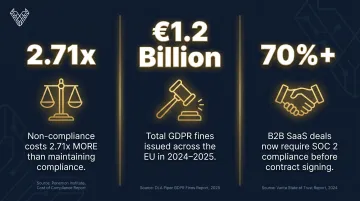
- Non-compliance costs 2.71x more than maintaining compliance programs, according to Ponemon Institute research
- GDPR regulators issued approximately €1.2 billion in fines in both 2024 and 2025
- Over 70% of B2B SaaS deals require a SOC 2 report before contracts are signed
A vCISO guides compliance readiness end-to-end: scoping the program, running gap assessments, overseeing control implementation, preparing documentation, and coordinating with auditors. For SaaS companies, this is as much a sales enablement function as a legal obligation.
Compliance programs work best when paired with technical validation. Vynox Security's manual-first penetration testing is commonly run alongside vCISO engagements to surface attack paths that could become audit findings. That gives organizations evidence of real security, not just documented controls.
This matters most for first SOC 2 or ISO 27001 audits, expansion into regulated industries, and when a customer security questionnaire has already exposed gaps.
Benefit 4: Flexibility and Scalability of Engagement
A vCISO engagement matches your actual security maturity and budget, not a fixed scope that may not fit next quarter.
Security needs shift fast, particularly for growth-stage companies:
- Pre-Series A: focused advisory, policy foundation, basic risk management
- Series B and beyond: full program build, compliance readiness, board reporting
- Post-incident: incident response leadership, remediation oversight
The vCISO model scales up or down without the overhead of re-hiring. Vynox Security structures these engagements around organizational size, maturity, and risk profile — so clients get what the situation requires, nothing more and nothing less.
Benefit 5: Objective External Risk Assessment
Internal teams develop blind spots. Familiarity with your own systems makes it genuinely hard to see what's wrong with them — not from negligence, but from proximity.
A vCISO is structurally positioned to see what internal teams miss: inherited technical debt, misconfigured controls, third-party risk that hasn't been properly assessed. That external perspective carries weight at the board level too. Internal security leaders sometimes soften uncomfortable findings due to organizational dynamics. A vCISO doesn't have that problem.
Benefit 6: Stronger Incident Response Planning and Management
Most organizations have an incident response plan. Far fewer have one that reflects how attacks actually unfold.
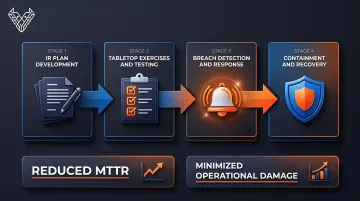
A vCISO builds and maintains an IR plan tailored to the organization's real environment — and brings the practical experience of running actual incidents. The difference between a template and a tested playbook shows up exactly when it matters: in the first hours of a breach, when response speed and clarity directly affect how much damage gets done.
The measurable impact shows up in mean time to respond (MTTR) and in how much operational and reputational damage a breach ultimately causes.
Benefit 7: Security Culture and Employee Awareness
The human element contributed to 68% of breaches in 2024, according to Verizon's Data Breach Investigations Report. That figure has held steady for years. Technical controls alone won't change that number.
A vCISO builds security awareness from the top down through:
- Policies that reflect how people actually work, not idealized workflows
- Training programs tied to real threat scenarios, not annual checkbox exercises
- Communication standards that make secure behavior the path of least resistance
The goal is making security a shared organizational responsibility, not a problem employees route around when it's inconvenient.
Benefit 8: Frees Internal Teams to Focus on Core Business
Without a dedicated security leader, compliance, governance, and risk management fall to whoever is closest to the problem — usually IT staff or operations teams already stretched thin. Both security outcomes and core team productivity suffer.
Offloading these responsibilities to a vCISO lets engineering teams ship product, finance teams focus on growth, and operations teams run without the constant interruption of security questionnaires, audit prep, and policy requests.
Benefit 9: Continuous Awareness of the Evolving Threat Landscape
A vCISO working across multiple clients and industries sees emerging attack techniques, regulatory changes, and sector-specific threats as they develop — not weeks later when a single-employer perspective catches up.
That real-time awareness translates directly into posture:
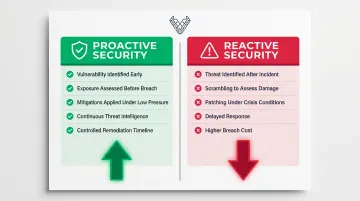
- Proactive: new vulnerability class identified, exposure assessed, mitigations applied before it becomes a breach
- Reactive: threat identified after the fact, scrambling to assess impact and patch under pressure
When a new class of vulnerability hits cloud infrastructure, a well-connected vCISO knows about it and knows whether it affects you.
Benefit 10: Alignment of Security Strategy with Business Goals
Security only gets budget and attention when leadership understands why it matters to revenue, customer trust, and operational continuity — not just to technical severity scores.
An effective vCISO translates security requirements into business language. A vCISO frames risk in terms boards can act on and prioritizes security investments based on actual business exposure, not technical noise. That shift reframes security from a cost center to a strategic function — one that protects deals, maintains customer confidence, and keeps growth moving.
What Happens When You Skip the vCISO Role
Operating without a dedicated security leader creates compounding consequences:
- Security strategy stays reactive — responding to incidents rather than preventing them
- Compliance deadlines get missed, triggering audit failures and stalled enterprise deals
- Incidents take longer to contain because no one owns the response process
The financial exposure is concrete. The 2024 IBM/Ponemon Cost of a Data Breach Report puts the average US breach cost at $9.36 million — a figure rising roughly 10% year-over-year. Hidden costs compound that further: regulatory fines, contract losses from failed security questionnaires, and reputational damage that takes years to recover.
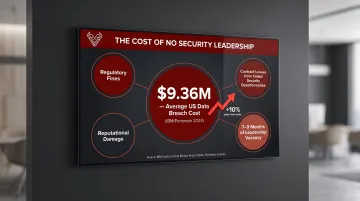
The talent shortage deepens the problem for organizations that pursue a full-time CISO hire instead. Recruiting alone takes 4–6 months, followed by another 90 days before a new hire is operationally effective. That's 7–9 months with no security leadership in place — during which compliance windows close, audits arrive, and vulnerabilities accumulate.
How to Get the Most Value from Your vCISO Engagement
A vCISO engagement delivers the most value when it's treated as a strategic partnership — not a reporting exercise.
Behaviors that separate high-performing engagements from low-impact ones:
- Clear scoping and defined KPIs from day one
- Consistent access to stakeholders across engineering, legal, and finance
- Quarterly security reviews with leadership, not just status updates
- Acting on recommendations rather than filing them away
- Integrating the vCISO into procurement, vendor review, and product decisions
Value also compounds when the vCISO's roadmap is validated with hands-on technical testing. Organizations that pair strategic leadership with realistic penetration testing (such as Vynox Security's manual-first, threat-led assessments) can close gaps with evidence-backed remediation rather than theoretical fixes.
When the vCISO identifies a control gap, a penetration test confirms whether it's actually exploitable. That combination produces security programs that hold up under both auditor scrutiny and real-world attack conditions.
Conclusion
The case for a virtual CISO comes down to operational reality. Organizations that delay structured security leadership don't just miss out on efficiency gains — they absorb growing risk exposure with every quarter that passes. Cost control, faster compliance, and cleaner risk posture are not abstract benefits; they accumulate directly on the balance sheet.
That urgency is precisely why the vCISO model works best as an ongoing strategic function, not a one-time project. The right engagement partner adapts the security program as the business scales, enters new markets, or faces evolving compliance requirements. For startups and mature organizations alike, that kind of consistent, senior-level security guidance is what separates a reactive security posture from a sustainable one.
Frequently Asked Questions
What is the difference between a CISO and a virtual CISO?
The core difference is employment structure. A virtual CISO delivers the same strategic responsibilities — risk management, governance, compliance oversight, and board-level reporting — on a contract or fractional basis rather than as a full-time hire. That means equivalent leadership outcomes at a fraction of the cost, without the months-long search process.
Is a CISO considered C-suite?
Yes. The CISO is a C-suite executive responsible for enterprise-wide security strategy and reporting to the CEO or board. A virtual CISO fills this executive function on a flexible engagement model, delivering the same strategic authority without the full-time overhead.
What are the core benefits of a strong cybersecurity program?
The five core outcomes are: protecting sensitive data from unauthorized access, preventing financial losses from breaches and regulatory fines, maintaining compliance with applicable frameworks, preserving customer trust, and ensuring operational continuity when incidents occur.
What are the benefits of CISO certification?
Certifications like CISSP, CISM, or CCISO validate a security leader's expertise in risk management, governance, and security program development. When evaluating a vCISO engagement, checking for these credentials is a practical way to confirm the practitioner can deliver real strategic value — not just advisory opinions.
How much does a virtual CISO cost compared to a full-time CISO?
Full-time CISOs command base salaries averaging $469,000 with total compensation potentially exceeding $1.6M at larger organizations. vCISO engagements typically run $3,000–$20,000 per month depending on scope, making the virtual model 30–70% less expensive while delivering equivalent strategic leadership.
When should a company hire a virtual CISO instead of a full-time CISO?
Consider a vCISO when a full-time executive hire isn't financially viable, when compliance deadlines can't wait for a 4–6 month search, when the CISO seat is vacant and needs immediate coverage, or when you need a security program that scales without re-hiring at every growth stage.