Introduction
Most organizations believe their network is secure — until a breach proves otherwise. By that point, the damage is already measured in downtime, data loss, and regulatory fines.
Network penetration testing closes that gap. Instead of waiting for an attacker to find vulnerabilities in your infrastructure, authorized security professionals find and exploit them first — then show you exactly what needs fixing.
This guide covers what IT managers, security leads, and business decision-makers need to know:
- What network penetration testing is and how it works
- How it differs from vulnerability scanning
- Internal vs. external and black/gray/white box testing distinctions
- How a professional engagement runs from start to finish
- What a typical assessment uncovers
- How pen testing connects to compliance requirements like SOC 2, ISO 27001, PCI DSS, and GDPR
TL;DR
- Network penetration testing is an authorized, simulated cyberattack on your network performed by ethical hackers to expose real vulnerabilities before attackers do
- Unlike vulnerability scanning, pen testing actively exploits weaknesses to confirm real-world impact — not just flag potential ones
- Scope and model vary: internal or external testing; black box, gray box, or white box depending on how much access the tester starts with
- Five key phases: planning, reconnaissance, exploitation, post-exploitation analysis, and reporting
- Drives compliance with PCI DSS, SOC 2, ISO 27001, and GDPR while strengthening overall security posture
What Is Network Penetration Testing?
Network penetration testing is a structured, authorized simulation of real-world cyberattacks against an organization's network infrastructure. Ethical hackers (either internal red teams or third-party specialists) probe the network to identify and exploit vulnerabilities before malicious actors can.
NIST SP 800-115 defines penetration testing as "security testing in which evaluators mimic real-world attacks in an attempt to identify ways to circumvent the security features of an application, system, or network."
How It Differs from a Vulnerability Assessment
The distinction matters and is frequently misunderstood:
- Vulnerability assessment (VA): Scans and catalogs potential weaknesses. It tells you which doors might be unlocked.
- Penetration test: Actively attempts to walk through those doors and documents what can be stolen, damaged, or disrupted.
A VA produces a list. A pen test produces evidence: screenshots, logs, and documented attack paths showing what a real attacker could actually do.
NIST SP 800-115 is explicit on this point: "manual processes can identify new or obscure vulnerabilities that automated scanners may miss," including chained attack paths that no automated tool can replicate.
This is where manual-first testing earns its weight. Vynox Security, for example, was built on the premise that automated scans routinely miss business logic flaws and multi-step attack chains — the kind of findings that only a human tester following an attacker's actual logic can uncover.
What a Network Pen Test Covers
Most engagements cover a broad range of assets and control points. Here's what typically falls in scope:
- Internal systems and network protocols
- Perimeter devices (firewalls, routers, IDS/IPS)
- Public-facing servers and DNS configurations
- VPNs and remote access systems
- Wireless access points
- Cloud-connected and hybrid infrastructure
Core objectives:
- Identify exploitable vulnerabilities across the network
- Test whether existing security controls actually hold under attack
- Determine how far an attacker can move laterally once inside
- Deliver prioritized, actionable remediation guidance
Types of Network Penetration Testing
Network pen testing is classified along two axes: scope (internal vs. external) and knowledge level (black, gray, or white box). Most organizations need a combination to achieve meaningful coverage.
Internal Network Penetration Testing
Internal pen testing simulates an attacker who has already gained a foothold inside the network — through compromised credentials, a phishing attack, or a malicious insider. The tester works from within the internal network and focuses on what that access enables.
What it evaluates:
- Weak or reused passwords and credential policies
- Excessive user privileges and overprivileged service accounts
- Insecure internal protocols (unencrypted traffic, legacy services)
- Missing network segmentation that enables lateral movement
- Misconfigured internal services and trust relationships
According to the 2024 Insider Threat Report by Cybersecurity Insiders, 83% of organizations reported at least one insider attack in the preceding year. Internal pen testing directly addresses this risk by showing how much damage a single compromised account can enable across the environment.
External Network Penetration Testing
External testing simulates an internet-based attacker targeting your public-facing infrastructure — the way most real-world breaches begin. The tester has no internal access and approaches from outside the perimeter.
What it evaluates:
- Open and unnecessarily exposed ports
- Unpatched internet-facing systems
- Misconfigured firewalls and DNS settings
- Exposed credentials and login interfaces
- Insecure VPN configurations and cloud service exposure
Per the Verizon 2025 DBIR, edge devices and VPNs jumped from 3% to 22% year-over-year as breach entry points — a signal that the external attack surface is expanding faster than most organizations realize.
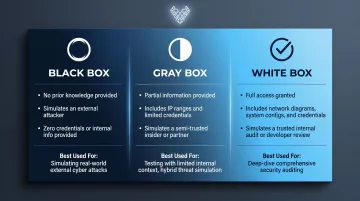
Black, Gray, and White Box Testing
Scope (internal vs. external) defines where testing happens. The knowledge model defines how much information the tester starts with — and that choice shapes what vulnerabilities surface.
| Model | Information Given to Tester | What It Simulates |
|---|---|---|
| Black box | None | External attacker with zero prior knowledge |
| Gray box | Partial (IP ranges, limited credentials) | Insider or compromised account |
| White box | Full (network diagrams, configs, credentials) | Deep-coverage stress test of the full environment |
Black box delivers the most realistic external attacker simulation, but it can miss issues that only surface with deeper context. Gray box is the most common choice for internal assessments — it balances realism with efficiency. White box is typically reserved for final validation, when the goal is exhaustive coverage rather than surprise.
Vynox Security's threat-led approach applies across all three models, mapping how attackers chain weaknesses together rather than treating each finding in isolation.
The Network Penetration Testing Process
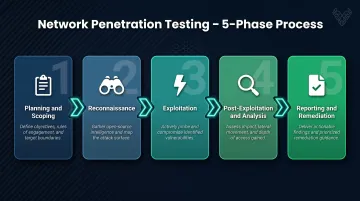
Professional network pen testing follows five phases. The quality of execution at each phase directly determines the value of the final deliverable.
Phase 1: Planning and Scoping
Before any testing begins, the engagement needs clear boundaries:
- Rules of engagement: What testers are and aren't permitted to do, and under what conditions
- Scope definition: Which IP ranges, systems, environments, and assets are included — and which are excluded
- Objectives and success metrics: What specific risks or scenarios the test is designed to address
- Stakeholder sign-off: Written authorization from appropriate decision-makers
Poor scoping is one of the most common reasons pen tests fail to deliver useful results. When the wrong systems are tested, or the scope is too narrow, findings don't reflect real organizational risk. As Zokyo's research on pen test failures notes, terminology confusion and scoping mismatches routinely produce tests that answer the wrong question entirely.
Phase 2: Reconnaissance
Reconnaissance is the intelligence-gathering phase. Testers map the network before attempting exploitation.
Passive reconnaissance (no direct contact with target systems):
- OSINT gathering on the organization's public footprint
- DNS enumeration and certificate transparency logs
- Public breach data and exposed credential sources
Active reconnaissance (direct interaction with systems):
- Port scanning to identify open services
- Banner grabbing to identify software versions
- Network topology mapping
- Identifying live hosts and operating system fingerprinting
This phase determines the quality of everything that follows. A thorough reconnaissance phase surfaces entry points that scanners alone would miss.
Phase 3: Exploitation
This is where pen testing separates from vulnerability scanning. Testers actively attempt to exploit discovered weaknesses to determine real-world impact.
Exploitation activities include:
- Gaining unauthorized access to systems or services
- Escalating privileges from standard user to admin
- Moving laterally across network segments
- Accessing sensitive data, internal systems, or credentials
- Establishing persistence to simulate an advanced persistent threat
The goal isn't to cause damage — it's to demonstrate what an attacker with the same access could realistically accomplish.
Phase 4: Post-Exploitation and Analysis
After gaining access, testers assess the full blast radius:
- How long can access be maintained without detection?
- What sensitive data is reachable from this position?
- What additional systems can be accessed through lateral movement?
- What would the business impact of this breach be?
This phase also includes cleanup: removing test artifacts, closing any backdoors opened during testing, and restoring configurations to their pre-test state.
According to CrowdStrike's threat intelligence research, the average attacker breakout time from initial access to lateral movement is just 1 hour and 58 minutes. Post-exploitation analysis measures whether your environment can detect and contain that movement in time.
Phase 5: Reporting and Remediation
A pen test report is only valuable if it drives action. A professional report should contain:
- A non-technical executive summary translating findings into business risk
- Risk and impact analysis for each finding, covering both exploitability and potential damage
- Prioritized remediation steps with clear, actionable next steps for technical teams
- Exploitation evidence including screenshots, logs, and proof-of-concept demonstrations
- Compliance mapping where relevant (PCI DSS, ISO 27001, SOC 2)
Vynox Security delivers audit-ready reports within 48 hours, with findings supported by proof-of-concept evidence, risk impact analysis, and remediation steps mapped to frameworks like ISO 27001 and OWASP. Reports are structured for both technical teams and executive or audit audiences.
Without prioritized remediation guidance, a report leaves security teams with findings but no clear path forward — which is where most pen test value is actually lost.
What Vulnerabilities Network Pen Testing Uncovers
The Most Common Findings
According to the Verizon 2025 DBIR, the top initial access vectors across confirmed breaches were:
- Credential abuse: 22% (the single most common entry point)
- Vulnerability exploitation: 20% (up 34% year-over-year)
- Phishing: 16%
Network pen tests are designed to find exactly these: the credential weaknesses, unpatched systems, and misconfigured services that make exploitation possible.
Common vulnerability categories uncovered:
- Weak, default, or reused credentials
- Missing multi-factor authentication on critical systems
- Open ports with no legitimate business requirement
- Unpatched or end-of-life software on network devices
- Overpermissive firewall rules
- Misconfigured cloud services with exposed management interfaces
- Missing or inadequate network segmentation
Why Manual Testing Finds What Scanners Miss
Automated vulnerability scanners are efficient at identifying known CVEs and missing patches. What they can't do is determine whether a vulnerability is actually exploitable in your environment — or whether three medium-severity findings chain together into a critical attack path.
Manual pen testing validates actual exploitability, eliminates false positives, and surfaces multi-step attack chains scanners cannot replicate. NIST SP 800-115 makes this explicit: only manual processes can identify "combinations of vulnerabilities on single or multiple systems" that automated tools routinely overlook.
The Lateral Movement Problem
This is where segmentation failures become critical. They're among the most dangerous findings in network pen testing — and among the least likely to appear in a scanner report.
Once an attacker establishes an initial foothold, the real question is: how far can they go? Poorly segmented networks, overprivileged service accounts, and misconfigured trust relationships allow attackers to pivot from a compromised workstation to a domain controller to a database server containing sensitive data. That full attack path only surfaces during active exploitation, not during a passive scan.
Network Pen Testing and Compliance
What the Frameworks Require
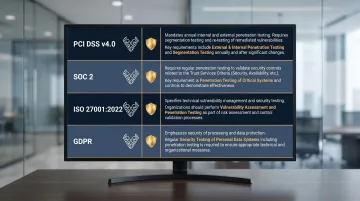
Most major data protection and security standards explicitly require or strongly expect regular penetration testing:
| Framework | Penetration Testing Requirement |
|---|---|
| PCI DSS v4.0 | Requirement 11.4 mandates annual internal and external pen tests, plus testing after significant changes. Service providers must test segmentation every six months. |
| SOC 2 | CC4.1 explicitly references penetration testing as a point of focus for evaluating control effectiveness. Auditors routinely expect a recent pen test as evidence. |
| ISO 27001:2022 | Annex A Control 8.8 requires organizations to identify and mitigate technical vulnerabilities through periodic, documented penetration testing. |
| GDPR | Article 32(1)(d) mandates "regularly testing, assessing and evaluating the effectiveness of technical and organisational measures." Pen testing is the most direct way to produce documented evidence of this. |
The Compliance-Security Gap
Compliance-driven pen testing and security-driven pen testing are not the same thing. Compliance tests demonstrate due diligence to auditors. Threat-led tests find the attack paths that actually put the organization at risk. Treating them as interchangeable creates a dangerous blind spot.
The Hacker News illustrated this clearly: an organization passes its annual pen test in January. A routine software update in February introduces a vulnerability. By April, attackers have exploited it — weeks before the next scheduled assessment.
That window is the real risk. Annual compliance testing cannot protect against vulnerabilities introduced after the last engagement — and the exposure surface keeps growing. NIST enriched nearly 42,000 CVEs in 2025, a 45% increase over any prior year.
Organizations that test only on an annual compliance schedule are, in practice, measuring yesterday's risk against today's threat landscape.
Closing that gap requires testing that serves both purposes at once. Vynox Security's network pen testing delivers audit-ready, compliance-mapped reporting with findings tied directly to Annex A controls, PCI DSS requirements, and risk registers — structured to satisfy auditor expectations and real threat-led security objectives in a single engagement.
Frequently Asked Questions
What is a network penetration test?
A network penetration test is an authorized, simulated cyberattack on an organization's network infrastructure conducted by ethical hackers. The goal is to identify and actively exploit real vulnerabilities in routers, firewalls, servers, VPNs, and endpoints before malicious actors find them first.
What are the 5 steps of penetration testing?
The five phases are: (1) planning and scoping, (2) reconnaissance, (3) exploitation, (4) post-exploitation analysis, and (5) reporting with remediation recommendations. Each phase builds directly on the findings of the previous one.
What's the difference between a VA and a pen test?
A vulnerability assessment identifies and catalogs potential weaknesses through scanning. A penetration test goes further by actively exploiting those weaknesses to confirm real-world impact — producing evidence of what an attacker could actually access, steal, or damage.
What is an external network penetration test?
An external pen test simulates an internet-based attacker targeting public-facing assets: web servers, firewalls, VPNs, DNS configurations, and exposed ports. The goal is to identify perimeter vulnerabilities before real attackers find and exploit them.
What are the limitations of penetration testing?
Pen tests reflect your security posture at a single point in time, not after new changes or exposures emerge. They're also bounded by the agreed scope and depend heavily on the skill and methodology of the testing team, which is why recurring assessments matter.
What is infrastructure penetration testing?
Infrastructure penetration testing is often used interchangeably with network penetration testing. It evaluates the security of an organization's underlying IT infrastructure — servers, routers, switches, firewalls, and network protocols — to identify exploitable weaknesses across the environment.