
Introduction
Most organizations have invested heavily in their perimeter defenses — firewalls, intrusion detection, and external monitoring. The assumption, often unstated, is that keeping attackers out is the same as staying secure. It isn't.
Once an attacker has internal access, those perimeter controls offer almost no resistance. Attackers get inside through phishing, stolen credentials, and compromised third-party accounts. According to the IBM Cost of a Data Breach Report 2024, attacks using stolen credentials took an average of 243 days to identify and 84 days to contain — a 327-day exposure window where attackers move freely through internal systems.
Internal penetration testing addresses what perimeter defenses can't measure: how far an attacker can move, and what they can reach, once they're already in.
This guide breaks down what internal pen testing is, how each stage works, and what it reveals that automated scans and compliance checklists routinely miss.
TL;DR
- Internal pen testing simulates what an attacker can do once inside your network — via compromised credentials, phishing, or insider access
- Lateral movement paths, privilege escalation opportunities, and misconfigured internal systems all get exposed — findings automated scans routinely miss
- Four stages drive the process: scoping, reconnaissance, exploitation and lateral movement, and reporting
- Unlike external pen testing, internal testing assumes a foothold already exists — the goal is measuring blast radius, not just whether someone can get through the door
- SOC 2, ISO 27001, GDPR, and PCI DSS all require evidence of internal control testing
What Is Internal Penetration Testing?
Internal penetration testing is a controlled, simulated attack conducted from within an organization's network. A skilled tester — given some form of internal access — attempts to access, compromise, or disrupt systems the way a real threat actor would. The core question it answers is direct: once someone is inside, what can they actually reach?
What It Is Not
Many organizations conflate internal pen testing with adjacent practices. The distinctions matter:
- Vulnerability scanning identifies known weaknesses and misconfigurations but doesn't attempt to exploit them — NIST SP 800-115 describes scanning as "a starting point, not an end result"
- External pen testing starts outside the network perimeter and asks whether an attacker can breach it — a fundamentally different question
- Security audits are compliance-driven reviews of policies and configurations, not simulated attacks
Understanding what internal pen testing is not makes the next question easier to answer: how should it actually be structured? That depends on the knowledge model chosen for the engagement.
The Three Testing Models
The knowledge model shapes what a test can realistically reveal:
| Model | Tester's Starting Knowledge | Best For |
|---|---|---|
| Black Box | No prior information; simulates a blind attacker | Testing detection capability, realistic breach simulation |
| White Box | Full network details, credentials, documentation | Most thorough coverage; simulating informed insider |
| Gray Box | Partial knowledge — user-level access, some network context | Most common; balances realism with efficiency |
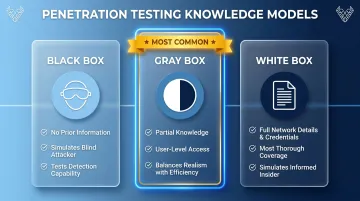
In practice, gray box is the most common choice for internal engagements. It mirrors a compromised employee account scenario — the attacker has enough context to move, but not enough to skip the hard work.
Compliance Alignment
Internal pen testing isn't only a security practice — it's increasingly a compliance requirement:
- SOC 2 (CC4.1): Points of Focus explicitly name penetration testing as an expected evaluation method
- ISO 27001:2022 (Annex A 8.8): Requires periodic, documented penetration tests to identify technical weaknesses
- GDPR (Article 32(1)(d)): Mandates "regularly testing, assessing and evaluating the effectiveness of technical and organisational measures"
- NIST SP 800-115: The primary federal framework for security testing methodology — widely referenced in US regulatory and audit contexts
How Does Internal Penetration Testing Work?
Internal pen testing follows a structured sequence of stages. Each phase builds on the last, so results are comprehensive and actionable rather than a random list of flagged ports.
Planning and Scoping
Before any testing begins, the tester and organization define:
- Scope: Which systems, network segments, and data types are in-scope
- Rules of engagement: What's off-limits (production databases, critical infrastructure during business hours)
- Testing windows: When testing can occur to minimize operational disruption
- Objectives: Whether the goal is to reach a specific server, escalate to domain admin, or demonstrate access to sensitive data stores
Poor scoping is the most common reason internal pen tests deliver limited value — an overly narrow scope misses real attack paths, while an undefined scope creates operational risk. Getting this stage right determines whether the rest of the engagement produces evidence or noise.
Reconnaissance and Enumeration
Once internal access is established — via physical connection, VPN, or a simulated compromised account — the tester maps the environment. This includes:
- Identifying live hosts, open ports, and active services
- Mapping Active Directory structure: user accounts, group memberships, trust relationships
- Locating shared drives, accessible file stores, and internal applications
- Identifying misconfigurations or over-permissive access controls
Tools generate lists. Skilled testers determine which items on those lists represent real attack paths — a distinction that requires understanding how systems interact, not just what they are. Manual-first testing consistently delivers greater depth here than automated scanning alone.
Exploitation and Lateral Movement
This is where the test moves from mapping to demonstrating real-world impact.
Testers attempt to exploit identified weaknesses, including:
- Misconfigured services or legacy protocols (for example, SMB signing not enforced)
- Weak or reused credentials susceptible to pass-the-hash or relay attacks
- Unpatched software with known exploits
- Overly permissive access controls between network segments
Once initial access to a system is confirmed, the tester moves through the network the way a real attacker would — reaching toward higher-value targets like domain controllers, financial systems, or sensitive data repositories, and documenting every step.
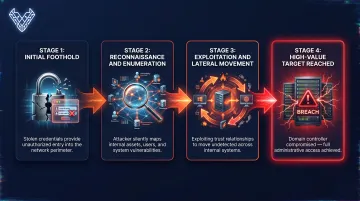
This phase consistently surfaces what tool-only assessments miss: business logic flaws, trust relationship abuses, and chains of individually low-severity findings that together enable full network compromise. Vynox Security's threat-led approach is built around the question "if this system were attacked in the real world, what would actually break?" — which is why chained attack paths get caught rather than overlooked.
Reporting and Remediation Guidance
A well-structured internal pen test report delivers more than a CVE list. It provides:
- An attack narrative: How the tester moved through the environment, what they accessed, and in what order
- Prioritized findings: Ranked by exploitability and business impact, not just CVSS score
- Remediation guidance: Specific, sequenced steps — not just "patch this" but how and in what sequence
- Compliance mapping: Findings tied to relevant framework controls (SOC 2, ISO 27001, PCI DSS)
Vynox Security delivers reports within 48 hours and provides hands-on remediation support, including fix validation and retesting, so findings get resolved rather than filed away.
Why Organizations Need Internal Pen Testing
The Credential and Insider Threat Reality
Perimeter defenses are built to stop attackers at the door. The problem is that most successful breaches don't come through the door. They come through the front desk, using legitimate credentials.
According to the Verizon 2024 Data Breach Investigations Report, nearly 38% of analyzed breaches used compromised credentials — more than double the breaches that used phishing or vulnerability exploitation. Over the past decade, stolen credentials have appeared in almost one-third of all confirmed breaches.
The consequence: once credentials are compromised, an attacker moves through the internal network with the same access as a legitimate user. Internal pen testing is the only way to understand how far that access actually reaches.
The Automated Scan Gap
Vulnerability scanners are useful but limited. They cannot:
- Simulate lateral movement between systems
- Test whether weak credentials can be chained into privilege escalation
- Evaluate trust relationships between internal systems
- Identify business logic flaws in access controls
The most critical organizational risk — the attack paths that lead to domain compromise or data exfiltration — almost always lives in these gaps. Closing those gaps requires combining AI-augmented tooling with manual validation. That combination is what enables 3× deeper coverage than tool-only scans — because a skilled tester can chain findings, test logic, and probe trust relationships in ways no scanner can.
The Defense-in-Depth Case
Most organizations treat the internal network as implicitly trusted. Internal pen testing challenges that assumption directly: it produces evidence of exactly what an attacker can reach once inside.
That evidence does something a compliance checklist cannot — it maps actual attack paths and blast radius, giving security and leadership teams a concrete basis for prioritizing internal security investment.
Three things internal pen testing reveals that no audit or scan will surface:
- Lateral movement paths — which systems an attacker can pivot through after gaining initial access
- Privilege escalation routes — where misconfigured permissions or weak credentials unlock admin-level control
- Blast radius — how much of the environment is exposed if a single endpoint or account is compromised
Internal vs. External Penetration Testing
These two tests answer different questions. Running only one leaves a significant visibility gap.
| External Pen Testing | Internal Pen Testing | |
|---|---|---|
| Starting position | Outside the network perimeter | Inside the network, with some access |
| Core question | Can an attacker get in? | How much damage once they're in? |
| What it reveals | Exposed services, perimeter weaknesses, public-facing misconfigurations | Lateral movement paths, privilege escalation, access control failures |
| Assumes | No prior access | A foothold already exists |
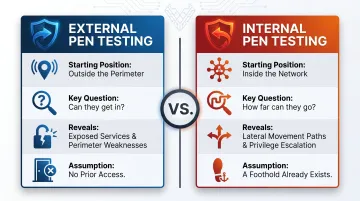
Organizations that only run external tests have no visibility into post-breach damage potential — and those that skip internal testing have no insight into how attackers move once they're inside. The two tests address fundamentally different threat scenarios, which is why neither alone is sufficient.
The most effective programs run both on a coordinated schedule — external testing to validate that perimeter controls hold, internal testing to confirm that post-breach damage is limited.
Conclusion
Internal penetration testing moves security decisions from theoretical risk assessments to evidence-based answers. It shows exactly where protection breaks down after a breach — not in the abstract, but in your specific environment, with your actual configurations and access controls.
Organizations that run internal pen tests regularly and act on the findings are in a measurably stronger position. They've seen which attack paths exist in their environment, confirmed which controls hold under pressure, and can direct security investment where it actually matters.
Vynox Security has conducted 200+ security assessments across industries over 10+ years, with a methodology built around threat-led testing that delivers findings you can act on. If you're evaluating whether your internal environment would withstand a real breach, that's exactly the question their assessments are designed to answer.
Frequently Asked Questions
What is internal network penetration testing?
Internal network penetration testing is a controlled, simulated attack launched from within an organization's network. It evaluates how much damage a threat actor with internal access — whether via compromised credentials, phishing, or an insider — could cause, including privilege escalation and lateral movement to sensitive systems.
What are the methods of internal network penetration testing?
Core techniques include network enumeration, Active Directory reconnaissance, lateral movement, and credential attacks such as pass-the-hash and SMB relay. Engagements run as black box (no prior knowledge), white box (full access details), or gray box (partial knowledge) depending on the objective.
What are the most critical steps in an internal network penetration test?
Three stages drive the most value: scoping and planning, exploitation and lateral movement, and reporting with prioritized remediation guidance. Each builds on the last — without clear scope, testing lacks direction; without prioritized reporting, findings rarely get fixed.
What is the difference between internal and external pentesting?
External pen testing evaluates whether an attacker can breach the perimeter from outside. Internal pen testing evaluates what an attacker can do once they already have internal access. Both answer different questions and are needed together for a complete security assessment.
What is the NIST standard for penetration testing?
NIST SP 800-115 is the primary federal guideline for security testing, defining four phases: Planning, Discovery, Attack, and Reporting. Published in 2008, it's widely cited by compliance frameworks including PCI DSS and SOC 2.
How often should an organization conduct internal penetration testing?
At minimum, annually — this aligns with PCI DSS Requirement 11.4.2 and SOC 2 audit expectations. Additional tests should be triggered by significant infrastructure changes, major cloud migrations, credential-related incidents, new compliance requirements, or before ISO 27001 surveillance assessments.