Introduction
Many security teams use "red teaming" and "penetration testing" as if they mean the same thing. They don't — and that confusion has real consequences. Organizations end up purchasing the wrong engagement at the wrong time, spending budget on an assessment that doesn't answer their actual security question.
A company that needs to validate its incident response capability gets a vulnerability list instead. A startup that needs a security baseline pays for a months-long covert operation it isn't ready to act on. Neither outcome serves the organization.
Both mistakes stem from the same root problem: conflating two distinct tools with different purposes. This article breaks down what each approach actually does, where they fundamentally differ, and how to choose the right one for where your security program stands today.
TL;DR
- Penetration testing is scoped, structured, and time-bound — it finds and exploits vulnerabilities in a defined target with your team's knowledge and cooperation
- Red teaming is covert and objective-driven — it simulates a real adversary pursuing a specific goal across your entire organization without your defenders knowing
- Pen testing fits compliance requirements, new system launches, and early-stage security programs; red teaming fits mature programs testing detection and response
- Pen tests run $4,000–$100,000+ over weeks; red team engagements run $40,000–$120,000+ over months
- The right choice depends on your security maturity, goals, and budget — not a universal ranking.
Red Teaming vs. Penetration Testing: Quick Comparison
| Dimension | Penetration Testing | Red Teaming |
|---|---|---|
| Primary Goal | Find and exploit maximum vulnerabilities in defined scope | Achieve a specific objective (e.g., data exfiltration) without detection |
| Scope | Specific systems, apps, or networks | Organization-wide: technology, people, processes |
| Typical Duration | 1–4 weeks | 4–8+ weeks (sometimes months) |
| Organizational Awareness | Collaborative — defenders know it's happening | Covert — only senior leadership informed |
| Attack Vectors | Technical exploitation within agreed boundaries | Multi-vector: technical, social engineering, physical |
| Cost Range | $4,000–$100,000+ | $40,000–$120,000+ |
| Security Maturity Required | Low to medium (CIS IG2) | High (CIS IG3, active SOC) |
| Output | Vulnerability list with severity ratings and remediation steps | Attack narrative, detection gaps, organizational resilience assessment |
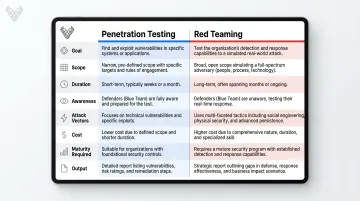
These two approaches aren't competing options. Most organizations start with penetration testing to identify and close known vulnerabilities, then graduate to red teaming once they have the security maturity to benefit from adversarial simulation. Where you are in that progression determines which one belongs on your roadmap now.
What is Penetration Testing?
Penetration testing is a structured, scoped, time-limited engagement where ethical hackers — working with full organizational knowledge and cooperation — simulate attacks against a defined target to find and exploit as many vulnerabilities as possible, then deliver prioritized remediation guidance.
NIST defines it as "a test methodology in which assessors, typically working under specific constraints, attempt to circumvent or defeat the security features of an information system."
Types of Penetration Tests
Organizations typically select one or two areas per engagement to ensure depth rather than breadth:
- Web application — OWASP Top 10, business logic flaws, authentication, session management
- API security — REST/GraphQL/SOAP endpoints, BOLA/IDOR, token handling, rate limiting
- Mobile application — Android/iOS static and dynamic analysis, insecure data storage, backend trust
- Cloud security — IAM misconfigurations, storage exposure, lateral movement paths (AWS, Azure, GCP)
- External/internal network — Perimeter exposure, internal segmentation, privilege escalation paths
- IoT — Firmware analysis, protocol security, device authentication, update mechanisms
Vynox Security covers all six, with every engagement built on manual-first testing rather than automated scanning output.
Why Manual Testing Matters
Automated scanners work by sending payloads with known malicious patterns — they have no contextual understanding of how your application is supposed to behave. That structural limitation means they consistently miss:
- Business logic flaws (for example, a checkout flow that allows negative-quantity pricing)
- Authorization bypass chains that require multiple steps
- Privilege escalation paths that depend on application-specific roles
Vynox Security was built around this gap — after observing that critical attack chains were consistently missed by automated and compliance-driven assessments. Every engagement uses manual-first testing with 100% human validation, delivering 3× deeper coverage than tool-only scans.
Compliance Frameworks Pen Testing Supports
| Framework | Requirement |
|---|---|
| PCI DSS v4.0 | Mandatory annual external and internal pen tests (Req. 11.4) |
| SOC 2 | Not explicitly required, but expected by auditors for CC4.1 and CC7.1 |
| ISO 27001:2022 | Recommended via Annex A Controls 8.8 and 8.29 |
| GDPR | Implied by Article 32(1)(d)'s requirement for regular security testing |
Where Pen Testing Fits Best
- Organizations establishing a security baseline for the first time
- SaaS companies validating new application releases before launch
- Compliance-driven teams needing documented evidence (SOC 2, PCI DSS, ISO 27001)
- Any organization with defined budget and timeline constraints
What is Red Teaming?
Red teaming is a covert, objective-driven engagement where a team of ethical hackers acts as a real-world adversary with no predefined target scope, no defender awareness, and no restrictions on attack vectors. The goal is specific: exfiltrate sensitive data, access a critical system, or compromise a privileged account — without getting caught.
NIST defines a red team as "a group authorized and organized to emulate a potential adversary's attack or exploitation capabilities against an enterprise's security posture."
The Multi-Vector Approach
Red teamers don't restrict themselves to technical exploitation. A real threat actor doesn't either. A typical red team engagement might combine:
- Technical exploits — unpatched services, misconfigurations, credential reuse
- Social engineering — phishing campaigns, pretexting, vishing calls to the help desk
- Physical intrusion — tailgating, badge cloning, attempting access to server rooms
- OSINT reconnaissance — mapping employee profiles, technology stack exposure, public breach data
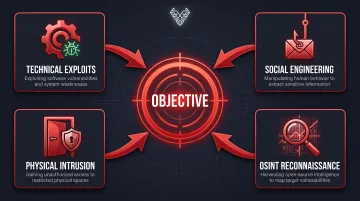
The team pursues whatever path is available, operating for weeks or months while staying below detection thresholds.
The Red Team vs. Blue Team Dynamic
The blue team (your internal security team or SOC) defends without knowing an exercise is underway. Measuring success here looks different from a standard assessment:
- Did the red team achieve its objective?
- How long did it take the blue team to detect the intrusion?
- How quickly and effectively did defenders contain and respond?
This distinction matters. According to the CrowdStrike 2026 Global Threat Report, the average eCrime breakout time dropped to 29 minutes — a 65% acceleration from 2024, with the fastest observed at just 27 seconds. Organizations that only test whether they can be breached (pen testing) but never test how fast they detect and respond are missing the most operationally critical question.
What Red Teaming Reveals That Pen Testing Cannot
Red teaming exposes gaps across three dimensions simultaneously:
- People — who clicks phishing emails, who shares credentials under pretexting
- Process — whether incident response playbooks hold up under real pressure, whether escalation procedures work
- Technology — EDR evasion, detection blind spots, logging gaps that let attackers move laterally unnoticed
Where Red Teaming Fits Best
- Organizations with a mature security program and an active blue team or SOC
- Teams wanting to stress-test incident response under realistic adversarial conditions
- Cloud service providers pursuing FedRAMP Authorization to Operate (ATO) — FedRAMP's CA-8(2) under NIST SP 800-53 Rev 5 explicitly requires red team exercises, with 3PAOs required to validate and attest to the test plan and report
- Organizations wanting to simulate advanced persistent threats against their people and infrastructure
Which One Does Your Organization Need?
Four variables drive the decision:
- Security maturity — Have you completed regular penetration tests and remediated findings?
- Engagement goal — Are you trying to find vulnerabilities, or test whether your defenses hold?
- Compliance obligations — Do your frameworks require specific testing types?
- Budget and timeline — Can you sustain a months-long covert engagement?
Each variable points toward a different answer. Here's how to apply them:
Choose Penetration Testing When:
- Your organization has never had a formal security assessment
- A specific application or system needs evaluation before launch
- You need documented evidence for SOC 2, PCI DSS, ISO 27001, or GDPR
- Budget and timeline are constrained (weeks, not months)
- You're at CIS Implementation Group 2 — establishing a pen testing program is the appropriate next step
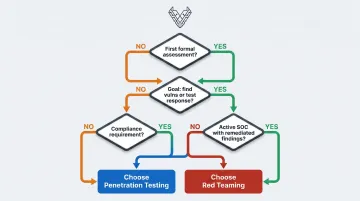
Choose Red Teaming When:
- You have an active SOC and have already remediated multiple rounds of pen test findings
- Your goal is validating incident response readiness, not finding individual vulnerabilities
- You need to simulate APT behavior targeting your people, processes, and infrastructure
- FedRAMP ATO is on your roadmap — CA-8(2) makes red teaming a distinct regulatory requirement
- You're at CIS Implementation Group 3, defending against sophisticated adversaries
A Note on Purple Teaming
Purple teaming is a collaborative variant where red and blue teams work in tandem — attackers execute techniques openly while defenders observe, adjust detection rules, and improve response in real time. It's not a replacement for either approach. The real advantage is speed: organizations get red team-level realism while defenders absorb and apply lessons in the same session — rather than weeks later in a report. Think of it as structured knowledge transfer with adversarial pressure applied in real time.
Conclusion
Penetration testing identifies exploitable weaknesses in defined systems and generates actionable remediation guidance. Red teaming tests whether your entire organization — its people, processes, and technology — can withstand and respond to a coordinated, realistic attack. Both are necessary at different stages of a security program's maturity.
The practical sequence: start with quality penetration testing to build your security baseline and satisfy compliance requirements. Once your defenses are mature enough to be meaningfully challenged — once you have a functioning SOC and remediated findings from multiple engagements — graduate to red teaming.
Whichever path you choose, the quality of the engagement matters as much as the type. Automated scanning dressed up as a penetration test won't close your real risk gaps. Manual-first, threat-led testing — the kind that thinks like an attacker rather than a compliance checklist — is what produces real security improvement.
Frequently Asked Questions
Frequently Asked Questions
What is a red team in penetration testing?
A red team is a group of ethical hackers who simulate real-world adversaries to test an organization's overall security posture, operating covertly to pursue specific objectives. Unlike a standard pen test team, red teamers work without predefined scope restrictions and without the defenders' knowledge.
What is the difference between a red team operator and a pentester?
A pentester systematically identifies and exploits vulnerabilities within an agreed scope, focusing on maximum vulnerability coverage. A red team operator employs broader adversary tactics (social engineering, physical access, stealth persistence) to achieve a specific objective without triggering detection.
What is the difference between red team and blue team testing?
The red team plays the attacker, attempting to breach systems covertly while pursuing a defined objective. The blue team plays the defender, monitoring for and responding to threats. Red team exercises measure how effectively the blue team detects and contains a realistic attack, all without advance warning.
How is red teaming different from penetration testing?
Three core differences: scope (specific systems vs. entire organization), awareness (collaborative vs. covert), and goal (find vulnerabilities vs. test holistic defense response including people and processes). Pen testing confirms whether a breach is possible. Red teaming tests whether your team would actually detect and stop one.
What is another name for penetration testing?
Penetration testing is commonly called "pen testing" or "ethical hacking." Some organizations also use "security testing" or "intrusion testing," though "penetration testing" is the formal term used by NIST and OWASP.
Can an organization benefit from both penetration testing and red teaming?
Yes. Most mature security programs use both. Regular penetration tests find and fix specific vulnerabilities and maintain compliance. Periodic red team exercises (typically every 12–18 months) validate whether defenses, people, and processes hold up against a realistic adversary.