This guide covers everything you need to know about network vulnerability assessments (NVAs): what they are, what they look for, how they work step by step, how they compare to penetration testing, and how often to run one.
TL;DR
- Finds, evaluates, and prioritizes security weaknesses across your network infrastructure — before attackers do
- Covers devices, configurations, access controls, and architecture — not just software patches
- Follows five phases: planning, discovery, scanning, analysis, and remediation verification
- NVAs identify weaknesses; penetration testing exploits them — different purposes, both required by frameworks like SOC 2 and ISO 27001
- Most organizations should run assessments quarterly at minimum, monthly for high-risk environments
What Is a Network Vulnerability Assessment?
A network vulnerability assessment is a structured, proactive process of identifying, evaluating, and prioritizing security weaknesses across your network infrastructure — routers, switches, firewalls, servers, endpoints, and cloud-connected systems.
Unlike endpoint security tools that rely on agents installed on managed devices, an NVA examines network-level components that are often "un-agentable" and routinely overlooked.
That gap is costly. 74% of cybersecurity leaders have experienced incidents caused by unknown or unmanaged assets — exactly what a well-executed NVA is designed to surface.
Understanding the definition is a starting point. How an NVA actually works — and what separates a useful one from a checkbox exercise — comes down to two complementary approaches.
Automated Scanning vs. Manual Assessment
Most NVAs combine both, and the distinction matters:
- Automated scanning identifies known vulnerabilities efficiently by probing systems against CVE databases. Fast and broad, but generates noise and misses context
- Manual assessment validates scan results, eliminates false positives, and uncovers logic-level issues that automated tools cannot detect — misconfigured access controls, chained attack paths, architecture weaknesses
Neither approach alone is sufficient. Authenticated scanning yields up to 300% more unique vulnerabilities than unauthenticated scanning, but raw scan output still requires human analysis to separate real risk from theoretical findings.
What the Output Looks Like
A completed NVA delivers more than a raw scan report. Expect:
- A prioritized list of vulnerabilities with severity ratings (CVSS scores)
- Affected systems and asset criticality context
- Business impact assessment for each finding
- Specific remediation recommendations
Prioritization separates useful output from overwhelming output. A long flat list of vulnerabilities gives your team no clear starting point. A ranked list tied to asset value and exploitability tells you exactly where to act first — before attackers do.
What Does a Network Vulnerability Assessment Look For?
NVAs cast a wide net. The most common vulnerability classes fall into three categories.
Unpatched Software and Configuration Weaknesses
- Unpatched operating systems and applications — vulnerability exploitation accounted for 20% of all breaches in 2025, a 34% year-over-year increase per the Verizon DBIR
- Outdated firmware on network devices — only ~54% of edge device vulnerabilities were fully remediated over the past year; median remediation time for critical edge flaws sits at 32 days
- Misconfigured firewalls and ACLs — CISA specifically flags incorrectly applied permissions and open ports (RDP, SMB, Telnet) as routinely exploited weak controls
- Cloud misconfigurations — approximately 23% of cloud security incidents stem from configuration errors

Access Control Weaknesses
- Default or weak passwords — 86% of users have never changed their router's default admin password, per IBM research
- Absent MFA — stolen credentials appear in 31% of breaches as an initial access vector
- Overly permissive user privileges — excessive access rights allow attackers to move laterally once inside
- Unnecessary open ports and services — each exposes an additional attack surface with no business justification
Architecture and Human-Factor Issues
- Poor network segmentation — a critical architectural flaw; flat networks let attackers move laterally across the entire environment once a single segment is breached
- Shadow IT — unregistered devices and unauthorized cloud services bypass security controls entirely
- Human error — the Verizon 2024 DBIR found the human element present in 68% of breaches, with misconfigurations and misdeliveries making up a consistent share
- Phishing susceptibility and credential reuse — both are discoverable through a network vulnerability assessment, along with accidental data exposure
Steps in a Network Vulnerability Assessment
A well-run NVA isn't a one-off scan — it's a repeatable process where each phase builds on the last.
Step 1: Planning and Scope Definition
Before any scanning begins, define:
- Goals — compliance requirement, risk reduction, specific system coverage, post-incident review
- Assets in scope — devices, subnets, cloud integrations, third-party connections
- Rules of engagement — scan windows, exclusion lists, points of contact to avoid disrupting operations
Skipping this step is among the most common NVA mistakes. Without clear scope, assessments miss critical assets or produce findings that can't be mapped to remediation owners.
Step 2: Asset Discovery and Inventory
Discovery tools map all live devices, open ports, operating systems, and running services — including shadow IT and devices absent from the official asset register. The scale of the gap is often underestimated: approximately 30% of IT assets are never entered into the system of record, per Gartner data.
You cannot assess what you don't know exists. Asset inventory is the foundation everything else rests on.
Step 3: Vulnerability Scanning
Automated tools (Nessus, OpenVAS, Nmap) probe network devices to detect known vulnerabilities by comparing findings against CVE databases. Key configuration decisions at this phase:
- Authenticated vs. unauthenticated scans — authenticated scans yield far more findings with fewer false positives; PCI DSS 4.0 now mandates authenticated internal scans under Requirement 11.3 (effective March 2025)
- Scan frequency and scheduling — timed to avoid operational disruption
- Exclusion lists — systems that require special handling or fall outside scope
Scanning produces raw output — not a finished assessment.
Step 4: Analysis and Prioritization
Turning that raw output into actionable findings requires human analysis:
Filter false positives from genuine findings
Cross-reference vulnerabilities against asset criticality
Assign severity using CVSS 4.0 scores (the current standard, released November 2023)
Build a prioritized remediation list — not a flat inventory of every flagged item
The key principle here: combine vulnerability severity with business impact. A critical CVE on an isolated test server is less urgent than a medium-severity misconfiguration on a customer-facing payment system. Asset context determines real priority.
Step 5: Remediation and Verification
Remediation actions typically include:
- Patching software and firmware
- Reconfiguring firewall rules and ACLs
- Closing unnecessary ports and disabling unused services
- Updating access controls and rotating credentials
- Applying compensating controls where immediate patching isn't feasible
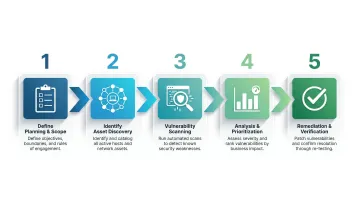
Remediation must be followed by verification. A re-scan or manual retest confirms vulnerabilities are actually resolved — not just marked closed in a spreadsheet. Vynox Security treats remediation support and retesting as part of every engagement, not an add-on — so internal teams get direct validation rather than a list of findings to figure out alone.
Network Vulnerability Assessment vs. Penetration Testing
These two services are often confused, and the difference matters when choosing what your organization actually needs.
| NVA | Penetration Testing | |
|---|---|---|
| Approach | Identifies and reports weaknesses | Actively exploits weaknesses |
| Depth | Broad coverage across all assets | Deep, scenario-based on specific targets |
| Output | Prioritized vulnerability list | Demonstrated attack paths and business impact |
| Frequency | Quarterly or continuous | Annual or after major changes |
| Best for | Regular coverage, compliance baselines | Proving exploitability, attack simulation |
NVAs are the right tool for regular, broad coverage and compliance reporting. Penetration testing is appropriate for validating specific systems, testing incident response, and demonstrating real-world exploitability. Most mature security programs — and most compliance frameworks — require both.
What Automated Tools Miss
Automated scanners cannot detect business logic flaws, context-dependent misconfigurations, or chained attack paths that only surface through manual expert analysis. A scanner might flag an open port. A skilled tester determines whether that port — combined with weak credentials and insufficient segmentation — creates a viable path to your most sensitive systems.
Vynox Security's approach combines automated scanning with 100% manual validation precisely because of this gap. Every finding is reviewed by a human analyst before it reaches your report — so what you receive is a prioritized, actionable list, not a raw dump of scanner output.
Why Network Vulnerability Assessments Matter
The Business Case
The cost of doing nothing is quantifiable. IBM's 2025 data puts the US average breach cost at $10.22 million. In healthcare, that figure climbs to $7.42 million — the most expensive industry for the 14th consecutive year.
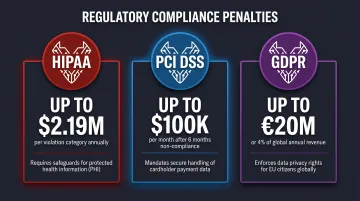
Regulatory penalties compound that exposure further:
- HIPAA violations — up to $2.19 million per violation category annually
- PCI DSS non-compliance — up to $100,000 per month after six months
- GDPR — up to €20 million or 4% of global annual revenue
32% of organizations hit by a breach were required to pay regulatory fines, with 48% of those fines exceeding $100,000.
Compliance Requirements
Regular vulnerability assessments are explicitly required across major frameworks:
- PCI DSS 4.0 — quarterly internal and external scans, authenticated internal scans mandated
- HIPAA — risk analysis required under 45 CFR 164.308, interpreted to include vulnerability assessment
- SOC 2 — periodic vulnerability scans required under CC7.1
- ISO 27001:2022 — Annex A Control 8.8 mandates systematic identification and timely remediation
- GDPR — Article 32 requires appropriate technical security measures
Regular NVAs create an audit trail demonstrating due diligence — documentation that becomes critical when regulators come asking after an incident.
The Proactive Posture
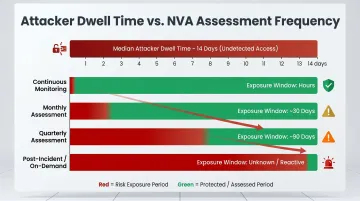
Organizations that run structured assessments find vulnerabilities on their own schedule and patch them before attackers can exploit them. Those that skip this step hand that advantage to the other side. Global median dwell time has worsened to 14 days — meaning attackers increasingly operate inside networks undetected for longer. A consistent NVA program shortens that exposure window and keeps remediation on your terms, not theirs.
How Often Should You Run a Network Vulnerability Assessment?
Frequency should match your risk profile:
| Environment | Recommended Frequency |
|---|---|
| Standard business networks | Quarterly minimum |
| Internet-facing systems | Monthly |
| Healthcare, finance, regulated industries | Monthly or continuous |
| After significant infrastructure changes | Immediately (new devices, cloud expansions, software updates) |
| Post-security incident | On-demand, before returning to normal operations |
PCI DSS quarterly scanning is the most widely cited compliance baseline. For organizations with dynamic environments — frequent deployments, cloud infrastructure growth, remote workforces — continuous or managed assessment programs close the gaps that point-in-time scans leave open.
That's where managed assessment programs become practical. Vynox Security's Managed Security Services delivers continuous vulnerability monitoring, configuration reviews, and remediation tracking — functioning as an extension of your internal security team rather than a vendor that hands off a report and disappears.
Frequently Asked Questions
What is a network vulnerability assessment?
A network vulnerability assessment is a proactive, structured process for identifying, evaluating, and prioritizing security weaknesses across network infrastructure — including devices, configurations, and access controls. The goal is finding exploitable gaps before attackers do, with output that drives prioritized remediation.
What are the steps in a network vulnerability assessment?
Five core phases: planning and scope definition, asset discovery, vulnerability scanning, analysis and prioritization, and remediation with verification. Each phase builds on the last — skipping any step compromises the accuracy and usefulness of the final findings.
What are CVE, CVSS, and CWE?
CVE is a standardized catalog of known vulnerabilities; CVSS is the 0–10 severity scoring system used to prioritize them (currently version 4.0); CWE classifies the underlying weakness types that cause vulnerabilities. All three are maintained by MITRE and used together to drive consistent, risk-based remediation decisions.
How is a network vulnerability assessment different from penetration testing?
An NVA identifies and reports weaknesses without exploiting them — broad coverage, ideal for compliance and regular monitoring. Penetration testing actively simulates real attacks to demonstrate exploitability and business impact. If you need to know what's exposed, start with an NVA. If you need to know what an attacker can actually do with it, you need a pentest — and most compliance frameworks require both.
How often should a network vulnerability assessment be conducted?
Quarterly is the standard minimum for most organizations. Monthly for internet-facing systems or regulated industries like healthcare and finance. On-demand after any significant network change — new device rollouts, infrastructure expansions, or security incidents.
Can automated scanning tools replace manual security assessment?
No. Automated tools efficiently detect known, catalogued vulnerabilities, but miss business logic flaws, chained attack paths, and context-specific risks. Manual expert review is essential to validate what automated scans find — and to uncover what they cannot.