
Introduction
$2.2 billion stolen from crypto platforms in 2024 — a 21% year-over-year increase. Then Q1 2025 arrived and made that look modest: $1.63 billion disappeared in just three months, driven largely by the $1.46 billion Bybit hack.
For teams building DeFi protocols, NFT platforms, or enterprise blockchain deployments, those numbers represent a simple reality: a security audit isn't a launch formality. It's the difference between a functioning protocol and a post-mortem.
This guide breaks down what blockchain security audits actually examine, how the process works, which vulnerabilities get surfaced most often, and what separates a rigorous auditor from one running automated scans with a report wrapper. Whether you're approaching mainnet deployment or hardening an existing protocol, you'll finish with a concrete framework for making the right call.
TL;DR
- Blockchain security audits cover smart contracts, consensus mechanisms, key management, and governance — not just surface-level code scans
- Pre-deployment auditing is essential — deployed smart contracts can't be patched after launch
- Access control failures and business logic flaws — the costliest vulnerabilities — require manual review to catch
- A single audit isn't enough; continuous monitoring and re-auditing after upgrades are essential
- Audit costs range from $5,000 for simple tokens to $500,000+ for complex bridge and ZK-rollup systems
What Is a Blockchain Security Audit?
A blockchain security audit is a systematic, technical evaluation of a project's smart contract code, protocol architecture, consensus mechanisms, and operational controls. What sets it apart from a standard software audit is what happens when something goes wrong: blockchain deployments are largely immutable, so bugs discovered after launch can't be patched the same way traditional software can.
When a vulnerability is discovered in conventional software, a patch ships within days. With smart contracts, there's no patch cycle. The 2016 DAO hack made this concrete — a reentrancy flaw allowed an attacker to drain 3.6 million ETH before anyone could respond. The only resolution was an unprecedented Ethereum hard fork, splitting the network into ETH and ETC. That's what a missed vulnerability costs when there's no rollback button.
Two Primary Audit Categories
Most blockchain security audits fall into one of two categories — or cover both:
- Protocol audits examine the underlying infrastructure: node configurations, validator setups, consensus logic, and network-level security
- Smart contract audits review the self-executing code governing transactions, token logic, and DeFi mechanics — line by line
Skipping protocol-level review while only auditing contracts leaves the foundation unexamined. Comprehensive coverage requires both.
When to Audit
Audits aren't a one-time pre-launch checkbox:
- Before mainnet deployment (always)
- After any significant code update or protocol upgrade
- When integrating new chains, bridges, or third-party oracles
- At regular periodic intervals — quarterly or semi-annually for active protocols
Key Components of a Blockchain Security Audit
Smart Contract Code Review
Auditors perform line-by-line analysis of contract code (Solidity, Rust, Vyper) looking for reentrancy, unchecked math, improper access control, and flawed state management. Manual review is non-negotiable here.
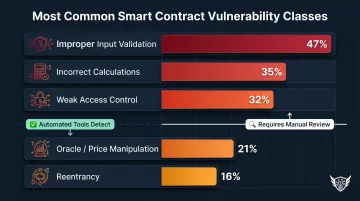
According to Immunefi's 2024 Hacker Ecosystem Survey, the most common vulnerability classes encountered by security researchers are:
| Vulnerability Class | % of Researchers Encountering It |
|---|---|
| Improper input validation | 47% |
| Incorrect calculations | 35% |
| Weak access control | 32% |
| Oracle/price manipulation | 21% |
| Reentrancy | 16% |
These top categories — input validation, calculations, access control — are business logic problems. Automated tools scan for pattern matches; they don't understand intent. The exploits that cost protocols millions consistently live in that gap between what a scanner flags and what a human recognizes as flawed logic.
Consensus Mechanism & Node Security
Auditors assess whether the chosen consensus model (PoW, PoS, DPoS) is correctly implemented and whether node configurations are hardened against long-range attacks, Sybil attacks, and stake manipulation. A correctly written smart contract running on a misconfigured validator network is still a vulnerable protocol.
Private Key & Wallet Management
Private key compromises accounted for 43.8% of all stolen crypto in 2024. Auditors evaluate how keys are stored, rotated, and protected — whether hardware security modules (HSMs), multi-signature schemes, or secure enclave solutions are in place. A single exposed key can drain an entire treasury.
Third-Party Integrations & Oracle Security
External data feeds, cross-chain bridges, and third-party libraries are common infiltration vectors. The Ronin ($625M), Wormhole ($320M), and Nomad ($190M) bridge exploits together exceeded $1.1 billion — all through integration-level vulnerabilities rather than core contract logic.
Auditors verify:
- Oracle aggregation from multiple sources
- Time-weighted average price (TWAP) implementations
- Library integrity via checksums and pinned versions
- Bridge logic for race conditions and flash loan exposure
Governance & Compliance Review
On-chain governance (token-holder voting, upgrade mechanisms) creates its own attack surface. Governance token accumulation attacks and malicious proposal injection are documented, real-world vectors — not theoretical edge cases.
Auditors review governance and compliance across several areas:
- Voting logic for token accumulation exploits and quorum manipulation
- Upgrade mechanisms for unauthorized proposal injection risks
- Compliance alignment with AML, ISO 27001, and GDPR requirements
- Regulatory obligations specific to the protocol's operating jurisdictions
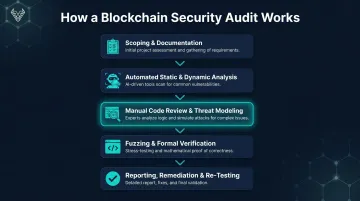
Step-by-Step: How a Blockchain Security Audit Works
Step 1 — Scoping & Documentation Gathering
Define exactly what's in scope: which contracts, chains, bridges, and off-chain components. Establish a code freeze — no new commits while the audit is active. Collect whitepapers, architecture diagrams, and any prior audit reports. Auditors who skip this step often discover mid-engagement that key components were never included — invalidating findings and forcing scope renegotiation under time pressure.
Step 2 — Automated Static & Dynamic Analysis
Auditors deploy specialized tools to scan for known vulnerability signatures:
- Slither (Trail of Bits) — converts Solidity to an intermediate representation, detects reentrancy, uninitialized storage, and tx.origin misuse in under one second per contract
- Echidna — property-based fuzzer that tests contract invariants via random input generation
- MythX — combines static analysis, symbolic execution, and fuzzing
These tools catch common issues quickly. They also generate false positives and miss complex logical flaws. They're a starting point, not a conclusion.
Step 3 — Manual Code Review & Threat Modeling
Experienced auditors manually trace execution paths, verify mathematical correctness in token economics and fee calculations, and build a threat model that maps realistic attack scenarios to specific contract logic. This is where automated tools consistently fall short — they detect pattern signatures, not intent.
Manual review catches what scanners can't:
- Business logic vulnerabilities — flaws in how contract rules interact under real-world conditions
- Flash loan exploits — attack paths that manipulate prices or liquidity within a single transaction
- Governance manipulation risks — vote-buying, proposal front-running, and quorum bypass techniques
Step 4 — Fuzzing & Formal Verification
For high-value contracts, advanced techniques add another layer:
- Fuzz testing feeds randomized inputs to discover unexpected edge cases that structured tests miss
- Formal verification mathematically proves contract properties hold under all conditions — CertiK demonstrated this approach would have caught the Beauty Chain integer overflow exploit that allowed an attacker to generate 7.51 × 10⁵⁸ fraudulent tokens
Step 5 — Reporting, Remediation & Re-Testing
The audit concludes with a severity-ranked report:
- Critical — exploitable now, requires immediate fix before any deployment
- High — significant risk, fix before launch
- Medium — moderate exposure, fix in near term
- Low / Informational — minor issues and best practice recommendations
A responsible audit firm retests after fixes are applied. Report delivery without re-testing is incomplete work.
Top Blockchain Security Vulnerabilities Audits Uncover
Reentrancy Attacks
A malicious contract calls back into a vulnerable contract before the first execution completes — draining funds repeatedly in a single transaction. The DAO hack is the clearest real-world case: 3.6 million ETH drained through a single recursive call flaw.
Code pattern review catches this early; the checks-effects-interactions pattern is the standard fix.
Flash Loan Exploits & Oracle Manipulation
Attackers use uncollateralized flash loans to temporarily manipulate price feeds, trigger artificial liquidations, or exploit arbitrage windows. The scale of damage is significant:
- Mango Markets lost $112 million in October 2022 through this exact mechanism
- In 2022 alone, over $403 million was stolen across 40+ oracle manipulation attacks
Audits address this by verifying TWAP implementations, oracle aggregation logic, and circuit breakers that freeze abnormal activity.
Integer Overflow/Underflow
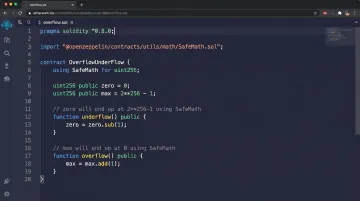
Unlike external manipulation attacks, this vulnerability lives inside the code itself. Older Solidity versions without safe math libraries are vulnerable to integer wrapping — extreme inputs cause counters to roll over to zero or maximum values, corrupting token balances or bypassing access controls.
Solidity 0.8.0 introduced built-in overflow protection, but contracts compiled with earlier versions without SafeMath remain exposed. Audits verify compiler version requirements and confirm safe math usage throughout.
Private Key Exposure & Supply Chain Attacks
Two related risks auditors check:
- Hardcoded keys — developers embedding credentials in repositories or config files, detectable via code scanning and git history review
- Compromised dependencies — third-party libraries injecting backdoors into production code, caught through dependency analysis and pinned version checksums
Blockchain Security Audit Best Practices
Use a Manual-First, Layered Approach
Automated scanners catch common patterns. They don't catch the business logic flaws that cause the most expensive exploits. The data supports this directly — access control failures alone cost $953 million in 2024, and these require human understanding of protocol intent to detect.
Vynox Security was founded on this gap: automated tools and checklist-driven assessments consistently missed critical attack chains and authorization gaps, leaving teams with a false sense of security.
Their manual-first methodology combines automated tooling with expert manual review and threat modeling, achieving 3× deeper vulnerability coverage than tool-only scans. This proves especially critical for complex DeFi logic and cross-chain bridge code, where automated tools routinely fall short. Catching those gaps before launch is exactly where code discipline becomes the next line of defense.
Enforce Code Freeze and Shift-Left Security
Most exploits target code changes made under launch pressure. Two practices reduce this risk substantially:
- Code freeze before audit — no new commits during the review window
- Shift-left security — integrate security checks into CI/CD pipelines from the start, treating security as a development phase rather than a pre-launch gate
Tools like Slither run in under a second per contract, making continuous automated scanning on every commit entirely practical.
Build in Continuous Monitoring Post-Audit
A one-time audit is a point-in-time snapshot. As protocols evolve, so does their attack surface. In 2024, approximately 60% of exploited protocols by dollar value had been previously audited; the exploits hit code changes or integration updates that post-dated the original review.
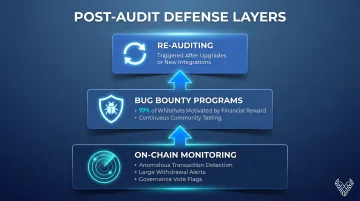
Post-audit defense layers include:
- On-chain monitoring tools flagging anomalous transaction patterns (sudden large withdrawals, repeated contract calls, unusual governance votes)
- Active bug bounty programs (77% of whitehat hackers are primarily motivated by financial opportunity, making bounties an effective continuous testing layer)
- Re-auditing after any significant upgrade or new integration
The 2024 DeFi ecosystem recovered approximately $220 million (roughly 15% of stolen funds) through white-hat interventions and on-chain negotiations. That's a meaningful outcome, but at roughly 15% of total losses, it underscores why prevention beats recovery every time.
How to Choose the Right Blockchain Security Auditor
Evaluate Expertise & Track Record
Look for:
- Proven experience with your specific blockchain stack (EVM, Solana, Cosmos, Layer 2s)
- Published audit reports with verifiable outcomes — not just certificates
- Auditors who demonstrate threat-led thinking, not checkbox compliance
- Experience across DeFi, NFT platforms, and enterprise deployments
Red flags (sourced from audit firm practitioners):
- No named auditors assigned to your engagement
- Unrealistic timelines ("3 days, no problem")
- No sample reports available on request
- No fix verification round included in scope
- Any promise of "100% security"
Assess Methodology: Manual vs. Tool-Only
Once you've confirmed an auditor's track record, dig into how they actually work. Ask prospective auditors directly: what percentage of your findings come from manual analysis versus automated tools? Request a sample report and check whether findings include specific remediation guidance, proof-of-concept details, and risk impact context — or just a list of scanner outputs.
Auditors who rely primarily on automated scanners will miss the attack chains that cause real losses. Euler Finance lost $197 million and Hedgey Finance lost $44.7 million in 2024 despite both having completed professional audits.
Methodology depth matters more than the audit certificate.
Look for Clear Reporting & Post-Audit Support
A quality audit delivers:
- Severity-ranked findings with specific, actionable remediation steps
- Re-testing after fixes are applied — not just report delivery
- Fast response during the fix cycle (sub-24-hour response times for urgent questions)
Vynox Security maintains an average response time under 24 hours and supports clients through remediation via dedicated Slack channels — not email queues. That access matters most during the fix cycle, when fast answers directly affect how quickly vulnerabilities get resolved before launch.
Frequently Asked Questions
What is a blockchain security audit?
A blockchain security audit is a systematic technical review of a project's code, architecture, and smart contracts to identify vulnerabilities before they can be exploited. Because deployed smart contracts are immutable once live, there's no patch cycle — flaws must be caught before launch.
Can blockchain be audited?
Yes — blockchain systems can and should be audited, covering smart contract code, consensus mechanisms, node infrastructure, wallet security, and governance. Unlike traditional software, deployed contracts can't be patched after the fact, which makes pre-launch review far more consequential.
What does a blockchain auditor do?
A blockchain auditor reviews smart contract code, tests for known exploit patterns, performs threat modeling, examines key management practices, verifies governance configurations, and delivers a severity-ranked report with remediation guidance. After fixes are applied, the auditor retests to confirm every vulnerability is fully closed.
What are the key steps in the audit process?
A typical audit moves through: scoping and documentation gathering, automated static/dynamic analysis, manual code review, threat modeling, fuzzing and formal verification (for high-value contracts), remediation support, and re-testing. Each phase builds on the last — skipping steps is where exploitable gaps tend to emerge.
How much does a blockchain security audit cost?
Costs range from $5,000–$15,000 for simple ERC-20 tokens, $20,000–$50,000 for medium-complexity DeFi protocols, and $150,000–$500,000 for complex systems like bridges and ZK-rollups. Hourly rates for experienced blockchain security experts typically run $800–$1,200/hr. The right frame for evaluating cost is potential loss exposure — a $30,000 audit on a protocol holding $10M in user funds is straightforward math.
What is the 51% rule in blockchain?
A 51% attack occurs when a single entity gains control of more than half of a network's mining hash rate or staking weight, allowing them to rewrite transaction history, double-spend coins, or block new transactions. Historical examples include Bitcoin Gold (~$18M lost, 2018) and multiple Ethereum Classic attacks in 2020. Security audits assess consensus configurations and validator distribution to evaluate a network's resistance to this attack.