Rust-based protocol teams often assume they're protected. The language's memory safety guarantees are real — but they address a narrow class of bugs. Buffer overflows and dangling pointers are off the table. Logic errors, broken access control, and misuse of unsafe blocks are not.
Three Sigma's analysis of Solana's exploit history puts this plainly: over $1 billion in losses across various Solana protocols, none caused by memory corruption. Every major hack traced back to application-level flaws that Rust's compiler had no mechanism to prevent.
This guide covers why Rust contracts still require audits, which vulnerabilities actually appear in production, how a proper audit is structured, and what development practices reduce risk before the first line of code ever reaches an auditor.
TL;DR
- Rust's memory safety eliminates buffer overflows — not logic errors, broken access control, or unsafe block misuse
- The top vulnerabilities in Rust smart contracts: integer overflow, missing signer checks, incorrect state ordering, unsafe block violations, and dependency risks
- Effective audits combine automated tools (cargo-audit, Clippy, Miri) with manual review — automation and human analysis each catch what the other misses
- Security built into development from day one costs far less than fixing vulnerabilities after launch
Why Rust Smart Contracts Still Need Security Audits
The Memory Safety Misconception
Rust's borrow checker and ownership model prevent a well-defined set of low-level bugs at compile time. That guarantee is genuine and valuable. What it doesn't cover is everything else.
The compiler cannot tell you whether your permission check is logically correct, whether state updates happen in the right order relative to external calls, or whether your token distribution logic matches what your whitepaper actually specifies. Those are business logic problems — and the type system has no way to catch them.
What Remains Fully Exploitable
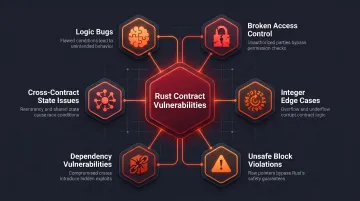
The vulnerability classes that cause production losses in Rust contracts include:
- Logic bugs — incorrect business rules that the type system cannot validate
- Broken access control — functions that fail to verify caller authority before executing privileged operations
- Integer edge cases — arithmetic that wraps or truncates in release builds when inputs reach boundary values
- Unsafe block violations — developer-introduced undefined behavior the compiler explicitly stops checking
- Dependency vulnerabilities — flaws imported from third-party crates, not written by your team
- Cross-contract state issues — unexpected execution ordering in NEAR, Solana, or Substrate multi-call flows
Immutability Changes the Stakes
On-chain code cannot be quietly patched. A missed vulnerability in a deployed contract is either exploited or left sitting as a live target. There is no silent update, no hotfix pushed overnight. Pre-deployment review is the only point in the lifecycle where findings can be fixed without consequence — which makes skipping it a structural risk, not just a quality concern.
Common Vulnerabilities in Rust Smart Contracts
Unsafe Block Misuse
Rust allows developers to bypass compiler safety checks inside unsafe blocks. The compiler stops enforcing alignment, aliasing, and lifetime rules the moment you enter one. Violations produce undefined behavior — code that may appear to function correctly in testing but behaves unpredictably under adversarial inputs.
Every unsafe region needs a clearly documented invariant explaining why it's sound. Without that documentation, neither internal reviewers nor external auditors can verify correctness — and attackers don't need the documentation to find the gap.
Integer Overflow and Underflow
Rust panics on integer overflow in debug builds. In release builds — which is what actually runs on-chain — overflow wraps silently by default. Custom arithmetic in token balance calculations, reward distributions, or fee logic can produce wildly incorrect results when inputs reach boundary values.
As Cantina notes, casting between integer types with as without bounds checks creates truncation risks that are structurally similar to Solidity's classic overflow pattern, exploitable through the same economic attack vectors.
Broken Access Control
Functions that don't verify the caller's role or authority before executing privileged operations are consistently one of the top vulnerability classes across all smart contract languages. On Solana specifically, two failure patterns appear repeatedly:
- Missing signer checks — the program doesn't confirm the expected account actually signed the transaction
- Missing ownership checks — the program doesn't verify the account owner matches the expected program ID
The Cashio exploit ($52 million, March 2022) is a direct example: missing account validation let an attacker supply fake collateral accounts and mint unbacked tokens with no authorization at all.
Incorrect State Management and Reentrancy-Like Patterns
Rust prevents some reentrancy vectors by design, but cross-contract call patterns reintroduce the risk in complex DeFi protocols.
NEAR's documentation states explicitly that "between a cross-contract call and its callback, any public method of your contract can be executed by anyone." That means any method could fire between a call and its callback — potentially multiple times. State must be updated before any external call is made, not after, and the contract must be designed assuming that sequence will be violated by an adversary.
Dependency and Supply Chain Risks
Rust contracts routinely import third-party crates for cryptography, serialization, and math. Sonatype's 2024 State of the Software Supply Chain report found that 512,847 malicious components were introduced to open source ecosystems since late 2023, with 80% of enterprise application dependencies unmanaged.
cargo-audit checks Cargo.lock against the RustSec Advisory Database and catches known vulnerabilities. It does not catch zero-days, logic flaws in dependencies, or malicious packages not yet catalogued. It's a necessary baseline, not a complete defense.
How a Rust Smart Contract Audit Works
A proper audit is a structured multi-phase process, not a single scan. The depth of each phase determines whether critical bugs are actually found.
Pre-Audit Preparation
Before any code review begins, auditors collect:
- Protocol documentation (whitepapers, architecture diagrams, specification comments)
- The exact build environment — typically WASM-targeted for Solana, NEAR, or Substrate
- A clear statement of what the contract is supposed to do
That last point matters more than it sounds. Auditors can only identify a gap between intent and implementation if they understand the intent. Contracts with poor documentation require considerably more manual effort to audit and produce less reliable results.
Automated Analysis and Manual Code Review
The automated phase opens the review:
- cargo-audit scans
Cargo.lockfor dependencies with known advisories - Clippy flags Rust anti-patterns and security-relevant lint warnings
- Miri detects undefined behavior in
unsafecode — out-of-bounds memory accesses, use-after-free, uninitialized reads - RustSec provides the advisory database that backs dependency scanning
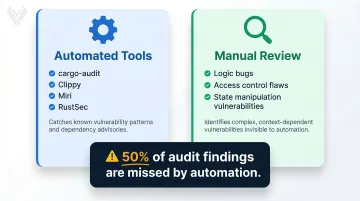
These tools are the opening scan. They are not the final verdict.
Manual review is where the highest-value findings surface. Security experts trace data flows function by function, validate logic against the specification, and probe edge cases that no automated tool can reason about. An academic analysis from 2025 found only 12 security analysis tools exist for Solana compared to 113 for Ethereum — meaning the reliance on manual expertise in Rust contract audits is far greater than most teams anticipate.
That gap in tooling has a direct consequence. Trail of Bits' aggregate audit data shows approximately 50% of all audit findings are unlikely to be caught by any automated tool. Logic bugs, access control flaws, and subtle state manipulation vulnerabilities surface through human reviewers reasoning about behavior — not pattern-matching against known signatures.
Testing, Simulation, and Reporting
The testing phase moves from review to active verification:
- Unit and integration tests are written or reviewed for coverage of edge cases and error paths
- Simulated attack scenarios — reentrancy attempts, overflow inputs, malformed messages — are executed to confirm behavior under adversarial conditions
- Fuzzing targets are applied at deserialization and input-parsing boundaries
Auditors then document findings with severity levels and specific remediation guidance. Once fixes are applied, a re-audit confirms the issues are resolved without introducing new ones. The final published report also functions as a trust signal for users, investors, and integrating protocols — and is increasingly a prerequisite for serious DeFi integrations.
Security Best Practices for Rust Smart Contract Development
Security in Rust smart contract development lives in the daily habits of writing, reviewing, and maintaining code — not in a final checklist before deployment.
During Development
edge cases
- Test cross-contract call sequences for state consistency after callbacks
Common Audit Mistakes That Put Projects at Risk
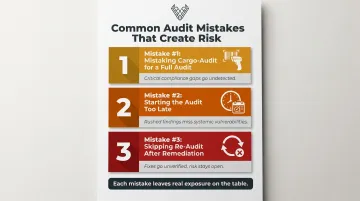
Three mistakes show up repeatedly across Rust smart contract projects — and each one leaves real exposure on the table.
Mistaking cargo-audit for a full audit. Static analyzers surface known patterns and catalogued advisories. They cannot evaluate business logic, governance flaws, or custom protocol interactions. A project that runs
cargo-auditand calls it done has been scanned, not audited.Starting the audit too late. Contracts reviewed after architecture decisions are locked in are harder and more expensive to fix. Issues discovered at this stage can require significant redesign — adding weeks to launch timelines. An earlier review, even a lightweight architecture assessment, catches structural problems when they're still cheap to address.
Skipping the re-audit after remediation. Patching a vulnerability without re-verification is a common oversight. Fixes can introduce new bugs, alter behavior in adjacent functions, or incompletely address the original finding. The contract going to mainnet should reflect the reviewed state — not the pre-fix version plus unverified commits.
Frequently Asked Questions
How do you audit a Rust smart contract?
Auditing follows a structured sequence: environment setup and documentation review, automated scanning (cargo-audit, Clippy), expert manual review, attack simulation and fuzzing, and a re-audit after fixes. Each phase builds on the last. Skipping any step leaves entire categories of risk unexamined.
How much does a Rust smart contract audit cost?
Cost depends on contract complexity, code volume, and target blockchain. Simple token contracts run $5,000–$15,000; standard DeFi protocols typically land at $50,000–$100,000. Rust-specific audits carry a 20–30% premium over EVM equivalents, and rushed timelines add another 30–50%. Complex bridges or ZK systems can exceed $300,000.
Do I still need an audit if Rust provides memory safety?
Yes. Memory safety eliminates buffer overflows and use-after-free bugs — not logic errors, broken access control, or unsafe block misuse. Every major documented Solana exploit to date was caused by application-level logic flaws, none by memory corruption.
What are the most common vulnerabilities found in Rust smart contracts?
The recurring findings are: unsafe block contract violations, broken access control (missing signer or ownership checks), integer overflow in custom arithmetic during release builds, incorrect state ordering in cross-contract calls, and vulnerable third-party crate dependencies.
How long does a Rust smart contract audit take?
Simple token reviews take 2–5 days; standard DeFi protocols typically require 3–6 weeks; complex systems (bridges, ZK-rollups, L1s) run 2–6 months. Manual review time should never be compressed — rushed audits consistently miss critical findings.
What is the difference between an automated and a manual Rust smart contract audit?
Automated tools scan for known vulnerability patterns and dependency advisories at speed. Manual review involves security experts reasoning about business logic, edge cases, and attack scenarios that tools cannot model. A thorough audit requires both — automated tools as the first pass, manual review as the primary source of high-severity findings.