
Both extremes create problems. Auditing unstable code wastes budget and produces findings against a version that won't exist at launch. Under-auditing — or treating a pre-launch audit as permanent coverage — leaves post-upgrade vulnerabilities completely unreviewed.
This article defines how often smart contracts should be audited, what conditions trigger a re-audit, and how to build a defensible audit schedule based on your protocol's stage and risk profile.
TL;DR
- Audit frequency isn't fixed — it depends on code changes, total value locked (TVL), external dependencies, and development stage
- Every contract must be audited before mainnet deployment, with code fully frozen
- Significant upgrades, new integrations, or business logic changes require a focused re-audit of affected components
- Annual reviews are recommended for high-value contracts, even without code changes
- Avoid three common mistakes: auditing unstable code, skipping re-audits after upgrades, and deploying before fixes are verified
Why Audit Frequency Directly Impacts Protocol Security
Smart contract code is public and immutable. Any undetected vulnerability becomes a permanent attack surface — visible to every attacker — until users migrate to a new contract. That means the timing and regularity of audits directly determine how long exploitable flaws stay live.
The Audit Drift Problem
Post-audit code changes are one of the most documented exploit vectors in DeFi. Zellic's analysis of the $190 million Nomad bridge hack found that only 18.6% of the critical Replica.sol contract had been audited at the time of the exploit. The fatal bug existed in code introduced after Quantstamp's audit concluded — code that was never reviewed.
Zellic calls this "audit drift": the growing gap between the audited codebase and the one actually running in production. Every unreviewed upgrade, integration, or parameter change widens that gap and leaves your codebase more exposed than when the audit concluded.
The Cost Asymmetry
The numbers make the case plainly:
| Item | Cost |
|---|---|
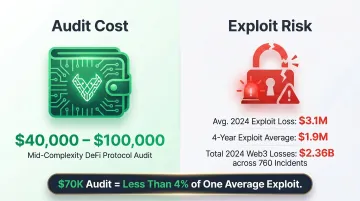
| Mid-complexity DeFi protocol audit | $40,000–$100,000 |
| Average exploit loss per incident (2024) | $3,108,880 |
| Average exploit loss (4-year average) | ~$1.9 million |
| Total Web3 losses in 2024 | $2.36 billion across 760 incidents |
Sources: CertiK Hack3d 2024 Report, Sherlock Audit Pricing 2026
A $70,000 audit represents less than 4% of a single average exploit loss. Halborn's Top 100 DeFi Hacks Report found that audited protocols accounted for only 10.8% of total value lost across the industry's worst 100 hacks — despite representing a meaningful share of active protocols.
Audits don't guarantee immunity. They do, however, demonstrably reduce both the likelihood of a successful exploit and the scale of damage when one occurs — which is exactly why frequency matters.
When to Audit: Frequency Benchmarks by Scenario
Audit frequency isn't a calendar setting. It's contextual: driven by development stage, the nature of changes made, and the value at risk.
Based on Development Stage
Pre-launch (first audit): A smart contract must be audited after reaching code freeze — all features implemented, integration points defined, no major architectural changes planned. The audit should complete at least 4–6 weeks before planned launch to allow time for remediation, re-verification, and any necessary iteration.
Auditing code that's still being actively developed wastes budget. The audited version and the deployed version will diverge, and the audit provides false assurance about a codebase that no longer exists.
Early-stage protocols (0–6 months post-launch): Protocols in active iteration should treat every significant release or feature addition as a trigger for a focused audit of changed components — not necessarily the full codebase, but the modified logic and its interaction points.
Based on Protocol Changes and Upgrades
Upgradeable/proxy contracts: Each upgrade cycle requires an audit of the new implementation before it goes live. The Ronin bridge ($10M, August 2024), Audius ($6M, July 2022), and LI.FI ($11M, July 2024) exploits all involved upgradeable contract changes deployed without a corresponding security review. In the LI.FI case, a new facet was added to a diamond proxy pattern without a separate audit, and the unaudited facet contained the vulnerability.
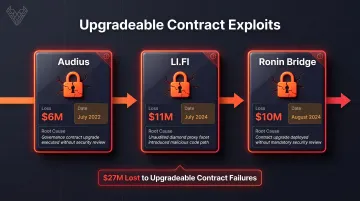
Upgrade mechanisms are themselves a primary attack surface.
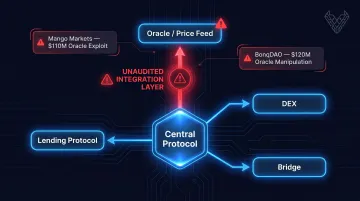
New external integrations: Adding a new oracle, DEX, bridge, or lending protocol requires a targeted audit focused on interaction logic. Cross-protocol composition is one of the highest-risk categories in DeFi.
The Mango Markets exploit ($110M, October 2022) and BonqDAO hack ($120M, February 2023) both targeted oracle integration layers rather than core contract logic. The vulnerable surface was created at the point where the protocol connected to external price feeds.
Based on TVL and Time Thresholds
TVL milestone re-audits: Crossing significant TVL thresholds — $1