Here's the uncomfortable truth: most of those vulnerabilities were present in the code long before the breach. They were just never examined through a security lens.
Regular code review asks whether code works. Secure code review asks whether code can be exploited. These are fundamentally different questions requiring different expertise — and conflating them is one of the most common mistakes development teams make. This guide breaks down what secure code review actually is, how it operates as a structured process, and why human judgment remains essential even with modern automated tooling.
TL;DR
- Secure code review is the security-focused examination of source code to find exploitable vulnerabilities before software ships, separate from functional review and penetration testing.
- The process follows four stages: scoping and planning, execution (manual + automated), reporting, and remediation follow-up.
- Manual review catches vulnerability classes automated tools miss: business logic flaws, IDOR, and context-dependent authorization gaps.
- Secure code review fits into the SDLC at multiple points: pull requests, pre-release gates, and compliance cycles.
- Reviews aren't complete until fixes are verified — skipping remediation follow-up is how most engagements fail in practice.
What Is Secure Code Review?
Secure code review is the deliberate, security-focused examination of application source code — line by line and logic by logic — to identify vulnerabilities, coding weaknesses, and exploitable patterns before software reaches production.
The OWASP Secure Code Review Cheat Sheet defines it as analyzing "application logic, data flow, and implementation details to detect security flaws that require human expertise and contextual understanding." That last phrase matters. The emphasis on human judgment isn't incidental — it's the whole point.
How It Differs from Functional Review and Pen Testing
The distinction is one of intent:
- Functional code review asks: does this code do what it's supposed to?
- Secure code review asks: can an attacker abuse the way this code works?
- Penetration testing attacks the application from outside, without source code access, to validate what's externally exploitable
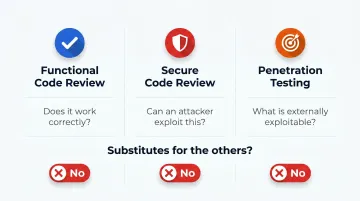
These activities complement each other, but none substitutes for the others. NIST SP 800-53 Rev. 5 (Control SA-11) treats static code analysis, manual code review, and penetration testing as separate, enumerated controls — each requiring distinct techniques and expertise.
Two Review Types
| Review Type | When It's Used | Scope |
|---|---|---|
| Baseline | New applications, compliance cycles, post-incident analysis | Full codebase |
| Diff-Based | Pull requests, commits, sprint deliverables | Incremental changes only |
The depth differs significantly. A baseline review of a legacy codebase might take weeks. A diff-based review of a focused pull request might take hours — but both require the same security-first mindset.
What Secure Code Review Is Not
- Not equivalent to running an automated SAST scan
- Not a one-time audit that checks a compliance box
- Not interchangeable with penetration testing
Automated tools — SAST, DAST, and AI-assisted scanners — cannot evaluate intent, understand business context, or reason about how application features interact. These gaps account for a disproportionate share of high-severity vulnerabilities.
Business logic flaws and authorization gaps routinely escape automated scans because they require understanding what the code is supposed to do before recognizing when it's doing something dangerous. That's a human judgment call, not a pattern match.
How Does Secure Code Review Work?
Secure code review follows a defined sequence of stages. Teams that treat it as a one-time scan — rather than a structured workflow — consistently miss the vulnerabilities that matter most.
Stage 1: Planning and Scoping
Before any code is read, the review needs a plan. This means:
- Defining scope — which components, modules, or commits are in review
- Gathering context — architecture documentation, threat models, prior security findings, and data flow diagrams
- Identifying reviewers — internal security engineers, developers with security expertise, or an external security partner
Risk-based prioritization happens here. Not all code carries equal risk. Components that typically receive the deepest scrutiny:
- Authentication and session management modules
- Authorization and access control logic
- Data handling and processing functions
- Cryptographic implementations
- Third-party integrations and dependencies
Reviewing everything with equal depth is neither efficient nor practical. High-risk areas get depth; lower-risk sections get coverage.
Stage 2: Review Execution
This is where the actual analysis happens — and where the distinction between manual and automated review has the biggest impact.
Manual review traces data flows from user-controlled inputs (sources) through processing logic to outputs (sinks). At each step, the reviewer asks: does a security control exist here? Is it applied correctly? Can it be bypassed through an alternate code path?
The vulnerability classes that only manual review reliably surfaces:
- Business logic bypasses — skipping payment steps, exploiting multi-step workflows
- IDOR and authorization gaps — access controls present in one code path but absent in another
- Race conditions — exploitable timing windows in concurrent operations
- Insecure cryptographic usage — weak algorithms, predictable randomness, improper key handling
Automated tools (SAST/SCA) run first to surface known vulnerability patterns and flag risky dependencies. This allows human reviewers to direct analytical effort toward findings that require judgment — rather than spending time on pattern-matching that tools handle well. The two approaches aren't competing; they're sequential.
Stage 3: Reporting and Documentation
A finding report is only useful if a developer can act on it. Each finding should include:
- Vulnerability type and CWE classification
- Exact code location (file, function, line number)
- Severity rating
- A realistic attack scenario — not just "this is exploitable" but how
- Specific remediation guidance
Vague reports get deprioritized. Overly technical reports get misimplemented. The most effective reports are built for developer readability — each finding manually validated and paired with proof-of-concept reproduction, impact analysis, and concrete remediation steps.
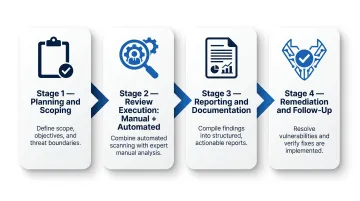
Stage 4: Remediation and Follow-Up
After developers implement fixes, the reviewer re-examines the affected code to confirm:
- The fix is correct and complete
- No new vulnerabilities were introduced by the change
- The original attack path is genuinely closed
This step is frequently skipped — and that's a problem. Without verification, a report is just a list of known vulnerabilities, not a completed review.
From a compliance standpoint, several frameworks require documented evidence that identified vulnerabilities were actually addressed — not just reported:
- SOC 2 (CC8.1)
- ISO 27001 (Control A.8.28)
- GDPR (Articles 25 and 32)
When compliance is on the line, follow-up review isn't optional.
What Vulnerabilities Does Secure Code Review Uncover?
Secure code review surfaces vulnerabilities across a broad range of categories, many of which automated scanners routinely miss. The MITRE CWE Top 25 (2024), derived from analysis of 31,770 CVE records, includes entries directly discoverable through source code review:
- Injection flaws — SQL injection (CWE-89), OS command injection (CWE-78), improper input validation (CWE-20)
- Broken authentication — improper authentication (CWE-287), hard-coded credentials (CWE-798)
- Authorization failures — missing authorization checks (CWE-862)
- Cross-site scripting — CWE-79
- Cryptographic weaknesses — weak algorithms, predictable randomness, improper key management
Most of these categories map predictably to known patterns that static analysis tools handle reasonably well. But one class of vulnerability consistently escapes them.
Business Logic Flaws: What Automated Tools Miss
Business logic flaws are in a category of their own. These aren't coding errors in the conventional sense — they're cases where code functions exactly as written, but can be abused by an attacker.
A few real-world patterns show how this plays out in practice:
- Injecting a lower price on an e-commerce summary page before checkout completes
- Starting and canceling transactions to retain loyalty points without finishing a purchase
- Accessing another user's records through predictable object identifiers
The OWASP Web Security Testing Guide notes that automated tools are "incapable of detecting logical vulnerabilities" because they have no way to evaluate whether a user can circumvent the intended business process. No scanner understands your application's intent — only a skilled reviewer can map what the code should do against what an attacker could make it do.
Manual Review vs. Automated Tools
Automated tools are genuinely useful. SAST and SCA tools scan large codebases quickly, flag known vulnerability signatures, and surface risky dependencies at scale. For pattern-matching against established weakness categories, they're the right tool. Where they fall short is everything that requires context.
The False Positive and False Negative Problem
A 2025 study cited by Pixee AI found that of 2,116 vulnerabilities flagged by traditional SAST tools across open-source repositories, only 180 were real — a 91% false positive rate. Meanwhile, research from Endor Labs found that SAST tools miss between 47% and 80% of actual security flaws under test conditions.
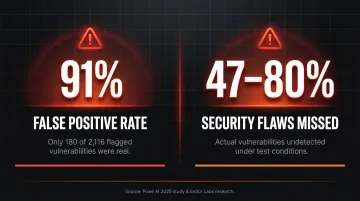
The net result: teams reviewing tool output spend most of their time triaging noise, and still ship code with exploitable vulnerabilities.
What Automated Tools Cannot Evaluate
- Understand application-specific business rules
- Evaluate trust boundaries in context
- Reason about how multiple components interact to form an attack chain
- Detect vulnerabilities that only manifest during specific user workflows
These aren't limitations that better algorithms will eventually solve. They require someone who understands what the application is supposed to do — and can reason about how an attacker might make it do something else.
Manual-First as the Higher-Fidelity Standard
Manual-first review doesn't replace automated tools. It uses them as a first pass, then applies human judgment to everything that requires context.
This is how Vynox Security approaches code review: automated scanning handles pattern detection, and experienced reviewers focus on business logic, authorization logic, and multi-step attack chains that tools cannot evaluate. The result is 3× deeper coverage than tool-only scans, particularly for the vulnerability classes most likely to cause real-world breaches.
Conclusion
Secure code review is a structured human process — one that demands attacker thinking, defined methodology, and the judgment to distinguish code that works from code that can be exploited under real conditions.
The four stages — scoping, execution, reporting, and remediation follow-up — each serve a distinct purpose, and shortcutting any of them leaves real vulnerabilities in place. Automated tools handle surface-level detection well, but the vulnerabilities behind the most serious breaches — business logic flaws, chained exploits, context-dependent access failures — are the ones tools consistently miss.
For organizations that need code review to go beyond scanning, Vynox Security's manual-first, threat-led methodology has driven 200+ security assessments across startups and cloud-native SaaS platforms. Reach out at sales@vynoxsecurity.com to talk through what a review covers for your specific codebase.
Frequently Asked Questions
How do you perform a secure source code review?
Start by defining scope and running automated SAST/SCA tools as a first pass. Follow with manual analysis of data flows, authorization logic, and business logic. Document findings with severity ratings, provide remediation guidance, and verify fixes before closing the review.
What is secure source code review?
It's the security-focused examination of source code to identify exploitable vulnerabilities before software ships. Unlike functional code review (which checks correct behavior) or penetration testing (which attacks the app externally), secure code review finds vulnerabilities at the source — including logic flaws that external testing would miss.
What should be included in a secure source code review checklist?
Key domains include input validation, authentication and access control, cryptographic implementation, error handling, and third-party dependency checks. OWASP's Secure Code Review Cheat Sheet provides a widely used framework covering these areas in full.
How is secure code review different from penetration testing?
Penetration testing attacks the application from the outside to find what's externally exploitable, without reading the source code. Secure code review examines the actual code to find vulnerabilities at their root — including issues that would never surface during an external test, such as business logic flaws or authorization gaps in non-exposed code paths.
How long does a secure code review take?
Timelines depend on codebase size and complexity. A focused review of a single module or API can take 1-3 days, while a full application review typically runs 1-3 weeks. Automated tooling speeds up the first pass; manual analysis of business logic takes the most time.
How can I assess the quality of source code?
From a security standpoint, look for sound input validation, proper error handling, absence of hardcoded credentials, avoidance of dangerous functions, and up-to-date dependencies with no known CVEs. These indicators reveal whether security was treated as a design concern or an afterthought.