So does the attack surface. According to Akamai's 2026 API Security Impact Survey, 87% of organizations experienced an API security incident in the past 12 months, averaging 3.5 incidents per year at a cost exceeding $700,000 each. The problem isn't just volume — it's visibility. Only 23% of enterprises maintain a full API inventory, meaning most organizations are testing endpoints they know about while leaving the rest exposed.
Automated scans don't close this gap. They miss business logic flaws, authentication chain weaknesses, and authorization failures that require human judgment to find. Structured API security testing does.
This guide explains what API security testing actually is, how the process works, what methods it uses, and what good looks like in practice.
TL;DR
- API security testing probes endpoints for weaknesses in authentication, authorization, input handling, and business logic before attackers find them
- Testing follows a defined sequence: scope the attack surface, scan, test manually, then remediate
- Key methods — SAST, DAST, IAST, fuzzing, and manual pen testing — each catch different vulnerability classes
- For business logic flaws and multi-step authorization failures, automated tools fall short — manual testing is the only reliable method
- Testing should happen continuously throughout the SDLC, not just at launch
What Is API Security Testing?
API security testing is the structured process of evaluating API endpoints for security vulnerabilities — broken authentication, authorization failures, injection flaws, excessive data exposure — before those vulnerabilities can be exploited in production.
It exists because APIs are high-value targets by design. Unlike a web UI, an API exposes application logic and data directly, often with machine-to-machine access that bypasses front-end controls entirely. A misconfigured endpoint can be accessible without authentication, and general web scanning won't catch it.
Understanding what API security testing covers requires separating it from two things it's commonly confused with.
What It's Not
It's distinct from:
- Functional API testing — which checks whether an API returns correct responses, not whether those responses are secure
- General DAST scanning — which covers only a fraction of API endpoints, particularly missing those not surfaced through the front end
API Types and Why They Matter
The testing approach shifts depending on the API type:
- REST APIs — highly susceptible to BOLA/IDOR at scale because they expose predictable object identifiers like
/api/users/{id}; changing that ID is often all it takes - GraphQL APIs — introduce introspection abuse risks; even with introspection disabled, error message "suggestions" can help attackers reconstruct schemas using tools like Clairvoyance
- SOAP APIs — vulnerable to XML injection, XXE attacks, and WSDL exposure that maps the entire API contract for attackers
- gRPC APIs — require protocol-aware testing that standard HTTP scanners can't perform natively
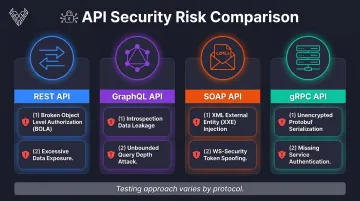
The OWASP API Security Top 10 (2023 edition) defines the benchmark for what API security testing is designed to uncover — from Broken Object Level Authorization at the top to Unsafe Consumption of APIs at the bottom. Many persist because they're architectural problems, not surface-level code bugs — which is precisely why checklist-driven scans miss them.
How Does API Security Testing Work?
API security testing follows a defined sequence. Each phase builds on the previous one, producing specific, usable findings rather than a generic list of alerts.
Scoping and Reconnaissance
Testing starts by mapping the full API attack surface. Testers collect:
- API documentation (OpenAPI/Swagger specs, Postman collections, HAR files)
- All exposed endpoints and supported HTTP methods
- Authentication mechanisms and token types
- Data flows between services
Shadow APIs — undocumented or forgotten endpoints from old versions or developer testing — are often the most vulnerable targets in an API environment. You can't test what you don't know exists. Vynox Security treats shadow API discovery as a standard step in every engagement, not something bolted on at the end.
Automated Scanning
Automated tools send crafted and malformed requests to each endpoint, testing for known vulnerability classes: injection, authentication bypasses, misconfigurations, rate limiting gaps. Using the API spec as a guide improves coverage significantly compared to crawling alone.
Automated scanners follow defined rules and known patterns — they cannot infer whether a user should have access to a specific object. That requires understanding business context. Research consistently confirms that business logic vulnerabilities, IDOR, privilege escalation, and workflow bypasses fall entirely outside what signature-based tools can detect.
Manual Testing and Exploitation
Automation defines the boundary of what's known. Manual testing exists to find what's beyond it. Skilled testers chain requests, manipulate parameters, test access controls across user roles, and abuse business logic flows that no scanner is built to attempt.
The vulnerability classes found almost exclusively through manual testing include:
- Broken Object Level Authorization (BOLA) — accessing another user's records by changing an ID
- Privilege escalation — elevating permissions by modifying a request parameter
- Mass assignment — writing to fields the API exposes but doesn't intend to accept
- Authentication bypasses that only emerge under specific request sequences
Vynox Security's methodology combines AI-augmented automation with experienced security researchers, achieving 3× deeper coverage than tool-only scans — because manual testing reliably catches what scanners structurally cannot.
Reporting and Remediation
Findings are documented with proof-of-concept evidence, risk impact analysis, and specific remediation guidance rather than a bare severity label. Quality reports map each vulnerability to its business risk and give development teams a clear fix path.
Vynox Security delivers audit-ready reports within 48 hours, structured to feed directly into compliance evidence packages for SOC 2, ISO 27001, GDPR, and PCI DSS. Findings map to risk registers and Statements of Applicability, making the output useful for both security and governance teams.
Key Methods of API Security Testing
No single method covers every attack surface. Effective API security programs combine multiple approaches based on development stage, risk level, and API type — because what catches a hardcoded secret in code won't catch a privilege escalation flaw at runtime.
| Method | How It Works | Best For | Key Limitation |
|---|---|---|---|
| SAST | Analyzes source code and API specs without executing the app | Catching hardcoded secrets, insecure patterns early in CI/CD | Can't detect runtime authorization flaws |
| DAST | Sends attack payloads to live running endpoints | Injection, auth weaknesses, rate limiting in staging | Limited coverage of multi-step authorization flows |
| IAST | Deploys an agent inside the app to monitor execution during testing | Code-level attribution with fewer false positives than DAST alone | Requires agent deployment; can affect performance |
| Fuzzing | Sends malformed, random, or unexpected inputs to trigger crashes | Input validation failures, edge-case logic errors | High false positives; misses context-dependent logic flaws |
| Manual Pen Testing | Human-driven testing of authorization, business logic, and chained exploits | BOLA, privilege escalation, multi-step attack scenarios | Time-intensive; doesn't scale continuously |
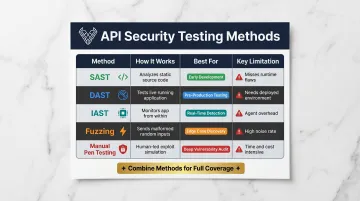
SAST and DAST belong in the CI/CD pipeline for continuous baseline coverage. But for any API handling sensitive data, financial transactions, or external third-party access, manual penetration testing is non-negotiable — automated tools routinely miss business logic flaws, chained exploits, and authorization gaps that only a human attacker would think to probe.
What Vulnerabilities Does API Security Testing Uncover?
API security testing is specifically designed to surface the vulnerability classes in the OWASP API Security Top 10. The ones that cause the most damage in practice:
Authorization and Access Control Failures
Broken Object Level Authorization (BOLA) is present in approximately 40% of all API attacks and has held the #1 position in the OWASP Top 10 for years. The exploit is straightforward: change a user ID, order number, or account reference in a request and see if the server returns data you shouldn't have access to. No sophisticated tooling required — just an understanding that the server isn't checking ownership.
Real consequences include:
- T-Mobile (January 2023): BOLA exposed 37 million customer records over a 40+ day dwell time
- Coinbase: A BOLA flaw let attackers sell $1,000 of Ethereum as $43,000 of Bitcoin
- Optus: An unauthenticated API endpoint exposed 10 million records and cost $11M in remediation

These aren't edge cases — they're the predictable outcome of APIs that validate endpoints but not object ownership.
Input-Based Vulnerabilities
Injection flaws arise when APIs accept unvalidated or improperly typed input. The most common types tested include:
- SQL injection — manipulating database queries through API parameters
- Command injection — passing OS-level commands through unsanitized fields
- Mass assignment — sending extra request fields to overwrite protected properties
Fuzzing and DAST surface most of these, but manual validation is still needed to confirm exploitability and assess business impact.
Logic-Layer Vulnerabilities
The most damaging API flaws often have no CVE and no known signature. A user pulls another user's records by changing an ID. A regular user elevates their own permissions by modifying a request field. These are authorization logic failures — and they're almost exclusively found through manual penetration testing, because detecting them requires understanding what the API is designed to do, not just what it does.
API Security Testing Best Practices
Shift Left: Embed Testing in the CI/CD Pipeline
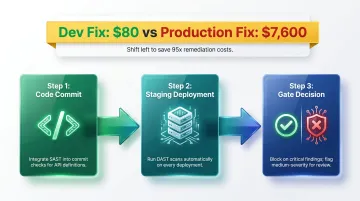
Fixing a vulnerability in development costs roughly $80. In production, that same fix costs approximately $7,600 — a 95x multiplier, per Ponemon Institute research. Organizations with mature DevSecOps practices save an average of $1.13 million per breach (IBM, 2025).
Practical steps:
- Integrate SAST into code commit checks for API definition files and source code
- Run DAST scans automatically in staging on every deployment
- Block deployments on critical findings; flag medium-severity issues for developer review
Test Authentication and Authorization Rigorously
Authentication and authorization failures are the top two categories in the OWASP API Security Top 10. For every sensitive endpoint, verify:
- Authentication is enforced (no unauthenticated access to private data)
- Access controls hold across different user roles and privilege levels
- Token handling is correct — expiration, revocation, and scope enforcement all function as intended
- Object-level authorization validates ownership per request, not just per endpoint
Combine Automation with Manual Testing
Automated tools handle breadth and speed. Manual penetration testing handles depth and context. Each covers what the other misses:
- Automated scanning catches known vulnerability patterns quickly across large API surfaces
- Manual testing uncovers logic flaws, chained exploits, and authorization gaps that scanners never flag
For APIs that handle sensitive data, support financial transactions, or expose data to external third parties, periodic manual penetration testing isn't optional — it's a baseline requirement. Vynox Security's manual-first approach targets exactly these environments, focusing on authentication flows, authorization logic, business rules, and data exposure paths that automated tools routinely overlook.
Frequently Asked Questions
What is API security testing and why is it important?
API security testing evaluates APIs for vulnerabilities including broken authentication, authorization failures, and injection flaws. Because APIs directly expose application logic and data, they're a primary attack vector that general web scanning won't adequately cover.
How do you test API security?
Map the full API attack surface including shadow endpoints, run automated scans using DAST and SAST tools, then conduct manual penetration testing to probe business logic and access controls. Document all findings with proof-of-concept evidence and remediation guidance tied to business risk.
What is API penetration testing?
API pen testing is a human-driven process where security experts simulate real-world attacks against API endpoints. It goes beyond automated scanning to find chained exploits, authorization bypasses, and business logic flaws that require contextual judgment to identify.
What are the key security considerations for REST APIs?
Core REST API security controls include:
- Enforce authentication on every sensitive endpoint
- Validate and sanitize all input
- Implement object-level authorization checks per request, not just per endpoint
- Use HTTPS exclusively and apply rate limiting against scraping and abuse
BOLA is the most common REST API vulnerability and requires dedicated manual testing to uncover reliably.
Which tools are commonly used for API security testing?
Burp Suite (manual testing), OWASP ZAP (open-source dynamic scanning), Postman (scripted test automation), and 42Crunch (OpenAPI spec auditing) are widely used. No single tool provides full coverage — effective programs combine multiple tools with manual testing.
What is SAST, DAST, and SCA?
SAST analyzes source code offline without execution. DAST tests live running applications by sending attack payloads to endpoints. SCA (Software Composition Analysis) scans third-party libraries and dependencies for known vulnerabilities. Together, they address three distinct risk layers: code, runtime, and supply chain.