: A Complete Guide](https://file-host.link/website/vynoxsecurity-kimd1h/assets/blog-images/bb03af64-e454-4fbc-8e64-b4d147ea8a6c/1779019789107900_76845aad14774c5599e33047b4b01cb3/360.webp)
Introduction
Black box web application penetration testing is a security assessment where the tester approaches your application with zero prior knowledge of its internals — mirroring the conditions a real external attacker faces.
This guide is written for security teams, startup founders, and product owners who build or operate web applications. If you handle user data, process payments, or expose APIs to the internet, attackers will eventually probe your application. The only variable is whether you find the vulnerabilities first.
The numbers back this up. According to the Verizon 2025 Data Breach Investigations Report, vulnerability exploitation as an initial access method grew 34% year-over-year, now accounting for 20% of all breaches. Basic web application attacks alone contributed to over 1,000 confirmed breaches in the same dataset.
This guide covers what black box testing is, how it works step by step, what separates quality engagements from shallow scans, and when a different approach might serve you better.
TL;DR
- Zero knowledge, real threat: Testing starts with only the target URL — no source code, credentials, or architecture docs provided
- Structured process: Reconnaissance → scanning → exploitation → post-exploitation → reporting
- Manual testing is non-negotiable: Automated scanners miss business logic flaws, IDOR chains, and chained attack paths
- Compliance-ready: Supports SOC 2 Type II, ISO 27001, and GDPR security testing requirements
- Limitations exist: A clean black box report doesn't guarantee full security — white box and gray box testing add deeper code-level coverage
What Is Black Box Web Application Penetration Testing?
In a black box engagement, the tester receives one thing: the application's URL. No source code, no architecture diagrams, no credentials, no internal documentation. The tester then attempts to compromise the application exactly as a real external attacker would — building knowledge incrementally through reconnaissance and probing.
The intended outcome is specific:
- Identify vulnerabilities exploitable from the outside
- Demonstrate real business impact (not theoretical risk)
- Produce a prioritized, evidence-based remediation roadmap
How It Compares to Other Testing Types
| Approach | Tester Knowledge | Best For |
|---|---|---|
| Black box | None — URL only | Simulating external attacker; validating perimeter exposure |
| Gray box | Partial — credentials or API docs | Balanced assessment; new applications with suspected design flaws |
| White box | Full — source code and architecture | Code-level security review; maximum coverage |
Black box testing most closely mirrors an opportunistic external attacker. It produces the most realistic picture of perimeter exposure, though NIST SP 800-115 notes that white box techniques "still tend to be more efficient and cost-effective for finding security defects" in custom software. Your threat model — not convention — should determine which approach fits.
Why Organizations Use Black Box Web App Pentesting
For customer-facing applications handling sensitive data, one question has direct business consequences: what can an external attacker with no privileged access actually do? Stolen credentials appeared in 88% of Basic Web Application Attacks in the 2025 DBIR — and the attack patterns targeting authentication, session management, and access control are precisely what black box testing is designed to stress-test.
What It Validates
Black box testing examines the controls that matter most for externally-facing applications:
- Authentication controls — password policies, MFA enforcement, account lockout behavior
- Session management — token entropy, session fixation, logout effectiveness
- Input handling — injection resistance, validation logic, error handling
- API exposure — unauthenticated endpoints, mass assignment, excessive data exposure
- Access control logic — IDOR, privilege escalation paths, horizontal vs. vertical authorization
OWASP's Top 10 2021 data shows Broken Access Control moved from #5 to #1, with 94% of tested applications exhibiting some form of it. For most web applications, authorization flaws aren't edge cases — they're the most likely path an attacker will take.
Compliance and Contractual Drivers
Black box pentesting supports several frameworks that security and legal teams increasingly reference:
- SOC 2 Type II — Trust Services Criterion CC4.1 references penetration testing as a point of focus for control evaluation
- ISO 27001:2022 — Annex A Control 8.29 requires security testing, including penetration testing
- GDPR Article 32(1)(d) — requires "regularly testing, assessing and evaluating" security measures
Beyond compliance frameworks, cyber insurance underwriters are tightening requirements. Penetration test reports now directly influence insurability and premium levels — making periodic testing something finance and legal teams care about, not just security teams.
How Black Box Web App Penetration Testing Works
A quality black box engagement follows a structured, manual-intensive process. The tester builds knowledge progressively across five phases, with each phase feeding the next — and the goal throughout is demonstrated exploitation, not theoretical flagging.
The five phases below represent that process.
Reconnaissance
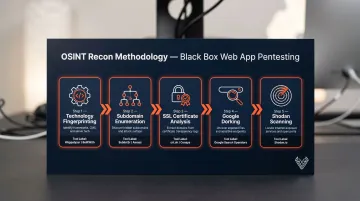
The tester maps the application's external footprint without triggering alerts or touching the application directly. This phase uses OSINT techniques to surface information attackers already have access to:
- Technology fingerprinting via Wappalyzer or BuiltWith — identifies frameworks, CMS, and server software with known CVEs
- Subdomain enumeration — exposes forgotten or unprotected subdomains
- SSL certificate analysis via Censys — reveals infrastructure relationships and certificate transparency logs
- Google dorking — finds exposed configuration files, backup archives, and indexed admin panels
- Shodan scanning — identifies internet-exposed services and misconfigurations
Strong reconnaissance frequently surfaces critical issues before active testing begins: outdated frameworks, exposed admin interfaces, or misconfigured cloud storage buckets. These findings don't require exploitation to be significant; they signal that basic security controls were never applied.
Scanning and Enumeration
Active scanning identifies the application's full attack surface:
- Port scanning to identify open services (Nmap)
- Web application fingerprinting and directory enumeration
- Endpoint discovery across authenticated and unauthenticated paths
- Automated vulnerability scanning to flag known weaknesses (Burp Suite, ZAP)
Critical caveat: Automated scan results require manual validation before any finding is reported. A 2024 benchmark found ZAP generated 88 false positive SQL injection findings on a single target application. NIST SP 800-115 explicitly notes that automated scanners have a "high false positive error rate" and only check for the possible existence of a vulnerability — not its confirmed exploitability.
Scanners also systematically miss business logic flaws, authorization issues, and chained vulnerabilities. These require manual analysis.
Exploitation
This is where tester skill determines what gets found. The tester manually attempts to exploit confirmed vulnerabilities, which commonly include:
- SQL injection — extracting or modifying database contents
- Cross-site scripting (XSS) — session hijacking, credential theft
- Broken access control and IDOR — accessing other users' data by manipulating object references
- Authentication bypass — circumventing login controls entirely
- API abuse — broken object level authorization, mass assignment, excessive data exposure
The goal is not to flag theoretical issues but to demonstrate real business impact. A finding that says "SQL injection possible" is far less useful than one that shows extracted records from the database.
Payload crafting and fuzzing extend this phase: custom payloads test how the application handles unexpected or malformed input, often revealing template injection, server errors, or validation failures that generic tool signatures never trigger.
Post-Exploitation and Lateral Exploration
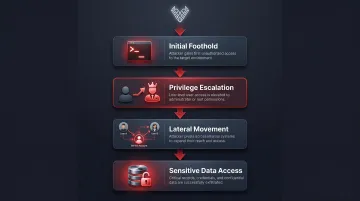
After gaining initial access, even limited access, a skilled tester shifts focus to what becomes reachable from that foothold — the same calculation a real attacker makes.
This phase typically involves:
- Privilege escalation — can a standard user reach admin functionality?
- Lateral movement — can access to one user account expose another user's data?
- Data access validation — what sensitive records are reachable without authorization?
- Session and token abuse — can captured tokens be replayed or transferred?
This stage often produces the highest-severity findings. A single compromised entry point can expose data, accounts, and functionality far beyond what surface-level testing reveals.
Reporting
The report is the primary deliverable the organization acts on. A quality pentest report includes:
- Executive summary — business-language summary of overall risk posture
- Risk-rated findings — Critical, High, Medium, Low with clear rationale
- Proof-of-concept evidence — screenshots, request/response data, or reproduction steps for each vulnerability
- Business impact statement — what an attacker could achieve if they exploited this finding
- Specific remediation guidance — not "fix your authentication" but concrete steps tied to the actual code or configuration
A raw scanner export is not a penetration test report. Vynox Security's reports are mapped to OWASP, ISO 27001, and relevant compliance frameworks, and structured for both technical remediation teams and audit reviewers. Every finding is manually validated before delivery, so nothing in the report requires a second round of triage to confirm.
Key Factors That Determine Black Box Pentest Quality
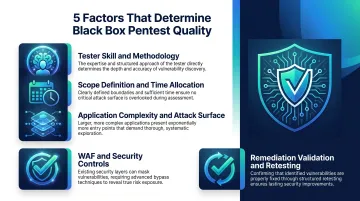
Not all black box engagements produce the same results. These five factors separate high-quality assessments from shallow compliance exercises.
Tester skill and methodology — Automated tools only surface known, detectable patterns. What actually gets found depends on the tester's ability to chain low-severity findings into high-impact attack paths. Manual-first testers catch business logic flaws and attack chains that no scanner will flag.
Scope definition and time allocation — Web application tests typically span 5–20 working days depending on complexity. Compressed engagements consistently miss chained vulnerabilities and business logic flaws. When time is limited, reducing scope is preferable to reducing depth.
Application complexity and attack surface — The number of user roles, authenticated endpoints, API surfaces, and third-party integrations directly affects coverage depth. A larger attack surface in a fixed time window means less depth per area tested.
WAF and security controls — WAFs, rate limiting, and bot detection constrain what a black box tester can probe. Testing against a staging environment avoids production risk but may not reflect real security controls — agree on this trade-off before the engagement starts.
Remediation validation — A pentest without a follow-up retest is a point-in-time snapshot. Whether fixes resolve the vulnerability — or introduce new ones — requires validation. Look for providers who include retesting as a standard deliverable, not an optional add-on.
Limitations and When to Reconsider
Common Misconception: Black Box Is the Most Thorough Approach
Black box testing is the most realistic simulation of an external attack. It is not the most comprehensive review of an application's security. White box and gray box testing provide access to source code and internal logic, enabling testers to find vulnerabilities that are structurally invisible from the outside.
A clean black box report does not mean the application is secure. It means no exploitable vulnerabilities were found given what the tester could observe, within the time allocated.
Common Misconception: Automated Scanning Equals Black Box Pentesting
Running a vulnerability scanner against a URL is not penetration testing. OWASP confirms that business logic flaws "cannot be detected by a vulnerability scanner and relies upon the skills and creativity of the penetration tester." Genuine black box pentesting requires:
- Manual exploitation of discovered entry points
- Business logic validation across user roles and workflows
- Attack chain analysis linking low-severity findings into critical paths
When a Different Approach Makes More Sense
| Situation | Better Fit |
|---|---|
| Goal is comprehensive code-level security review | White box |
| Application is new with expected architectural flaws | Gray box |
| Budget and time are extremely limited | Focused gray box or hybrid |
| External attack surface validation is the priority | Black box |
If you're working with a limited budget, a scoped gray box engagement gives testers enough internal context to go deeper — without the overhead of a full code review. You get more actionable findings per dollar than a broad black box sweep with too little time for manual depth.
Conclusion
Black box web application penetration testing stress-tests an application's defenses from an external attacker's perspective, identifies exploitable vulnerabilities with real business impact, and produces an evidence-based remediation roadmap. For organizations operating customer-facing applications, it's a critical component of a mature security program.
Its value is directly proportional to how it's executed. Black box testing delivers meaningful results when scoped appropriately, conducted manually by skilled testers, and paired with remediation support and re-testing. That means the partner you choose shapes the quality of what you find.
Vynox Security's manual-first, threat-led approach covers business logic flaws, IDOR chains, API abuse, and chained attack paths that automated tools routinely miss — so your report reflects what an actual attacker would exploit, not just what a scanner flagged.
Frequently Asked Questions
What is black box penetration testing?
Black box penetration testing is a security assessment where the tester has no prior knowledge of the target — only the URL — and simulates an external attacker to identify exploitable vulnerabilities. For web applications, this includes testing authentication, session management, input handling, access controls, and API exposure.
What is the difference between white box and black box pentesting?
In black box testing, the tester has no access to source code, architecture documents, or credentials. In white box testing, the tester has full visibility into the application's internals. Black box better simulates external threats; white box provides deeper, more comprehensive code-level coverage.
How long does a black box web application penetration test typically take?
Most engagements run one to three weeks depending on application size and scope. Complex applications with large API surfaces or multiple user roles may require more time — and should never be rushed, since business logic flaws and chained vulnerabilities only surface through manual investigation.
What does a black box penetration test report include?
A quality report includes an executive summary, risk-rated findings (Critical through Low), proof-of-concept evidence, a business impact statement, and specific remediation guidance — all manually validated, not a raw scanner export.
Is black box pentesting sufficient for SOC 2 or ISO 27001 compliance?
Black box pentesting can satisfy the penetration testing requirements referenced in SOC 2 Type II (CC4.1) and ISO 27001 Annex A Control 8.29, but auditors typically also expect evidence of scope, methodology, and remediation activity. Confirm specific requirements with your auditor before the engagement.
What information does a tester need to start a black box web app pentest?
The minimum required is the target application URL and an agreed scope document. Testers receive no credentials, source code, or architecture diagrams — the setup mirrors the exact knowledge state of an external attacker.