Introduction
AWS penetration testing is a structured, authorized security exercise in which testers simulate real attacker behavior against an AWS environment to expose IAM vulnerabilities, service misconfigurations, privilege escalation paths, and exploitable attack chains before real attackers find them.
The term gets thrown around loosely. Many organizations assume they've completed an AWS pentest after running Prowler or reviewing an automated configuration report — but those tools don't validate exploitability, and they don't chain findings into realistic attack paths. The IBM Cost of a Data Breach Report 2024 put the global average breach cost at $4.88 million, a 10% year-over-year increase.
For teams building toward SOC 2 or ISO 27001 compliance, conflating config scans with penetration testing doesn't just leave security gaps. It creates a false sense of assurance that auditors are increasingly equipped to call out.
This article breaks down what AWS penetration testing actually involves, how the methodology works phase by phase, and what separates a genuine engagement from a checklist exercise.
TL;DR
- AWS penetration testing simulates real attacker behavior through active exploitation, not passive scanning
- It differs from config reviews: testers chain IAM weaknesses, service misconfigurations, and credential exposures into multi-step attack paths
- Five phases structure the methodology: scoping, recon, IAM analysis, service-level testing, and cross-service attack chain analysis
- AWS permits testing of customer-owned resources without prior approval — but prohibits DoS simulation, Route 53 attacks, and testing AWS-owned infrastructure
- Prowler and ScoutSuite automate known checks across dozens of services — but what they miss requires manual analysis to find
What Is AWS Penetration Testing?
AWS penetration testing is a controlled, exploitation-based assessment scoped to the customer side of the AWS Shared Responsibility Model — IAM policies, service configurations, exposed credentials, and privilege escalation paths across EC2, S3, Lambda, API Gateway, and other services.
NIST SP 800-115 defines penetration testing as security testing where "evaluators mimic real-world attacks to identify ways to circumvent the security features of an application, system, or network" — and specifically notes it "seeks to find combinations of vulnerabilities that can be exploited to gain greater access than a single vulnerability would permit."
In AWS environments, the most damaging attack paths rarely come from a single misconfiguration. They come from chaining a slightly overpermissioned Lambda role with a misconfigured S3 bucket, or combining an IMDSv1-enabled EC2 instance with a vulnerable application endpoint.
How It Differs from Related Processes
| Assessment Type | Access Level | Exploitation? | Output |
|---|---|---|---|
| Config Review | Read-only | No | Benchmark gap list |
| Vulnerability Assessment | Read-only | No | Weakness catalog |
| AWS Penetration Test | Read + low-priv credentials | Yes | Validated attack chains + remediation |
The pentest actively validates exploitability. A config review checks whether a setting matches a benchmark — that distinction determines which findings you can actually trust going into remediation.
Why AWS Environments Need Dedicated Penetration Testing
AWS places full responsibility for IAM configuration, service permissions, inter-account trust, and data controls on the customer. Gartner has predicted that 99% of cloud security failures will be the customer's fault, driven by misconfiguration — not AWS infrastructure vulnerabilities.
Standard network scanners don't capture these risks. They weren't designed to reason about IAM permission combinations or cross-service trust relationships.
What Gets Missed Without AWS-Specific Testing
Across their cloud security assessments, Vynox Security's testers consistently encounter misconfigurations that automated tools flag incompletely or not at all:
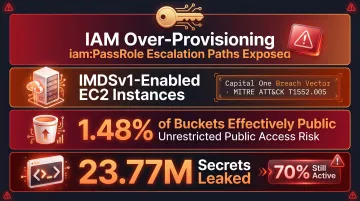
- IAM over-provisioning — roles granted AdministratorAccess or broad wildcards, enabling privilege escalation via
iam:PassRole,iam:PutUserPolicy, oriam:CreatePolicyVersion - IMDSv1-enabled EC2 instances — documented in the Capital One breach via MITRE ATT&CK T1552.005, where SSRF + IMDSv1 allowed an attacker to steal privileged IAM role credentials
- Publicly accessible S3 buckets — the Datadog 2024 State of Cloud Security Report found approximately 1.48% of S3 buckets remain effectively public; a 2025 incident exposed 273,000 bank transfer PDFs through this exact misconfiguration
- Hardcoded credentials — GitGuardian's 2025 report found 23.77 million new secrets leaked on public GitHub in 2024, with AWS IAM keys as the most frequently exposed type; 70% of those secrets remained active in repositories two years later
Manual-first, threat-led testing is designed to surface the attack chains that emerge when these findings compound. Automated tools evaluate individual configurations against known benchmarks — they can't model what happens when a public S3 bucket, an overpermissioned role, and a hardcoded key exist in the same environment simultaneously. That's what skilled testers do.
The Compliance Driver
Auditors now routinely ask for AWS penetration testing evidence during SOC 2 Type II, ISO 27001, and GDPR assessments. None of these frameworks mandate it explicitly, but SOC 2's AICPA Trust Services Criteria CC4.1 lists pentesting as a recognized type of separate evaluation for demonstrating control effectiveness.
In practice, auditors expect to see it. Organizations without testing documentation face a straightforward question they can't easily answer.
How AWS Penetration Testing Works: The Methodology
AWS pentesting mirrors real attacker behavior from initial foothold through demonstrated impact. Every phase involves active exploitation attempts under controlled, authorized conditions, not passive configuration review.
Pre-engagement requirements include a signed scope agreement, AWS-compliant rules of engagement per AWS's published penetration testing policy, and credential provisioning. Testers typically receive SecurityAudit-level read access plus a low-privilege developer or application role credential, simulating a realistic attacker starting position.
Step 1: Scoping and Rules of Engagement
Before testing begins, the following must be agreed in writing:
- Which AWS accounts and services are in scope
- Assessment type (white-box vs. grey-box) and starting credentials
- Which IAM permissions will be provisioned and why
- Explicitly prohibited activities under AWS's policy: DNS zone walking via Route 53, DoS/DDoS simulation, port flooding, and testing of AWS-managed infrastructure
AWS removed the prior-approval requirement for customer-owned resource testing in 2019. Most services: EC2, RDS, Lambda, API Gateway, ECS, Fargate, and others can be tested without advance authorization. Command and Control (C2) activity still requires prior approval.
Step 2: Reconnaissance and Account Enumeration
Testers map the environment before attempting exploitation:
- Identifying which AWS services are active and publicly exposed
- Mapping IAM principals, trust relationships, and multi-account structure (AWS Organizations, Service Control Policies)
- Reviewing CloudTrail status, GuardDuty configuration, and AWS Config coverage
Prowler's 595 automated checks across 84 services and ScoutSuite's configuration auditing provide a useful baseline. Manual CLI enumeration and direct policy review, including inline policies that automated tools frequently overlook, are required to catch what automated checks miss.
Step 3: IAM and Credential Analysis
This phase targets the most exploitable layer of most AWS environments:
- Reviewing policies attached to users, groups, and roles, with particular focus on inline policies
- Testing for privilege escalation via
iam:PassRole,iam:PutUserPolicy,iam:CreatePolicyVersion, and related actions — Rhino Security Labs documented 21 distinct escalation methods across these vectors - Checking code repositories and Lambda environment variables for hardcoded credentials
- Evaluating EC2 instance metadata service configuration (IMDSv1 vs. IMDSv2) for SSRF-based credential theft exposure
Step 4: Service-Level and Network Testing
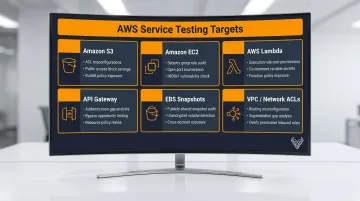
Testers examine individual services for exploitable misconfigurations:
- S3 — bucket ACLs, public access settings, bucket policy logic
- EC2 — security group rules, open ports, IMDSv1 exposure
- Lambda — execution role permissions, environment variable secrets, event source configurations
- API Gateway — authentication gaps, authorization bypass opportunities
- EBS snapshots — publicly shared snapshots containing sensitive data
- VPC/Network ACLs — routing and segmentation misconfigurations
Step 5: Cross-Service Attack Chain Analysis and Reporting
Individual misconfigurations get chained into realistic attack paths. This cross-service analysis is where material risk becomes visible.
A documented example from Vynox Security's assessments: a fintech application had a Lambda function triggered by a public S3 bucket upload. The function lacked input validation and ran under an overly permissive IAM role with database access. The attack chain: upload malicious content to the public S3 bucket, trigger Lambda execution, leverage IAM permissions to access sensitive data. Each finding looked manageable alone. Together, they represented a direct path to sensitive production data.
The final report should include CVSS-scored findings, attack chain narratives, proof-of-concept evidence, and remediation guidance tied to the specific findings uncovered, not generic descriptions that could apply to any AWS account. Vynox Security structures reports for both technical remediation teams and compliance auditors, with findings mapped to ISO 27001 Annex A controls and SOC 2 Trust Services Criteria where relevant, delivered within 48 hours.
Key Factors That Affect AWS Penetration Test Quality
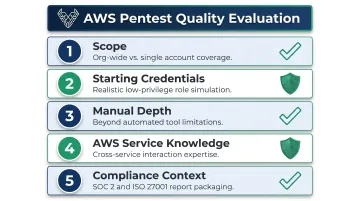
Not all AWS pentests produce equivalent results. Quality depends on several variables — evaluate these before engaging a testing partner:
- Scope: Testing a single AWS account while excluding the broader AWS Organization leaves cross-account trust relationships and lateral movement paths unexamined
- Starting credentials: SecurityAudit read access paired with a realistic low-privilege developer role produces findings closest to real attacker conditions; overly permissive starting credentials artificially inflate findings
- Manual depth: Automated tools cover known checks but miss newer services, service-to-service interactions, and novel permission combinations — manual review closes those gaps
- AWS service knowledge: Testers need working knowledge of how IAM, S3, EC2, Lambda, and other services interact, since misconfigurations in one often create exploitable paths through another
- Compliance context: SOC 2 and ISO 27001 engagements require specific evidence packaging, finding prioritization, and report formats — not all providers deliver these
Common Misconceptions About AWS Penetration Testing
"Running Prowler or ScoutSuite is an AWS pentest." Automated configuration scanning is analogous to running a Nessus scan in a network assessment — useful for identifying low-hanging fruit, but not a substitute for active exploitation. Prowler's 595 checks cover configuration benchmarks. They don't validate whether a permission combination can be chained into a privilege escalation path.
Many vendors present config scan reports as comprehensive pentests. Organizations that accept this framing walk away without knowing whether their IAM policies can be abused to reach production data.
"AWS secures everything in the cloud." AWS secures the underlying infrastructure — hardware, networking, physical facilities. The customer is entirely responsible for IAM policy design, service configurations, and data access controls. An AWS pentest validates the customer's side of this responsibility, not AWS's.
"Testing one AWS account covers the organization." Most mature organizations use multi-account architectures through AWS Organizations. Failing to assess cross-account trust relationships, assume-role permissions, and Service Control Policies leaves lateral movement paths unexamined. Testing a single account produces a partial picture of actual risk exposure.
"You need AWS's prior permission for every pentest." AWS updated this policy in 2019. Customers can now test their own resources across a broad list of services without submitting a prior approval request:
- Permitted: EC2, RDS, Lambda, API Gateway, ECS, and several others
- Prohibited: DoS simulation, Route 53 DNS attacks, and testing AWS-managed infrastructure
These boundaries apply regardless of the engagement scope.
When AWS Penetration Testing May Not Be the Right Starting Point
Penetration testing produces the most value when foundational misconfigurations have already been addressed. For organizations with no existing AWS security baseline, a configuration review using Prowler or AWS Security Hub will likely surface more actionable findings per dollar spent before a full pentest is engaged.
NIST SP 800-115 recommends a phased approach: configuration review, then vulnerability assessment, then penetration testing. That sequence ensures obvious issues get fixed before an engagement surfaces the more complex, chained attack paths that require significant remediation effort.
A pentest also loses effectiveness when scope limitations shield the most critical attack surfaces. Watch for these scenarios:
- Only a single low-privilege account is in scope while the broader AWS Organization is excluded
- Critical services are excluded due to business constraints, leaving blind spots that misrepresent actual attacker opportunity
- The engagement is purely checkbox-driven with no genuine interest in remediation
In these scenarios, the pentest findings won't accurately reflect the organization's real risk exposure — and the investment produces limited security improvement.
Conclusion
AWS penetration testing is an exploitation-based process that goes beyond scanning to validate how attackers could chain IAM weaknesses, service misconfigurations, and credential exposures into real breaches. Understanding the distinction between a config review, a vulnerability assessment, and a genuine pentest helps organizations determine whether they're improving actual security or just generating compliance documentation.
The methodology matters as much as the decision to test. When evaluating testing partners, look for demonstrated ability across three areas:
- Manual, threat-led analysis — not just automated scanner output
- Full-environment coverage, including IAM policy logic, cross-service interactions, and multi-account architectures
- Attack chain validation that connects individual findings into realistic breach scenarios
Vynox Security's approach starts from one question: if this environment were attacked right now, what would actually break? Getting a clear, evidence-backed answer to that question is what separates a real AWS security test from a compliance checkbox.
Frequently Asked Questions
Does AWS allow penetration testing?
AWS allows customers to perform penetration testing on their own resources without prior approval across a broad list of permitted services, including EC2, Lambda, RDS, and API Gateway. Prohibited activities include DoS/DDoS simulation, Route 53 DNS attacks, and testing AWS-owned infrastructure — these restrictions apply regardless of scope.
Is a vulnerability assessment the same as a penetration test?
A vulnerability assessment identifies and catalogs potential weaknesses using automated tools without attempting exploitation. A penetration test actively exploits identified vulnerabilities to demonstrate real-world impact and chain findings into attack paths. Only a pentest produces exploitation-validated results that confirm whether a finding is actually reachable.
What are the 5 stages of pen testing?
The standard phases are reconnaissance, scanning and enumeration, exploitation, post-exploitation and lateral movement, and reporting. In AWS environments, each phase is adapted to cloud-specific assets — IAM principals and policies, S3 configurations, EC2 metadata services, Lambda execution roles, and cross-account trust relationships.
What is VAPT in AWS?
VAPT (Vulnerability Assessment and Penetration Testing) in AWS combines automated configuration scanning of services and IAM policies with manual exploitation testing. Automated checks surface configuration weaknesses; manual adversarial testing confirms which findings are actually exploitable. Together, they produce a more complete picture than either approach alone.
How to check AWS security?
AWS security can be assessed using native tools (Security Hub, Inspector, CloudTrail, GuardDuty), open-source tools (Prowler, ScoutSuite), and professional penetration testing for exploitation-validated findings. Native tools handle continuous monitoring, open-source tools benchmark configuration, and pentesting confirms what's actually exploitable — each layer fills gaps the others miss.
What is AWS Inspector vs GuardDuty?
AWS Inspector is a vulnerability scanning service that identifies known CVEs and software misconfigurations in EC2 instances, container images, and Lambda functions. GuardDuty is a threat detection service that monitors CloudTrail, VPC flow logs, and DNS activity for suspicious behavior using machine learning. Neither replaces a penetration test. Inspector flags vulnerabilities without exploiting them; GuardDuty detects suspicious behavior but doesn't evaluate whether your configurations are exploitable in the first place.